
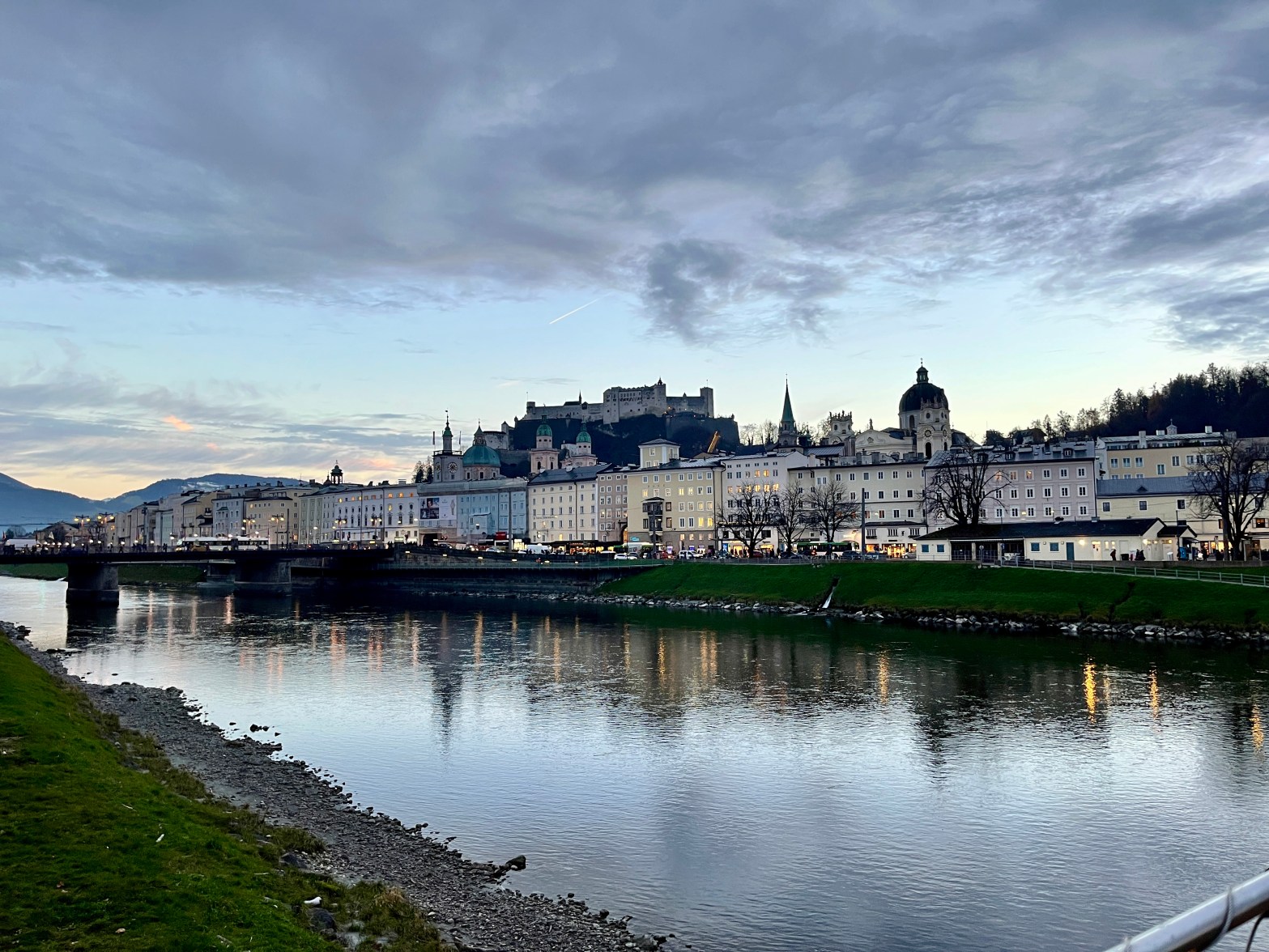
The hills were alive with the sound of mussssiiiccc!
Ok, they weren’t really in December, but that’s not the point.
Growing up, the Sound of Music was a staple in our house, so when Mom and I were deciding where we should go as a side trip from Munich, Salzburg was the obvious choice. Especially since it’s only a two-hour train ride from Munich, and you can use the Deutschland ticket (Germany’s all-inclusive travel ticket).
After arriving in the afternoon, we kicked off our time in Salzburg with a stroll from our hotel to Mirabell Palace and the famous gardens. Famous why? As a Sound of Music filming location, of course!

Unfortunately, in winter, most of the gardens are closed, so we missed some key locations. That’s OK, though. We could still see the famous Pegasus fountain and walk the same paths that Julie Andrews walked!


From there, we meandered into the Altstadt (old town) and found the Christmas market in the Domplatz and Residenzplatz. Here, you’ll find the Residenzbrunnen, the largest fountain in the city and one that’s also featured in the Sound of Music during the “I Have Confidence” song. Unfortunately, it was boarded up for the winter. ☹️


We intended to start our first full day with a walking tour, but it was quite rainy. So instead, we spent the morning at Mozarts Geburtshaus, the house where Mozart was born. In case you didn’t know, Mozart was born in Salzburg and lived there with his family until he was 25, when he moved to Vienna, which is a fact that will not be lost on you if you visit. You can visit the house where he was born and lived most of his life and the apartment where his family later moved. And, if you pay attention, you’ll notice various other spots in the city where “Mozart ate lunch here” or “Mozart frequented this location.” They are very proud.

The rain stopped after lunch (where I had Mozart’s favorite dish–Leberknödel mit Sauerkraut), so we decided to check out the Festung Hohensalzburg (Hohensalzburg Fortress), the one you see in the background of any Salzburg city picture. You can take a ~20-minute walk up to the fortress or a ~1-minute funicular ride, which we opted for since it was covered in our Salzburg Card (the city’s tourist pass, more on that later). At the top, you’ll find the fortress museum (history, armory, etc.), a small marionette museum, and some great views over the city.


We started the next day at the DomQuartier, just off the Residenceplatz, which includes entry to the Alte Residenz (the Old Residence) and the Salzburger Dom (cathedral). This complex is huge; you can easily spend an entire morning here, which we did. Definitely get the free audioguide to understand the purpose of the various state rooms. Eventually, the general tour leads you from the residence to the cathedral. We even accidentally timed it correctly and caught the daily organ concert at noon!


We finally fit in our obligatory walking tour in the afternoon. I say obligatory because a walking tour is the best way to learn a little bit of any city’s history and give context to the sites you’ve likely walked past (or will walk past) a thousand times. Salzburg’s old town is quite small, so our walking tour with Free Walking Tours Salzburg only lasted an hour and a half, which left plenty of time for some random bits and bobs on our last afternoon.
For instance, Café-Konditorei Fürst, the home of the original Salzburger Mozartkugel, a “marzipan and pistachio core wrapped in nougat dipped in dark chocolate.” Be prepared to pay €2 per chocolate-dipped ball and the store to be a complete zoo, but they were tasty and worth the splurge. They also make a great gift! Beware, you’ll see other red and silver-wrapped Mozartkugels if you’re traveling in Bavaria and Austria, but the original Salzburger ones are in blue and silver foil. These you can only find in Salzburg!

While we’re on the subject of sweet treats, you should also try the Salzburger Nockerl, which is meringue served on top of a warm raspberry compote. Typically, the meringue “mountains” come in threes, representing the three mountains around Salzburg. Three felt like a bit much for two people, but we found a single-mountain option at the Wirtshaus Elefant in the old town.

Finally, we stumbled on a shop called Christmas in Salzburg (address: Judengasse 11), which was the most amazingly spectacular thing I’ve ever seen. It’s an entire store dedicated to hand-painted and decorated eggs. Sounds bizarre, but it’s incredible. Despite the name, the eggs are primarily painted for Christmas and Easter, but you’ll also find various other themes. If you’re looking for a unique souvenir, this is your spot. Even if painted eggs aren’t your thing, the shop is worth visiting just to look. Pictures aren’t allowed inside, but the shop window gives a good impression.

Practical Info
Salzburg is a super easy side trip from Munich, with direct trains leaving roughly once per hour. And, as I mentioned, the route is covered by the Deutschlandticket or Bayern Ticket if you’re coming from or going to Munich. (These tickets are valid for one stop past the German border.)
Once you’re in Salzburg, I recommend the Salzburg Card, which is their city tourist card. They offer 24-, 48-, or 72-hour versions that can be purchased online or at various points in the city (tourist information centers or your hotel, for example). We did the 72-hour card for €41 (€46 in the high season), which gave us access to all the city buses and museums we visited (walking tour excluded). And, since we had bus access, we stayed in a hotel near the Hauptbahnhof (main train station), which had easy access to the old town at lower rates; hotels in the old town can get quite expensive, even in the low season.
And that sums up our short trip to Salzburg! I’m excited to visit again when the weather is warmer to see the city in a different light and visit some of the nearby outdoor attractions.

Until then, Tschüss!

 The Shwits