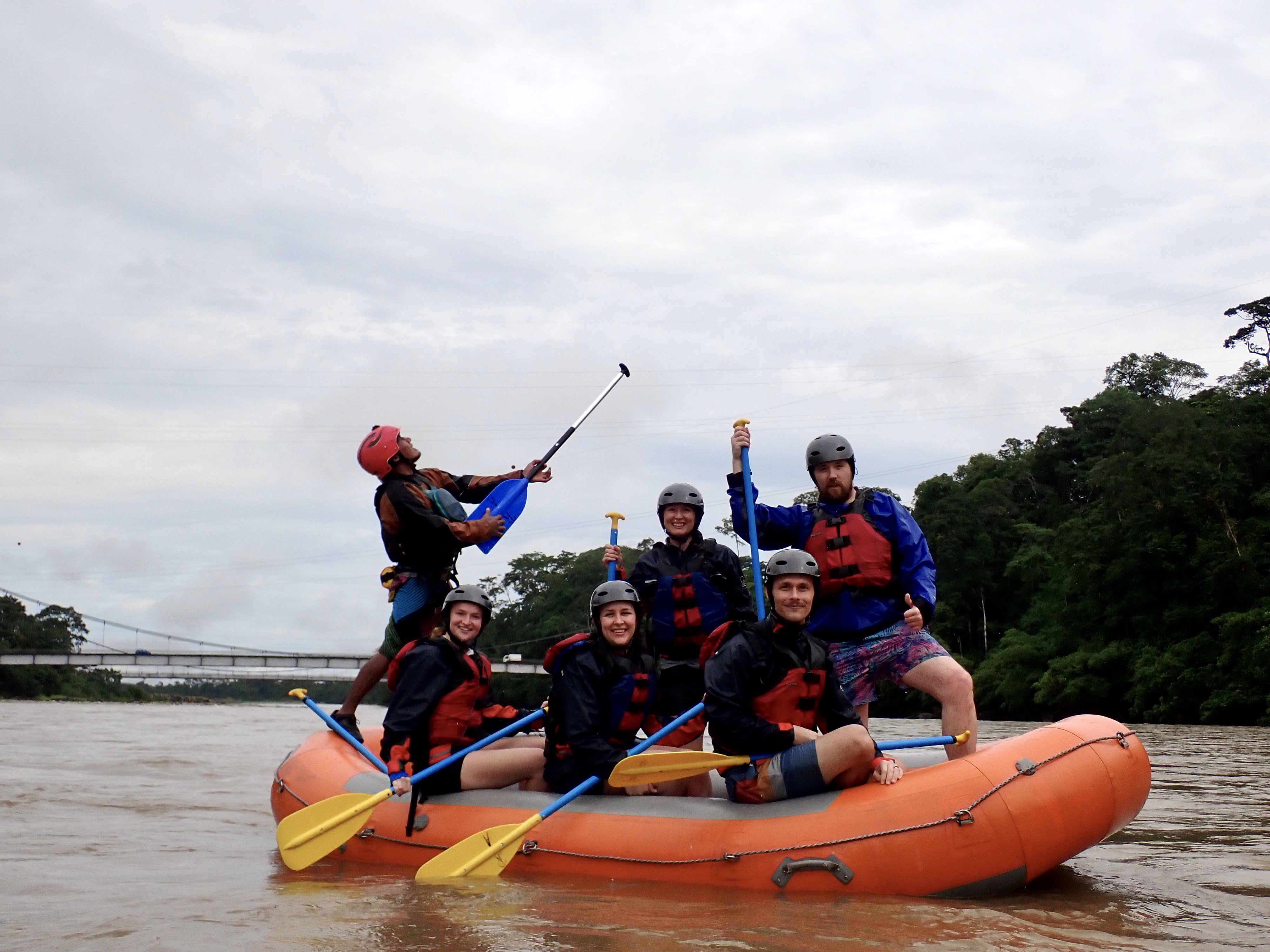
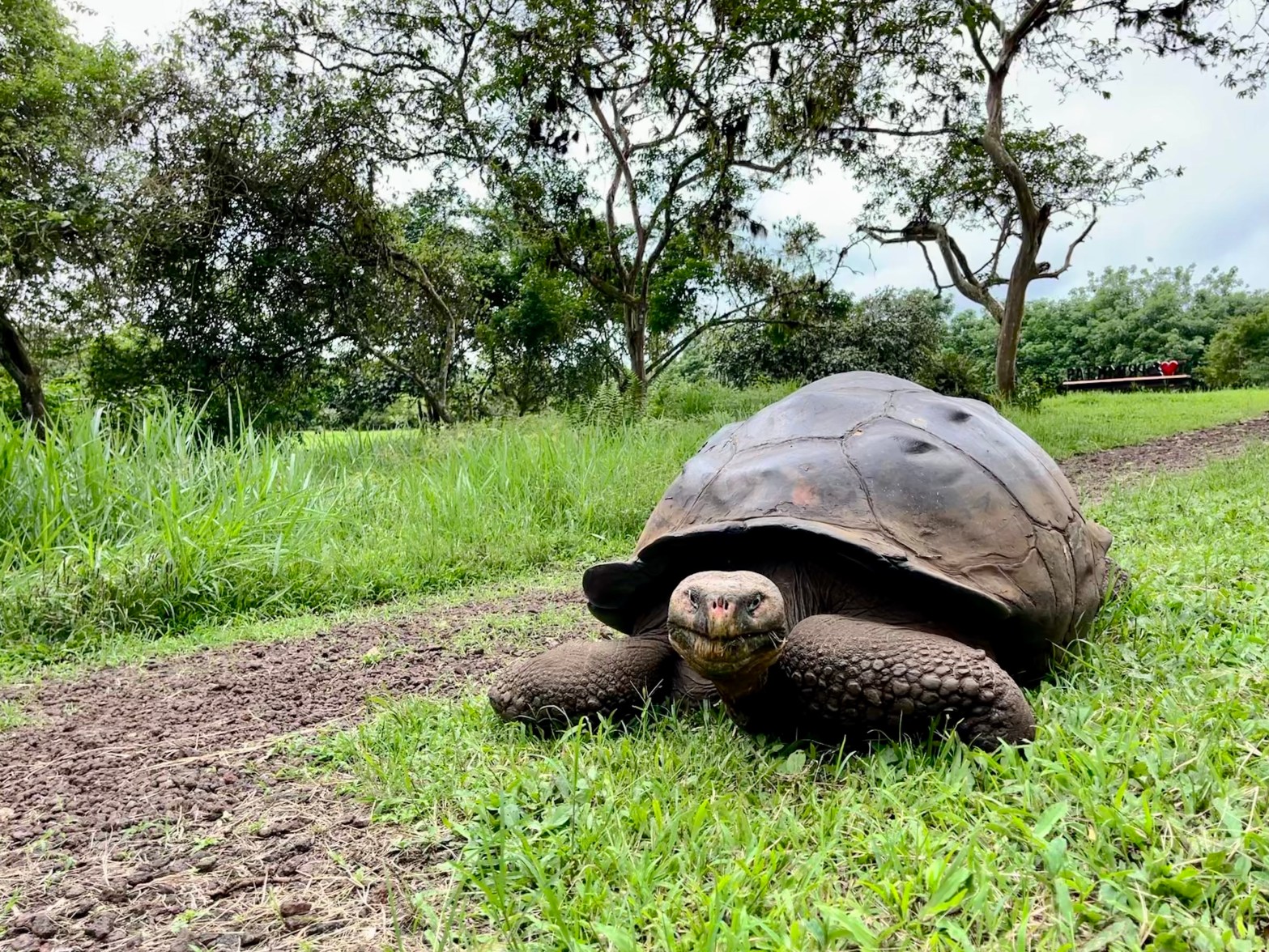
Cuyabeno Reserve, Ecuador

I’ll jump right in. This place is pure magic!

There are two main nature reserves in Ecuador’s Amazon region: Yasuní National Park and Cuyabeno Reserve. Yasuní National Park is arguably the more famous one; it’s the biggest and has one of the highest biodiversity rates per square meter in the world. However, Cuyabeno is just as impressive.

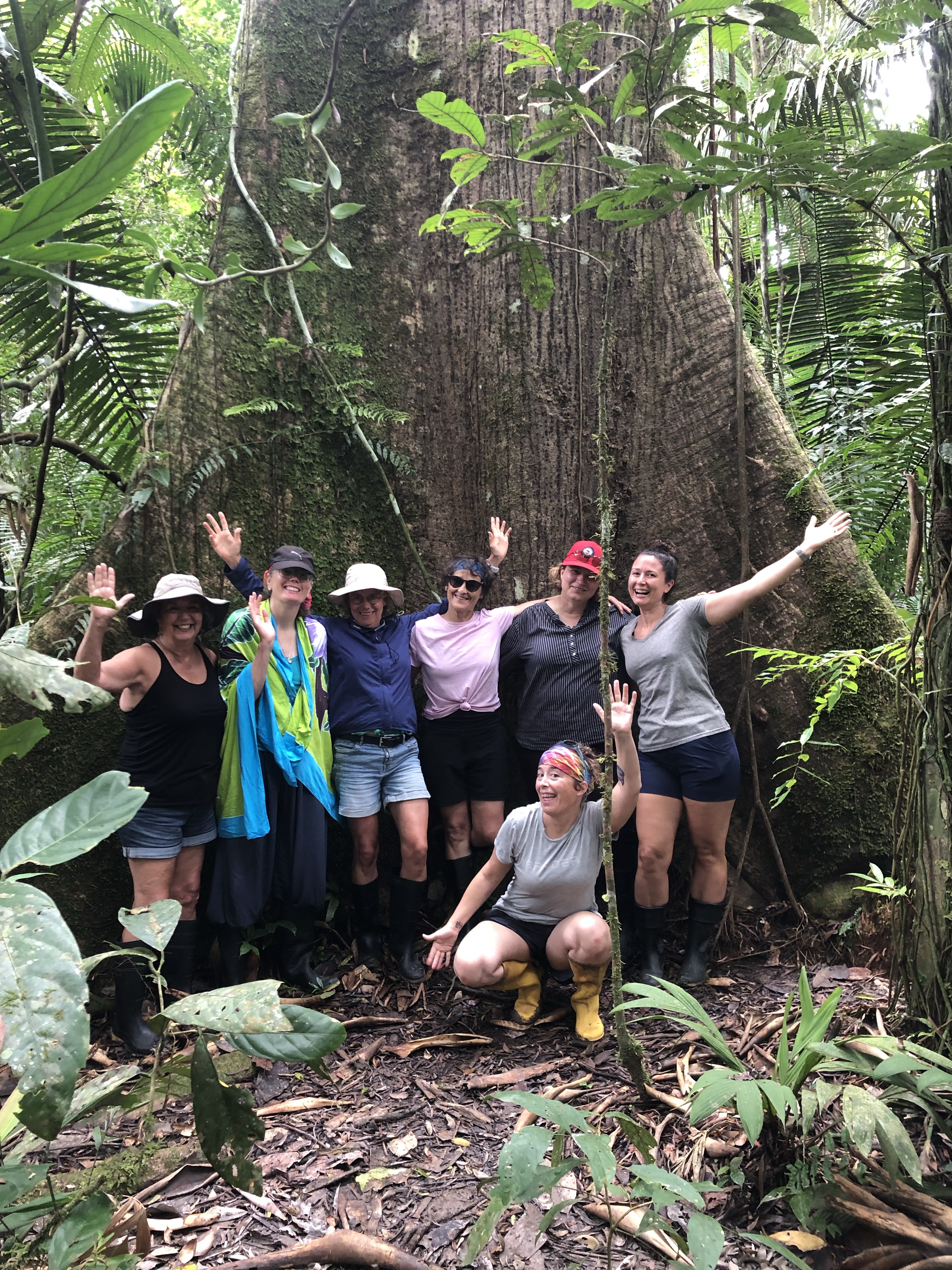
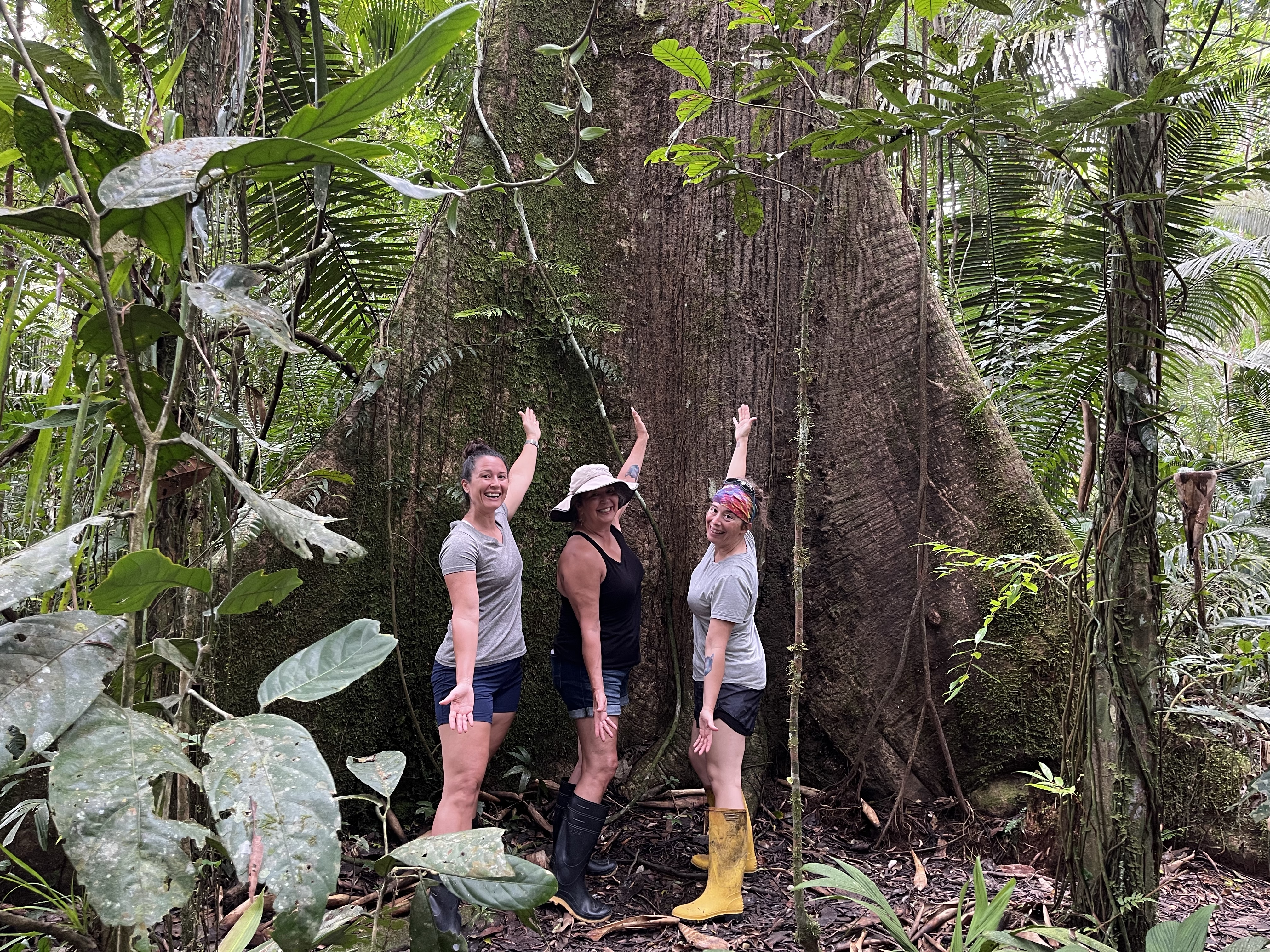
One of the biggest tree I’ve ever seen.

So what’s the difference? The type of forest. Yasuní is primarily humid tropical rainforest, in other words, what you might imagine when you hear the word “rainforest.” Cuyabeno, on the other hand, is mostly igapó forest (black-water flooded forest) with areas of tierrafirma (areas that don’t flood).

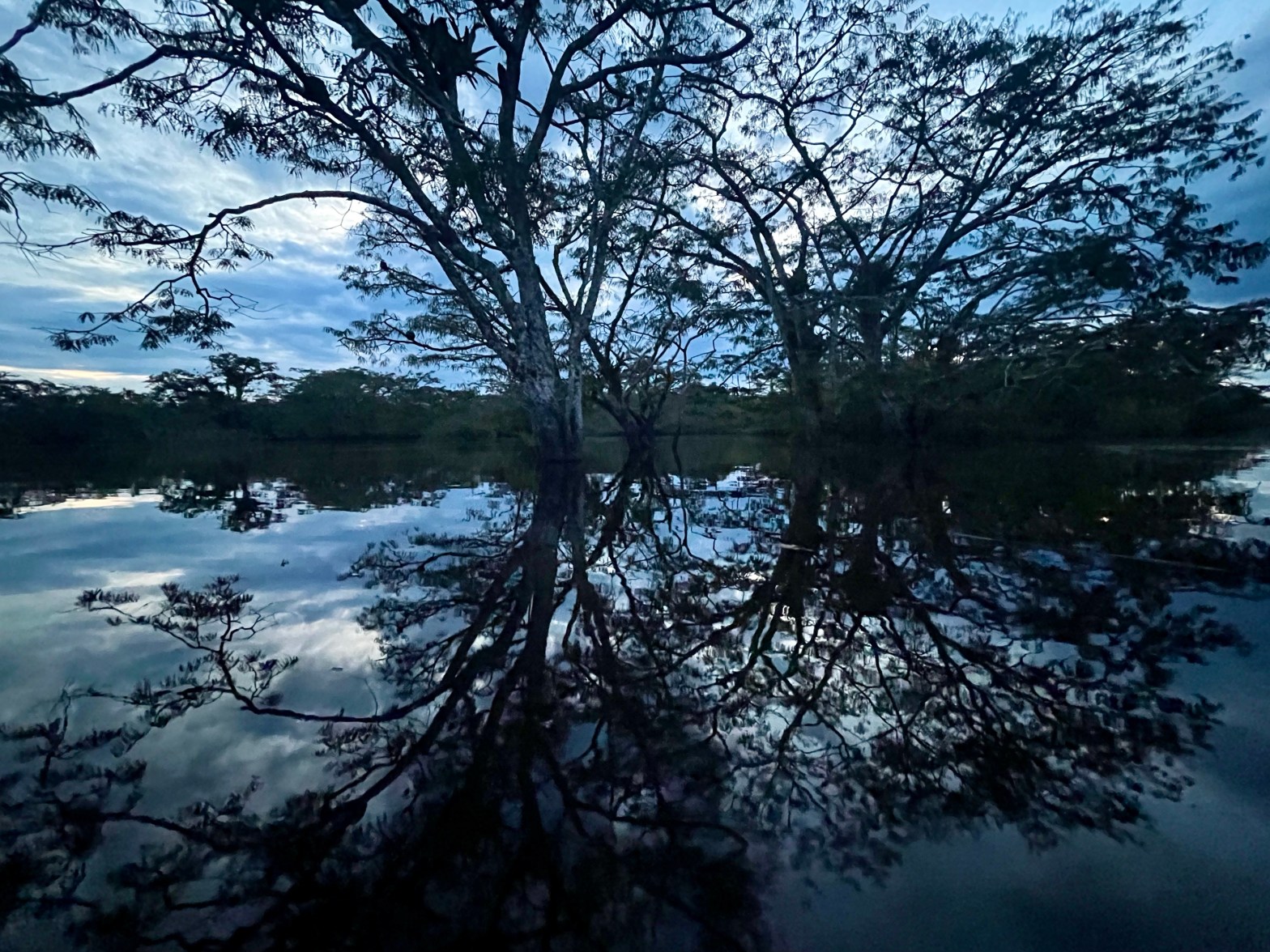
Part of the black-water forest.

I was lucky enough to visit Cuyabeno twice in a three-week period, once with my mom and cousin, and once with Shane and a crew from IKIAM (the university in Tena). So, as a professional Cuyabeno goer, I’m here to convince you why you should add Cuyabeno Reserve to your Ecuador itinerary!

1. Its easy to plan!

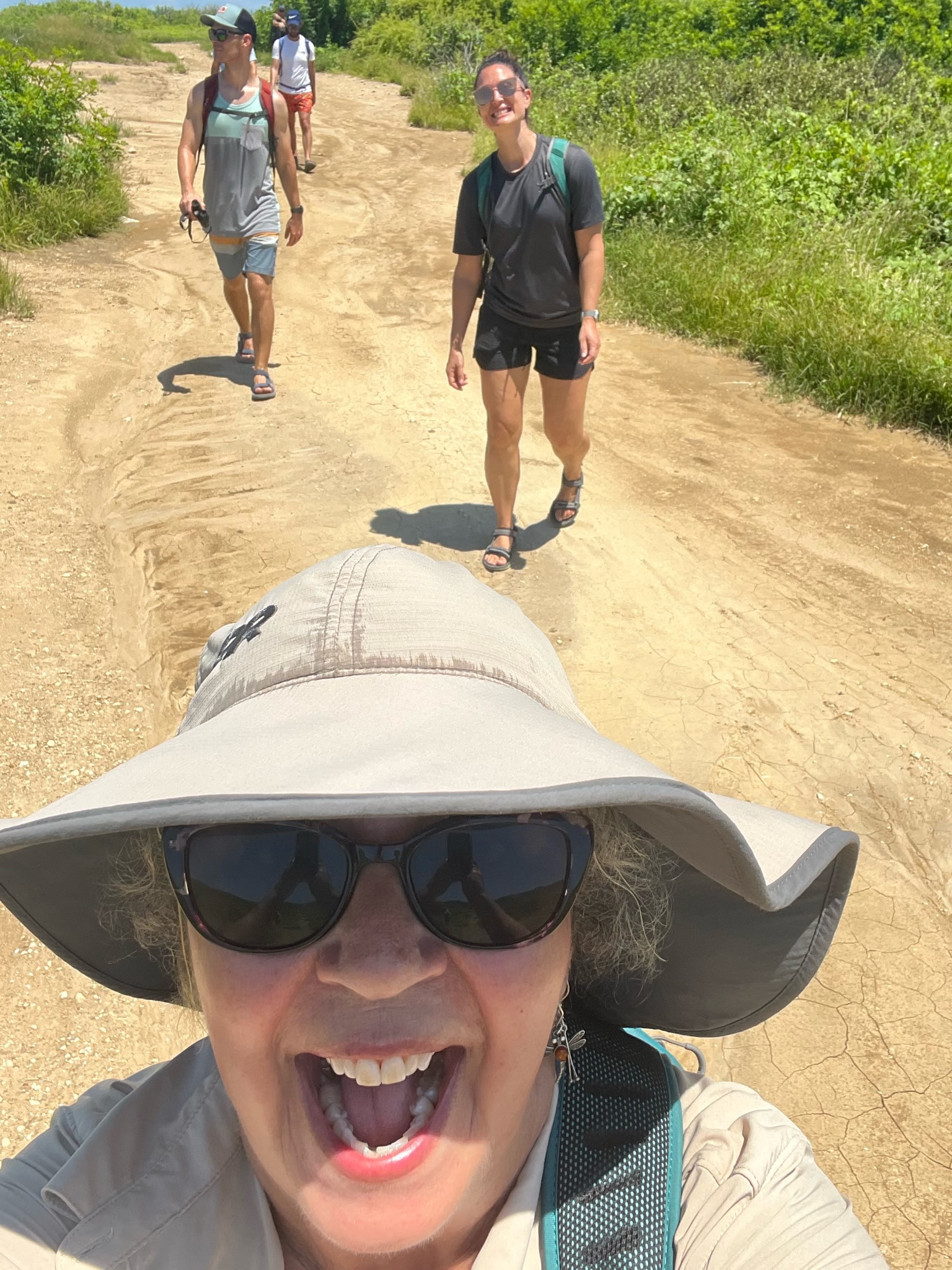
That’s me, reveling in how easy it was to plan this trip!

You’re only allowed to visit the reserve with a guide, which makes planning this portion of the trip a breeze. There are 14 lodges in the reserve, so your only decision is which one you prefer. They all offer nearly the same type of package, but vary based on the accommodation type, food, and location in the reserve.

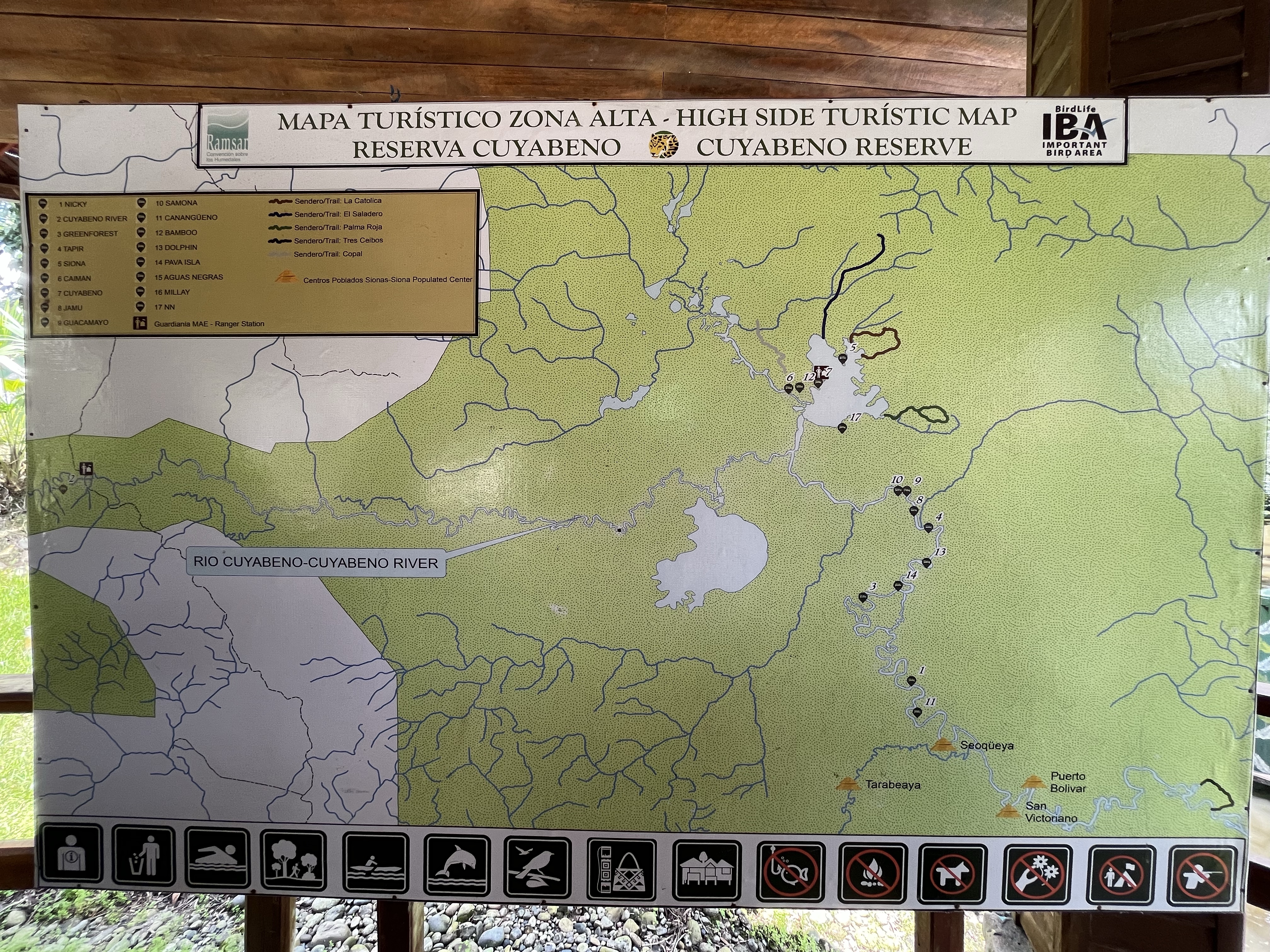
Map of the reserve with the lodge layout.

I stayed in two lodges, the Bamboo Lodge (with my mom and Clancy) and the Caiman Lodge (with Shane), both of which are a short boat ride from Laguna Grande, one of the main features of the reserve.

Bamboo Lodge
Caiman Lodge

Both lodges were clean, had good food, friendly staff, and felt safe. However, the Bamboo Lodge felt more upscale than the Caiman Lodge. The bamboo structures (hence the lodge’s name) were beautiful and the food was incredible. It also had small things that made it feel a bit more comfortable, like 24-hour electricity (80% of which comes from solar), filtered water (although they provide purified drinking water), and fluffy towels (which seems silly, but it’s not something I expected in the jungle!).

Alternatively, the Caiman Lodge had a better space to hang out during your downtime, their viewing tower had better views, and they had clotheslines for wet things (which you’ll need), but it felt a bit more rustic overall.

Neither place has wifi or cellphone service (nowhere in the reserve does), and it takes roughly the same amount of time to get there. So, really, your choice of lodge boils down to your personal preference and the price. Bamboo Lodge was a bit more expensive than Caiman Lodge, but it also had a few more features, like breakfast on the day of arrival and full almuerzo (versus a packed sandwich lunch) on the day of departure.

2. It’s all inclusive.

First off, I’d recommend the 3-night/4-day package, which is roughly $300 per person depending on the lodge. However, the price includes everything. Meals starting from lunch on the day of arrival until lunch on the day of departure, the two-hour transport from Lago Agrio (the closest city) to the port, the two-hour motorized canoe ride from the port to the lodge, accommodation, all of your guided activities, and jungle gear (rubber boots and ponchos). So, considering all that’s included, the price isn’t so terrible.

Oh, and did you catch that it’s quite a long journey to get there? It’s about 5 hours from Tena and about 8 hours from Quito to Lago Agrio. Then it’s another 4 hours to get to the lodges, which is why I recommend the 3-night/4-day (at minimum!). Gotta make the effort worth it!

However, another thing to keep in mind is that the tour starts once you’re on the boat. A guide must be with you at all times, and they are good at what they do! So, not only is the two-hour journey relaxing, but you’ll start seeing animals right away! For example, we saw five types of monkeys on the way in!

On the way to Bamboo Lodge!

3. All activities are included and pre-planned.

And, all activities are guided tours. In both places, on arrival, we were introduced to our guide who stayed with us for the duration of our visit. Also, since it’s a flooded forest, you have to go everywhere by boat, and the maximum number of people per boat is 10. So, the group stays small.

It was a bit different on the trip with Shane since we arrived with a pre-made group. However, on the trip with my mom and cousin, we were assigned a group on arrival. Honestly, it felt a bit like summer camp for adults because you eat all your meals and do all the activities with your group. Our guide, Wilson, even sat at the head of the table, just like back in my camp counselor days. 😆

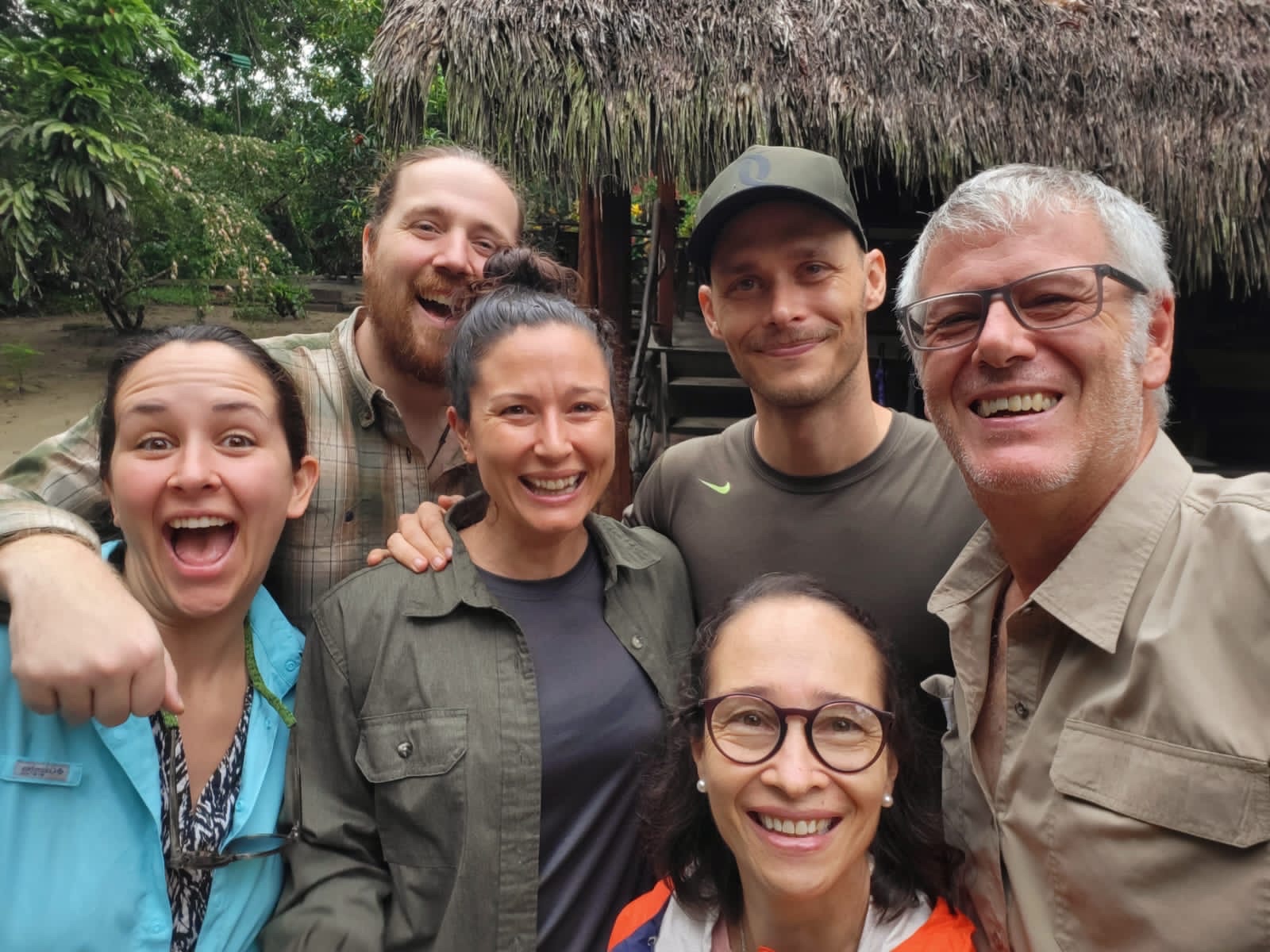
Now, I suppose this could be weird if you get a bad group, but we were lucky. Our seven-woman crew plus Wilson had a blast!

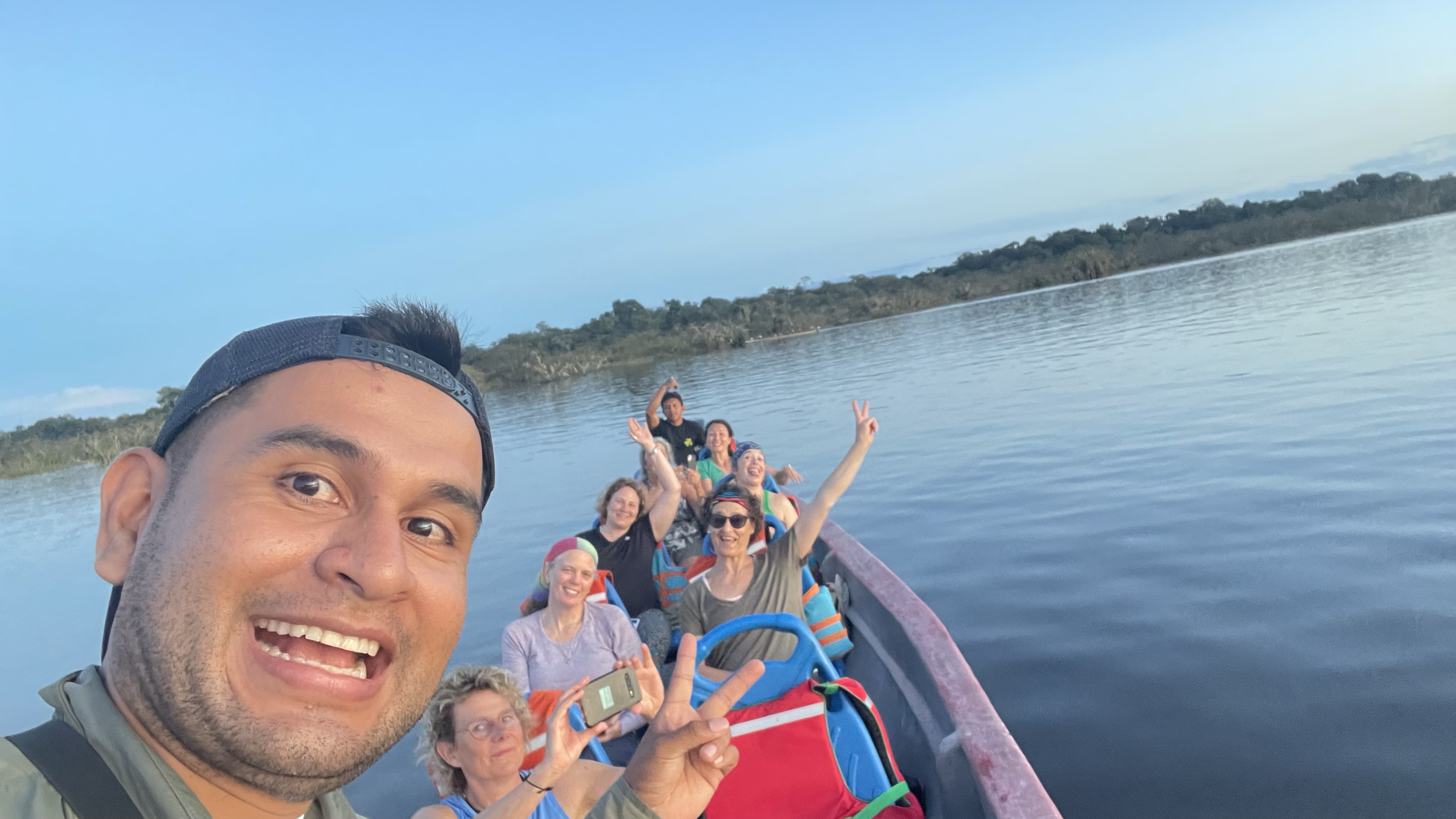
Wilson, our awesome guide!

The activities vary slightly depending on how many nights you stay. However, in general, you can expect motorized canoe rides to look for animals, standard canoe rides (paddling required!), day and night walks in the tierra firma, and swimming in Laguna Grande.

Paddling is hard work!
A peaceful evening on Laguna Grande.

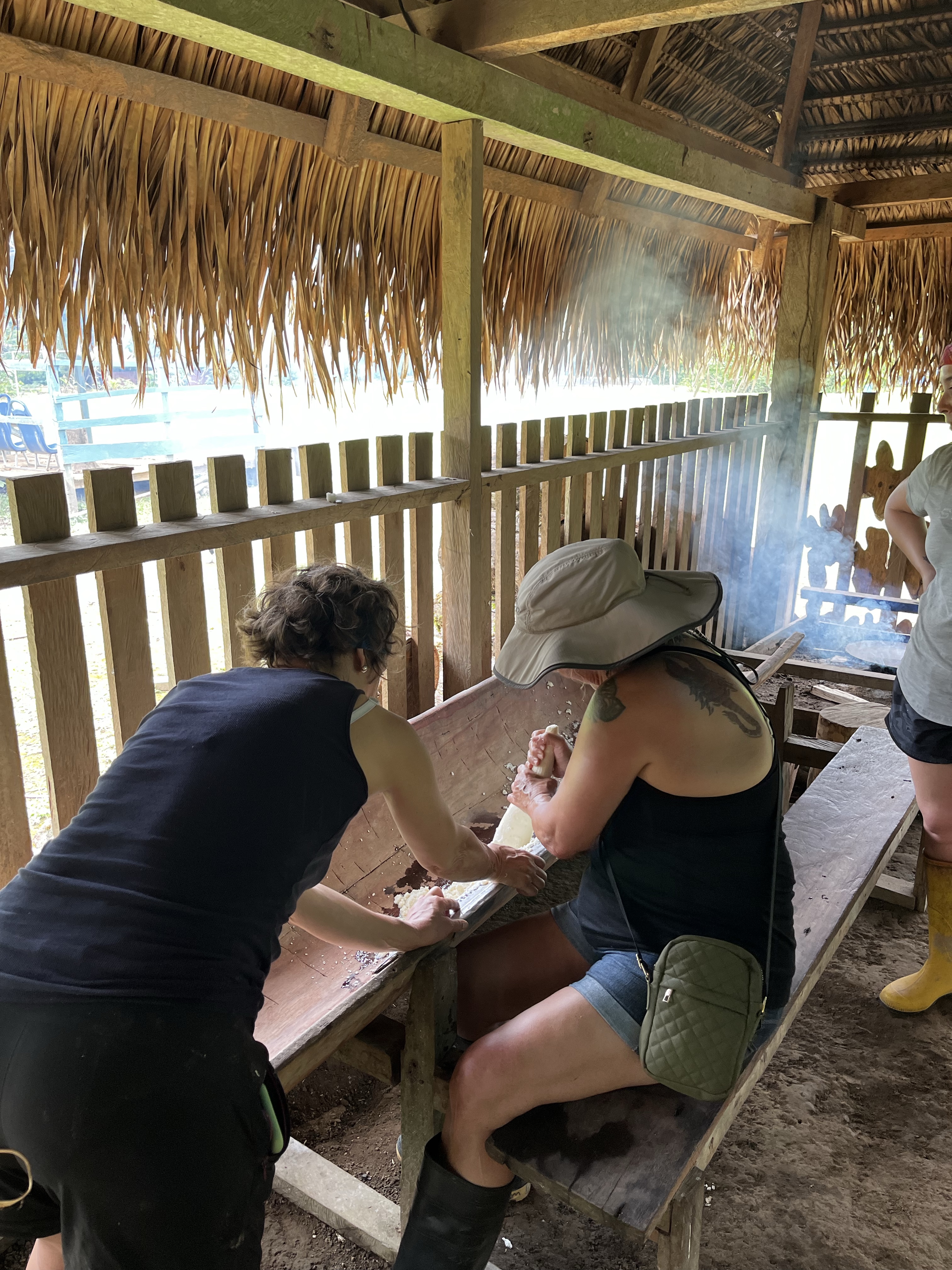
During longer stays (like the 3 night/4 day one), you’ll visit one of the local communities, which was an informative experience. We learned how to make cassava (a yuca bread) from scratch!

4. You’ll see a lot of animals!

Birds! Pink river dolphins! Sloths! Anacondas! Spiders! Monkeys! Caimans!

Take binoculars, people!

(I am no nature photographer. Here’s the best I could do. The rest of my animal photos just look like pictures of trees. 😆)

And these are a few of my favorite things!

(I hope you sung that.)

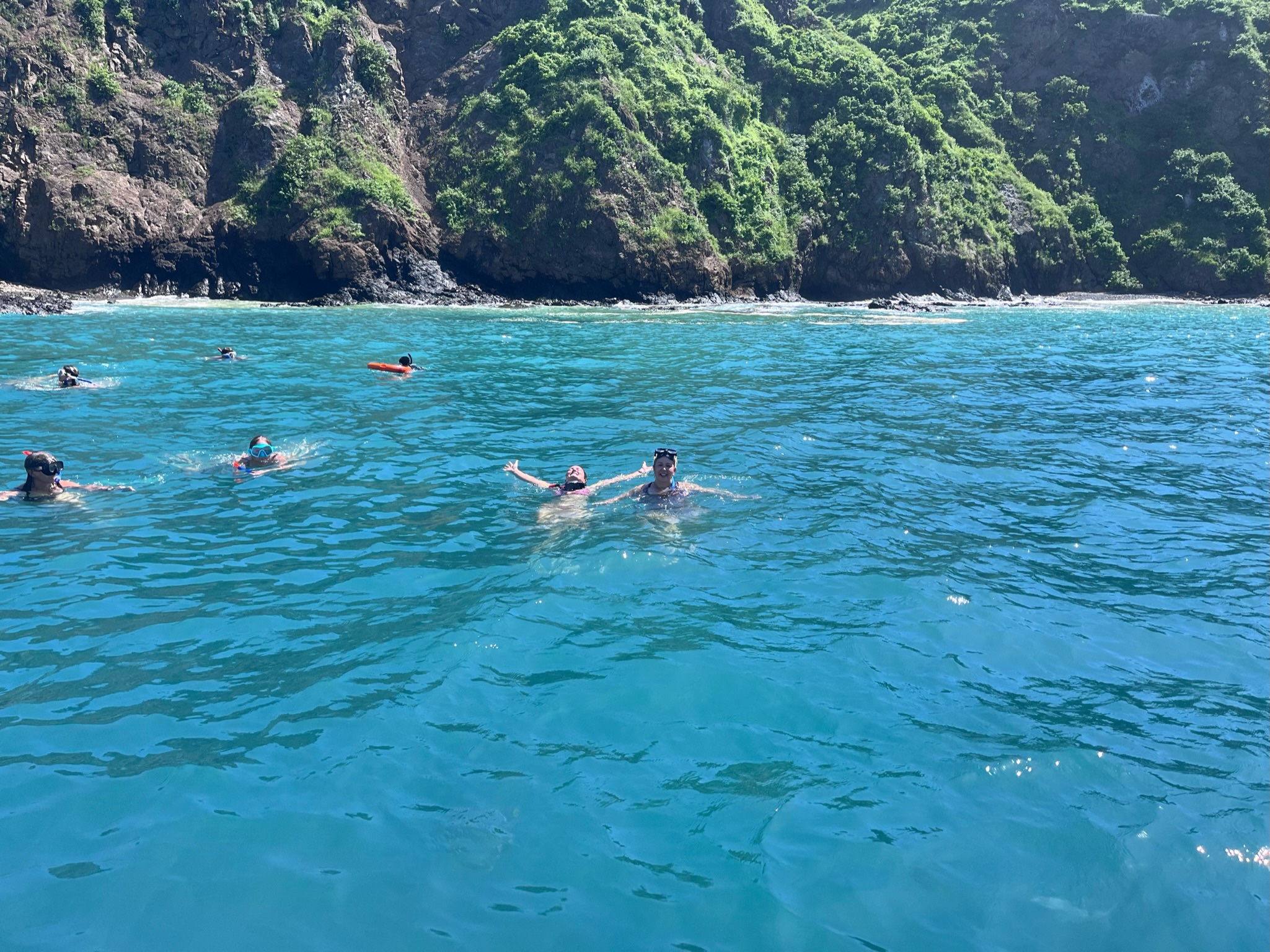
Swimming and sunset in Laguna Grande
The equator!

I did not expect this, and it was a true treat!

And for those keeping track, this was my mom’s third trip to the equator. 😁

The Milky Way!

I only have a picture in my mind, but yes, we saw the Milky Way! There’s no light pollution on Laguna Grande, and we were lucky with some clear nights. Riding in silence, staring up at the Milky Way is something I’ll not forget.

Night walks

Everything is different at night. And it’s dark, really dark!

You’ll get to experience that firsthand when the guide has everyone turn off their flashlights. 😜 Ignore my cheesiness, but, wow, standing in the pitch black listening to the sounds of the jungle. Go figure, it really sounds like those “sounds of the jungle” soundtracks!

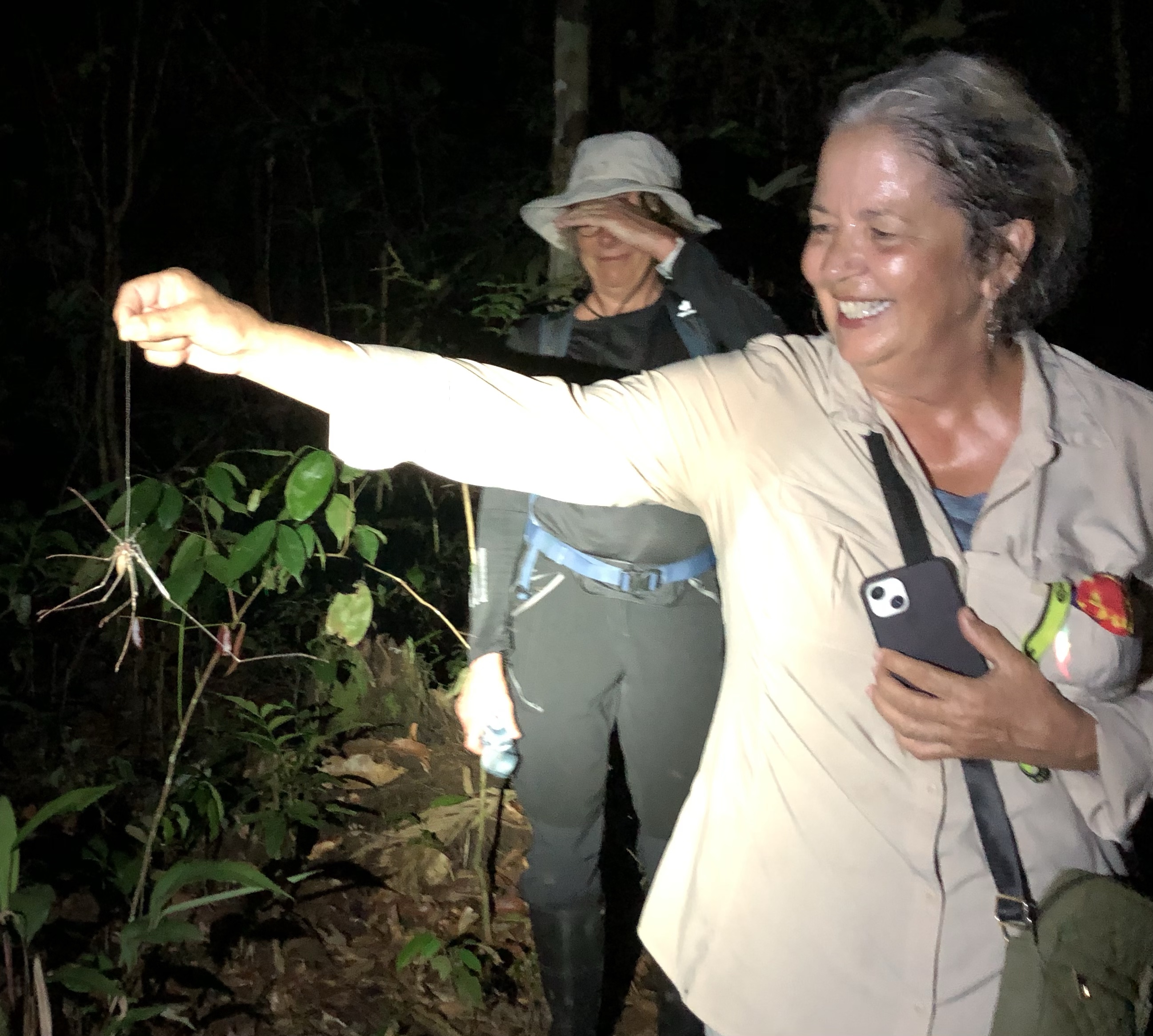
A scorpion spider. My mom is so brave!

So, are you convinced yet?

I feel so lucky to have shared this place with my mom, cousin, and Shane! In my opinion, the Amazon region is often overlooked on the average tourist itinerary. And while it may be a journey to get there, it’s one worth taking!

Nos vemos,
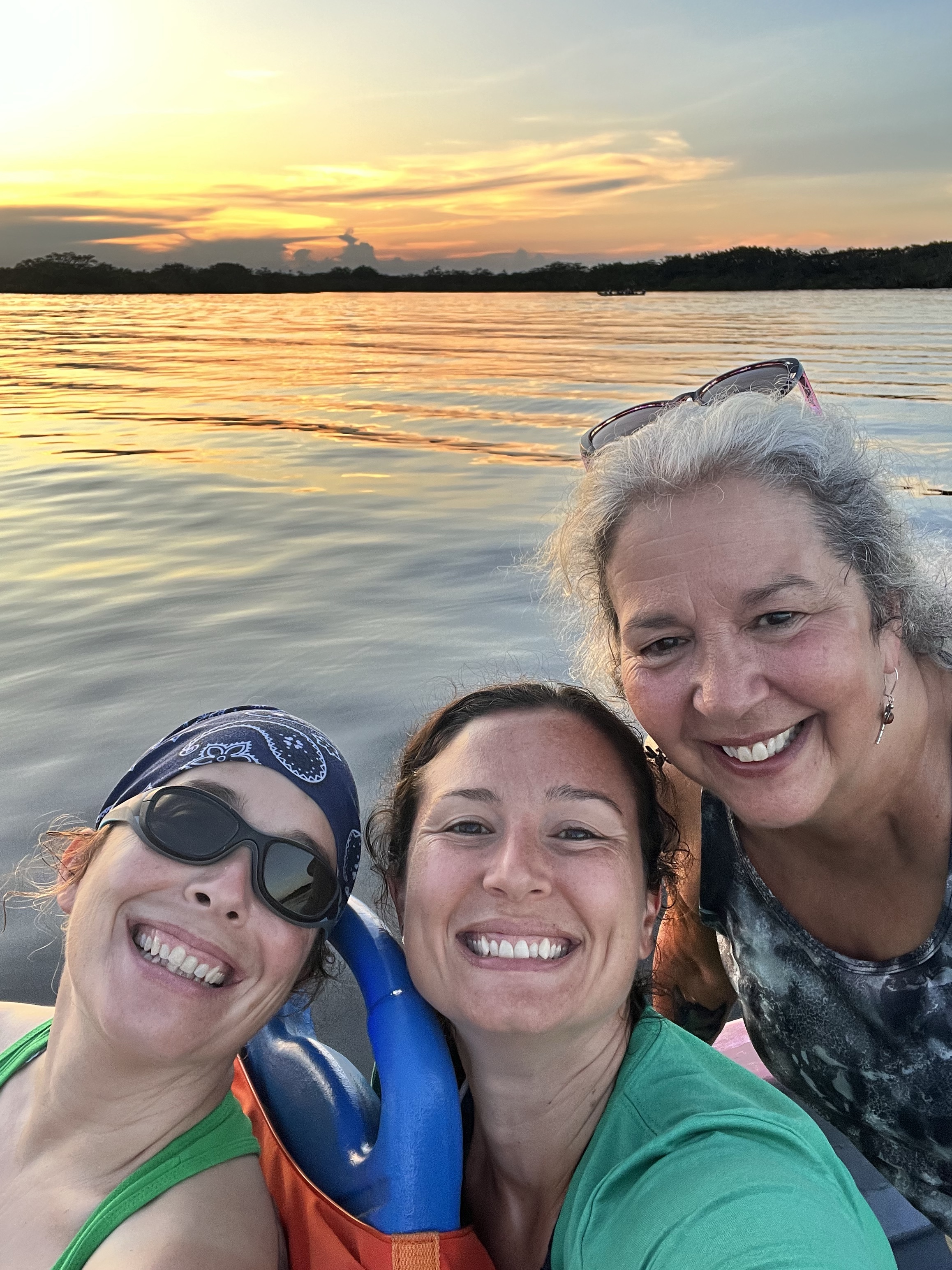
Whitney

Midad del Mundo, el Teleférico, & Other Ecuadorian Adventures

Can we talk about the fact that it’s July? How did that happen? Shane and I are just back from a glorious 10 days in the Galápagos Islands (!!), but before I get to that, I need to round out my family trip back in *gasp* April, when my mom visited for about 3 weeks.

After our adventures to Puerto López, Isla de la Plata, and Otavalo, my cousin Clancy joined us for the final 10 days of the trip. Our itinerary included Quito, Tena, and Cuyabeno Nature Reserve (more on that later!) and, other than Cuyabeno, was a hodgepodge of activities.

So, please enjoy my ramblings. 😜

First, I want to mention our amazing Airbnb in Quito. I mean, these views. On a clear day you could see three volcanoes from the balcony: Illinizas (north and south) and Pichincha. 😍

Volcan Illinizas can be seen in the distance behind and to the left of the white apartment buildings.

We wasted no time, and literally two hours after Clancy landed, we were off to the middle of the world! This was my third trip to the Midad del Mundo, and I’m sure it won’t be my last. How can you deny someone the joy of standing in two hemispheres at once?! Plus, I really enjoy the Intiñan Site Museum; it’s so interactive!

And, in case you’re keeping track, this was Mom’s 2nd of 3 trips to the equator during her three-week visit. Lucky lady!

We also happened to be in Quito during Easter weekend, which is a special weekend for Quiteños owing to the Jesus del Gran Poder procession on Good Friday. It’s probably best known to outsiders for its striking purple outfits.

Jesus del Gran Poder refers to a 17th-century wooden sculpture used to unite followers. The first procession occurred in Quito in 1961, with participants uniting around the image of Jesus del Gran Poder, and the procession has continued since to remember the death of Jesus. You’ll also notice in the photos that the participants carry heavy crosses, wear chains or cactuses strapped to their backs, or whip themselves as they walk. All this is to not only symbolize but recreate the suffering and sacrifice of Jesus. I’m not religious, but this was still an interesting event to witness!

In front of the Basílica del Voto Nacional.

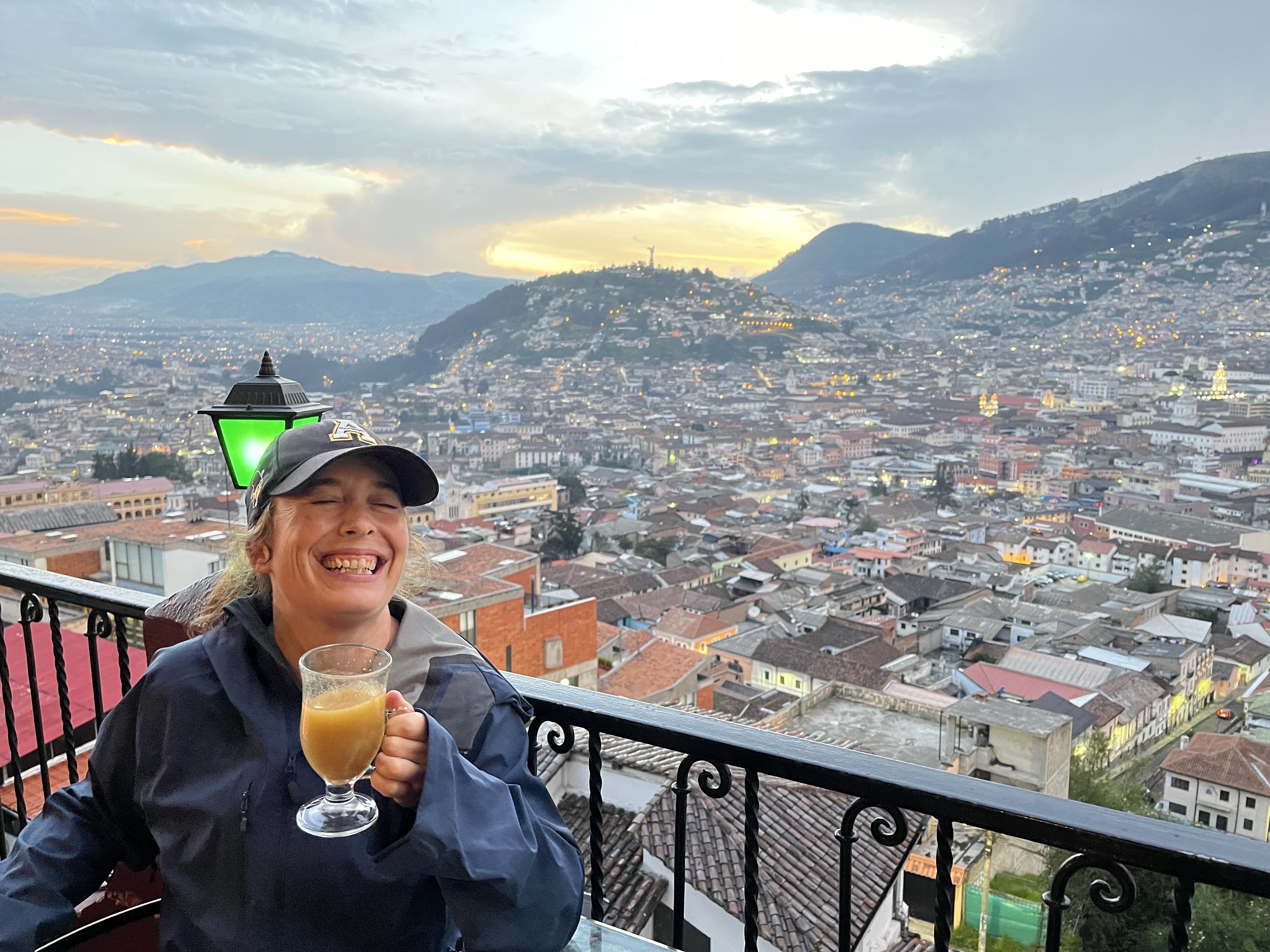
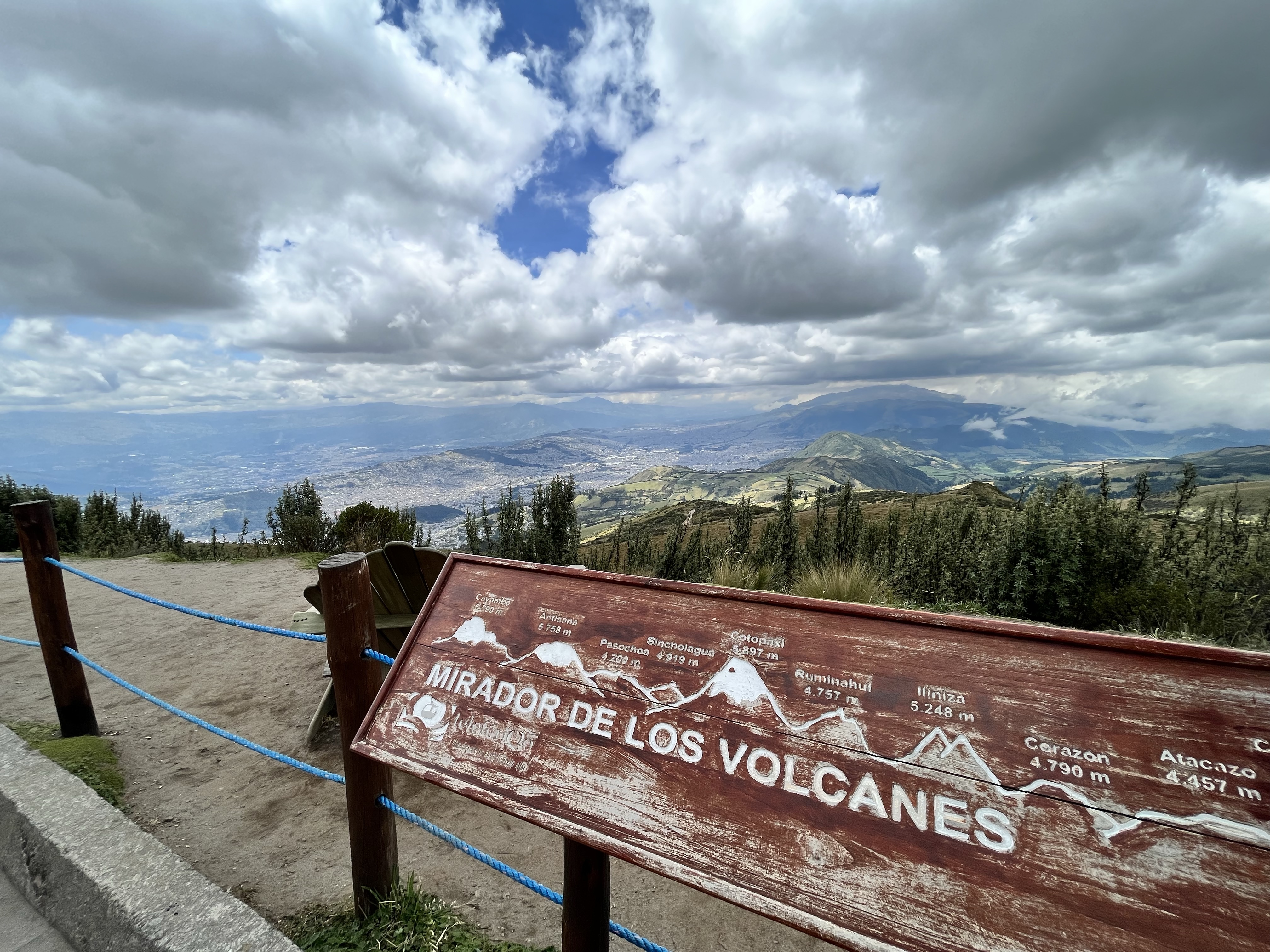
While in Quito, we also went to Cafe Mosaico for canelazo at sunset. Mom and I also visited the Guayasamín art museum (one of the most well-known Ecuadorian artists) and ventured to over 4,000 meters on the teleferico (cable car)!

Casa Museo Guayasamín.

After our time in Quito, we were off to Tena!

It’s always exciting to show off your city to visitors, so naturally, it rained nearly the entire time, we couldn’t do any roof sittin’, and nary a volcano revealed itself! I guess at least they got a true rainforest experience? 🤷‍♀️

You can tell how much it rained from how high and brown the river is.

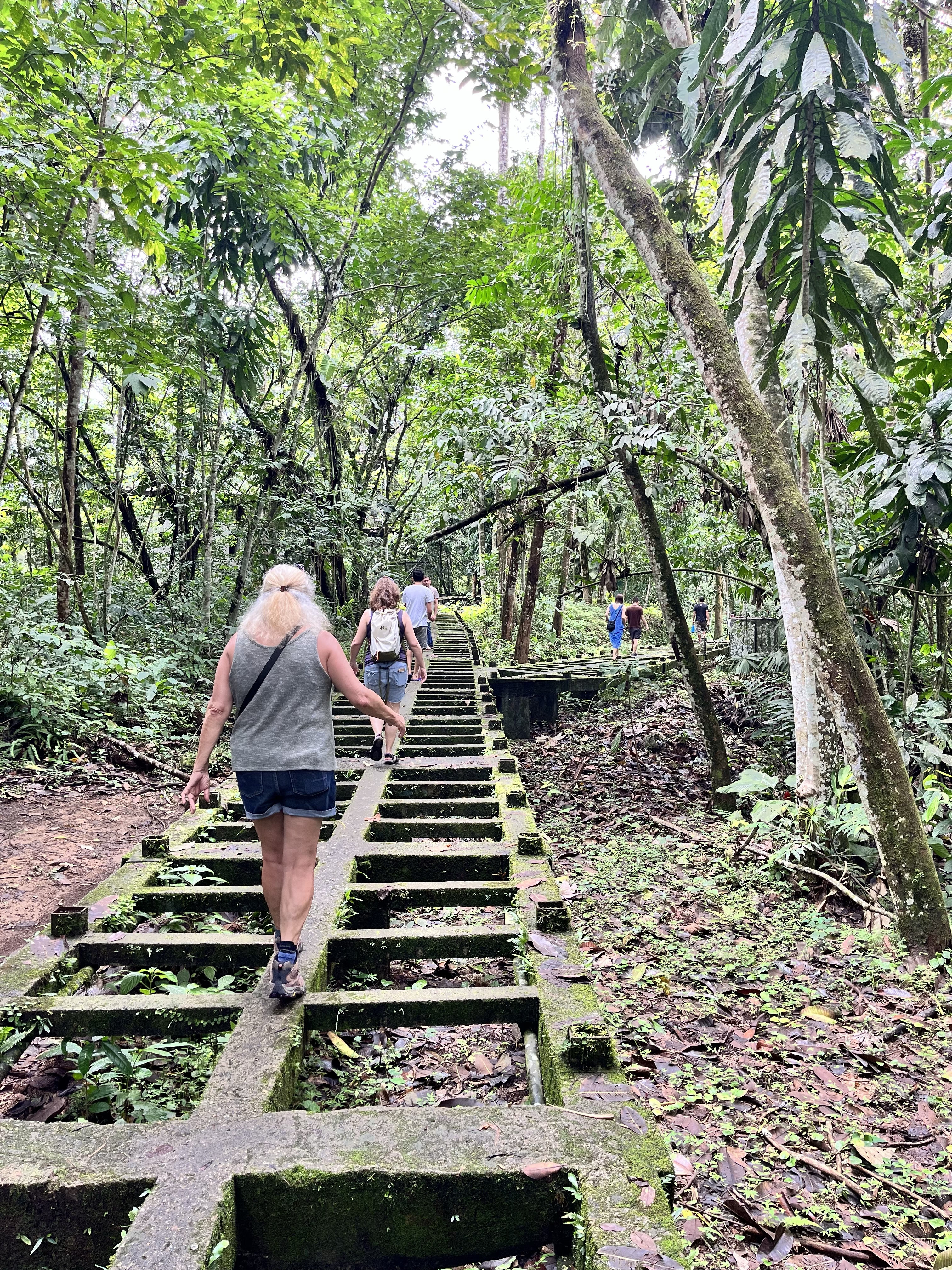
Nonetheless, we managed to get a few rain-free hours to visit Ikiam and Shane’s insectaries and Parque Amazónico La Isla in the center of Tena. This visit was particularly exciting because the squirrel monkeys were out (so so cute), as was the elusive tapir! Apparently, this park used to be a zoo, but somewhere along the line, it became too expensive to maintain. So, most of the animals were sent to other locations. The squirrel monkeys and tapir couldn’t be moved for whatever reason and now live freely in the park.

Also, unfortunately, “park” is a bit of a loose term. For example, the walkways were never finished, and the completed aspects, like the viewing tower, were abandoned and left to deteriorate. Consequently, crime in the park has increased since we’ve lived here. So, where you used to be able to wander freely, now you must go with a guide ($1 per person), which, in a way, was nice since they pointed out things I hadn’t noticed before. However, this is only one example of a common problem; Tena and many other places throughout the country simply don’t have the money to maintain various things, especially in an environment like the rainforest, where the sun and rain accelerate wear and tear.

And, of course there was time for helado con queso. In my opinion, a trip to Ecuador would be incomplete without it. 😬


Tena was the jumping-off point for the final part of the trip–Cuyabeno Nature Reserve!

So, nos vemos pronto!

Whitney

Otavalo & Lago Cuicocha: A Day Trip from Quito

Twice now, I’ve taken a scheduled day tour from Quito, the first time to Quilotoa and now to the market in Otavalo. Twice I’ve had nothing but a positive experience, so if you’re short on time or don’t want the hassle of figuring out the bus system, a scheduled day trip is absolutely worth the money.

So, after about a week on the coast in Puerto López, Mom and I were ready to explore the Andes! We booked our tour through Ecuatraveling, and the $50 per person fee covered transportation, your tour guide, and a bizcocho tasting (more on that later)!

Let’s get started, shall we?

Bizcochos in Cayambe

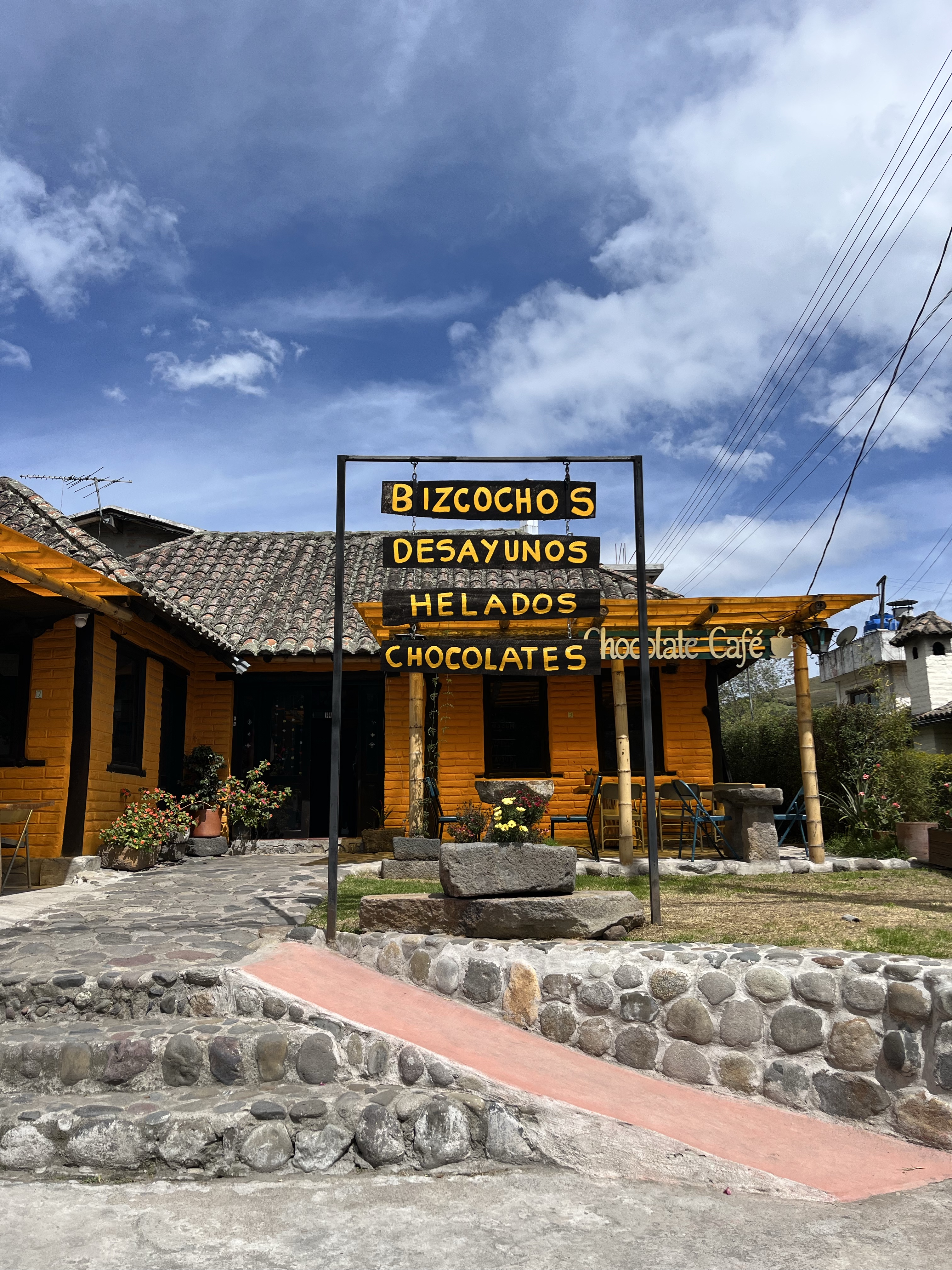
Our first stop was about an hour north of Quito in the town of Cayambe, famous for bizcochos, a pastry semi-comparable to the biscotti of Italy. Apparently, you’ll only find these delicious treats in the Cayambe area, so I was happy to stop for a tasting on the way!

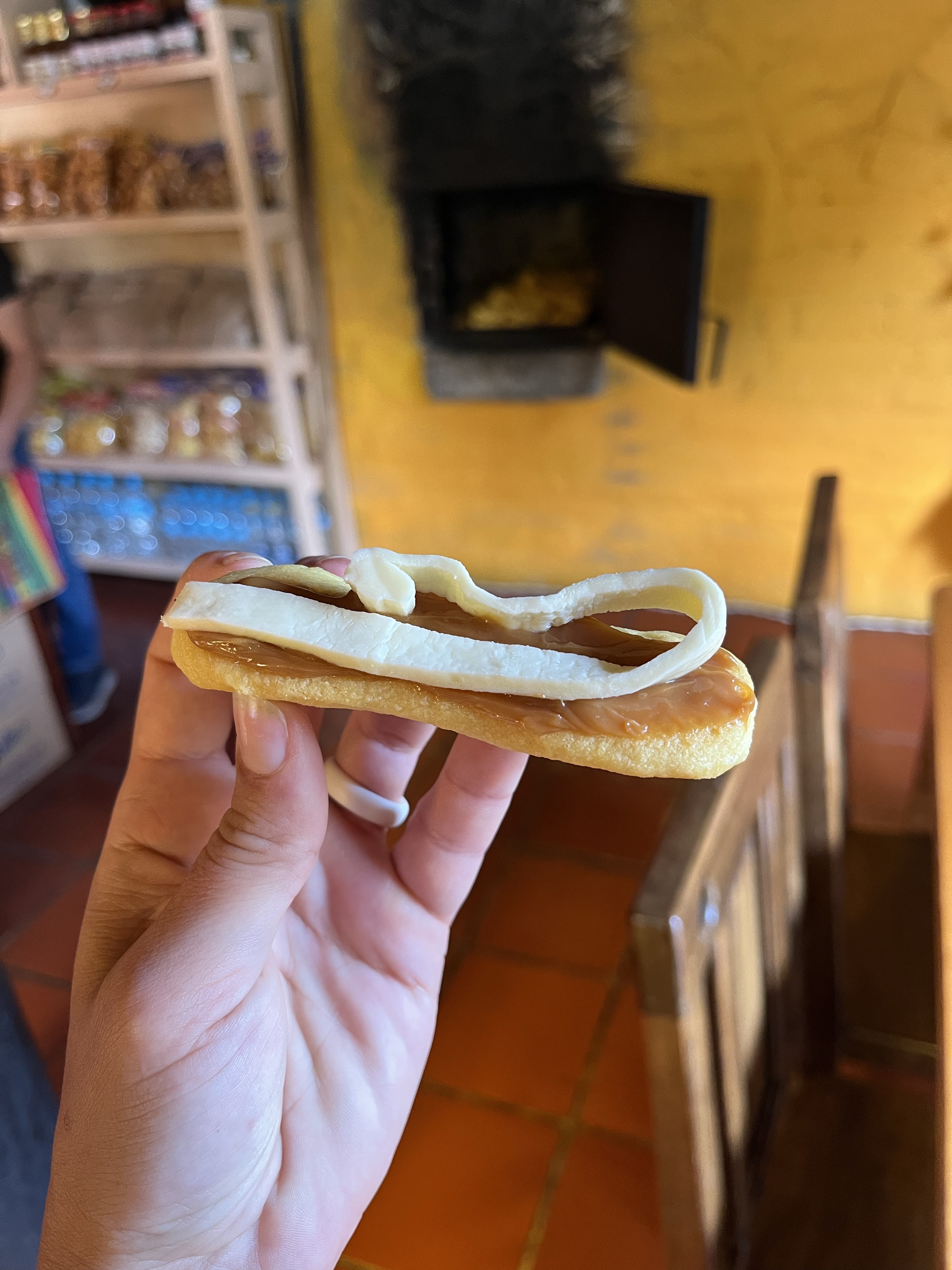
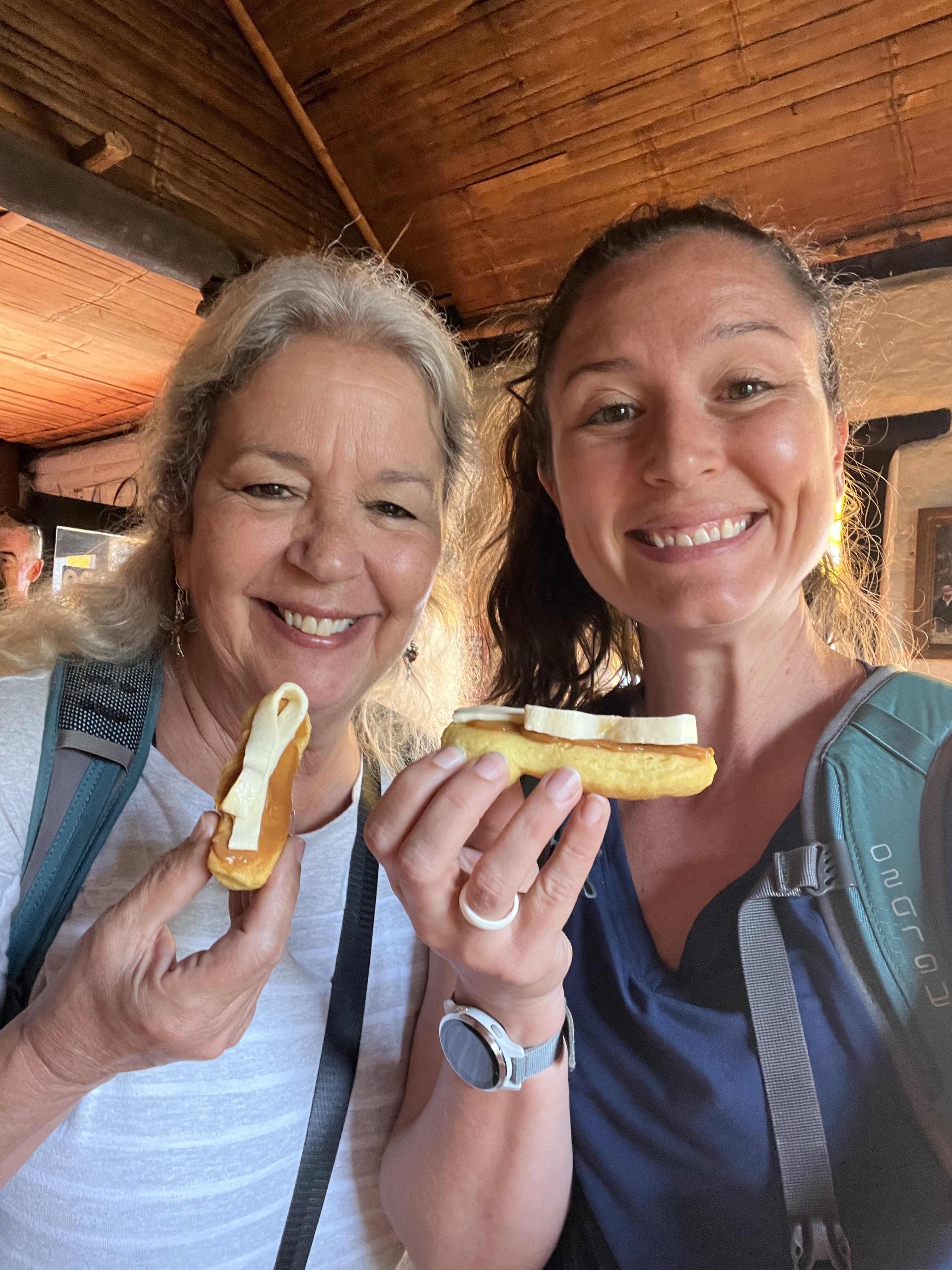
I won’t go into the recipe because, quite frankly, I don’t remember. I do, however, remember how to properly eat them. Sure, you can eat bizcochos plain. But for the full experience, you should add a respectable layer of manjar (more commonly known as dulce de leche) topped with queso de hoja, a type of white cheese typical to the area. Traditionally, the cheese comes in small rolled-up portions wrapped in a leaf (hence the name, hoja), perfect for unrolling on your bizcocho!

It was a perfect combination of buttery, flaky, sweet, salty, cheesy goodness!

After the tasting, we had about 30 minutes to grab some breakfast in their restaurant (paid separately). But, the classic breakfast was ~$4 and included two eggs, juice, coffee, and (of course) bizcochos!

The breakfast spot.

The Equator!

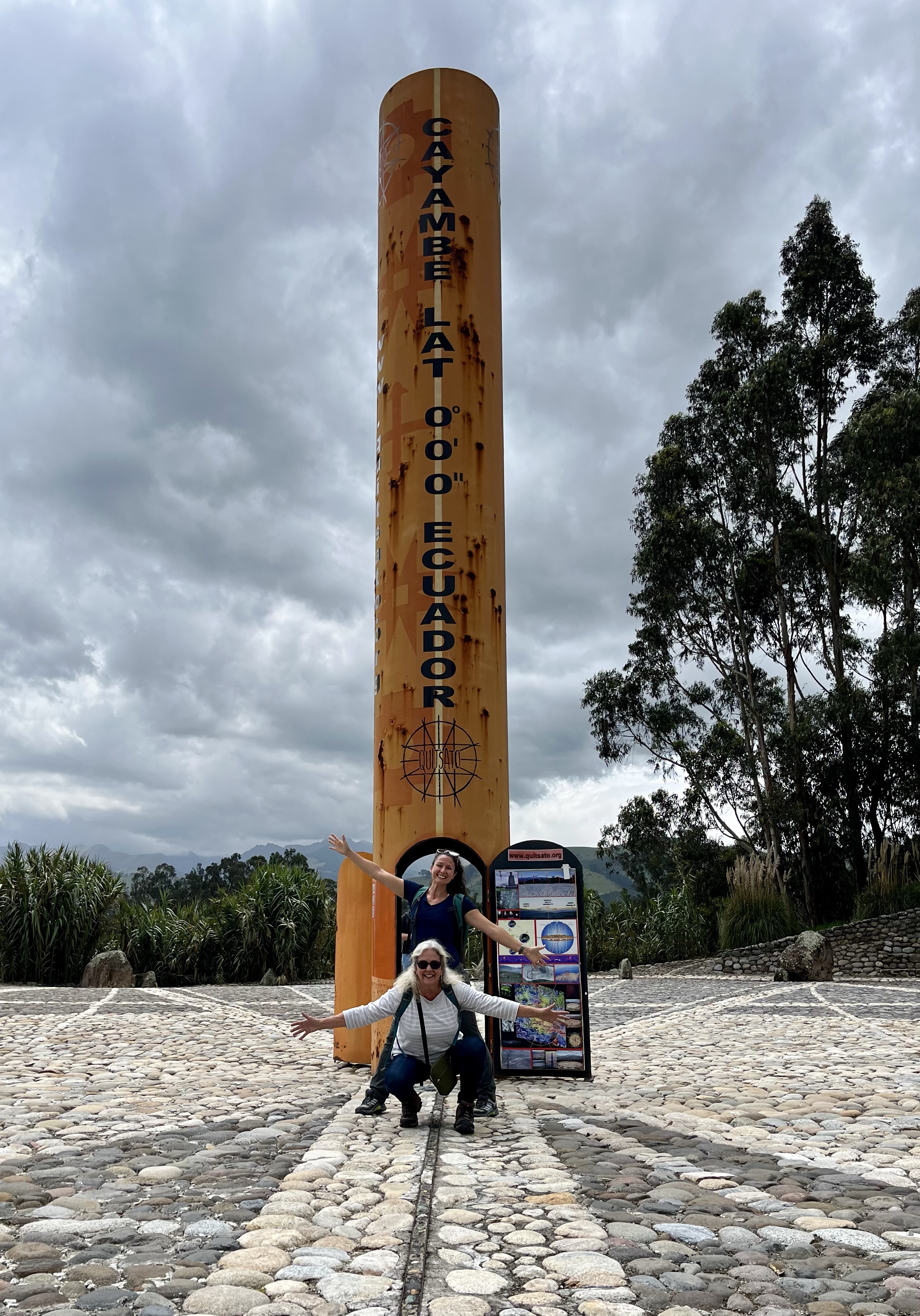
The next stop was literally 100 m down the street. So, we loaded back into the van for approximately 2 seconds to arrive at Quisato, a giant sundial on the equator!

Of course, it was cloudy when we arrived, so we didn’t get the full effect. But, unlike the monument at Mitad del Mundo, this sundial actually sits on the true equator line. It’s $5 to get in, but come on, are you really gonna skimp on $5? Plus, they have a small museum that tells the history of the equator and presents a new perspective on how we view the world; they propose left and right hemispheres instead of north and south.

Mom’s first trip to the equator!

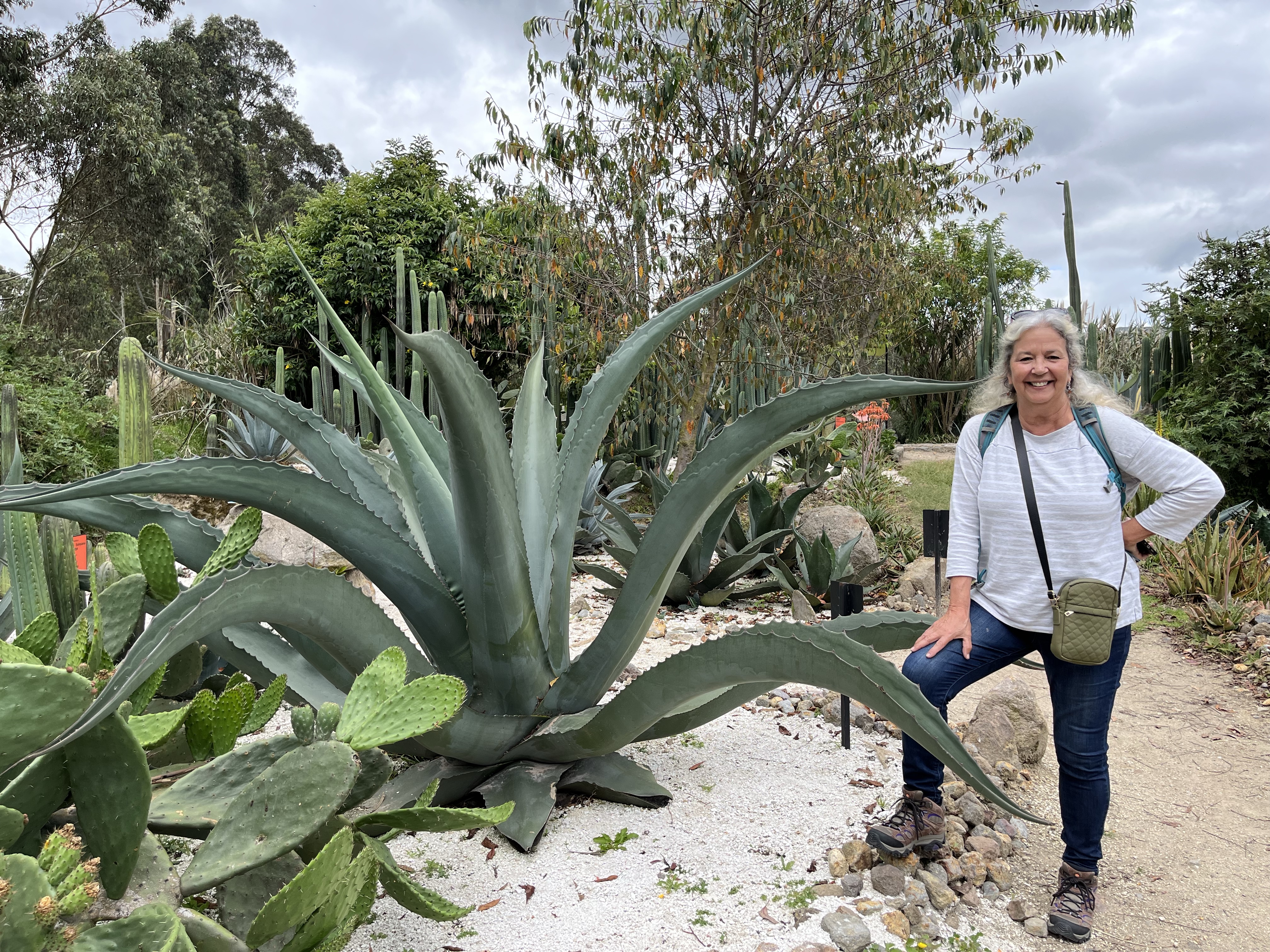
Also, if this is something you’re into, they have a really big agave garden, in both the number of species and the size of the agave!

That’s a big agave!

The Otavalo Market

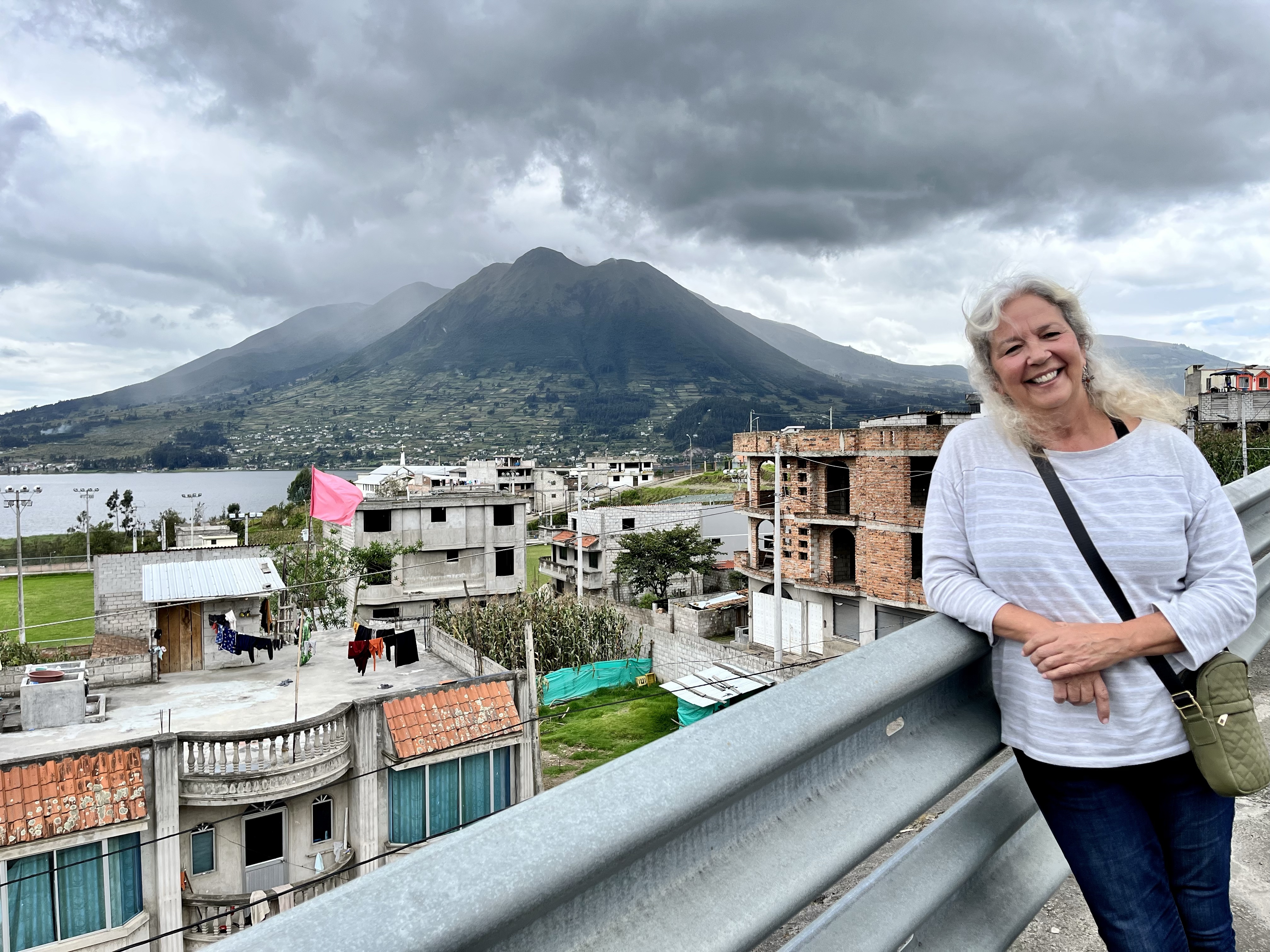
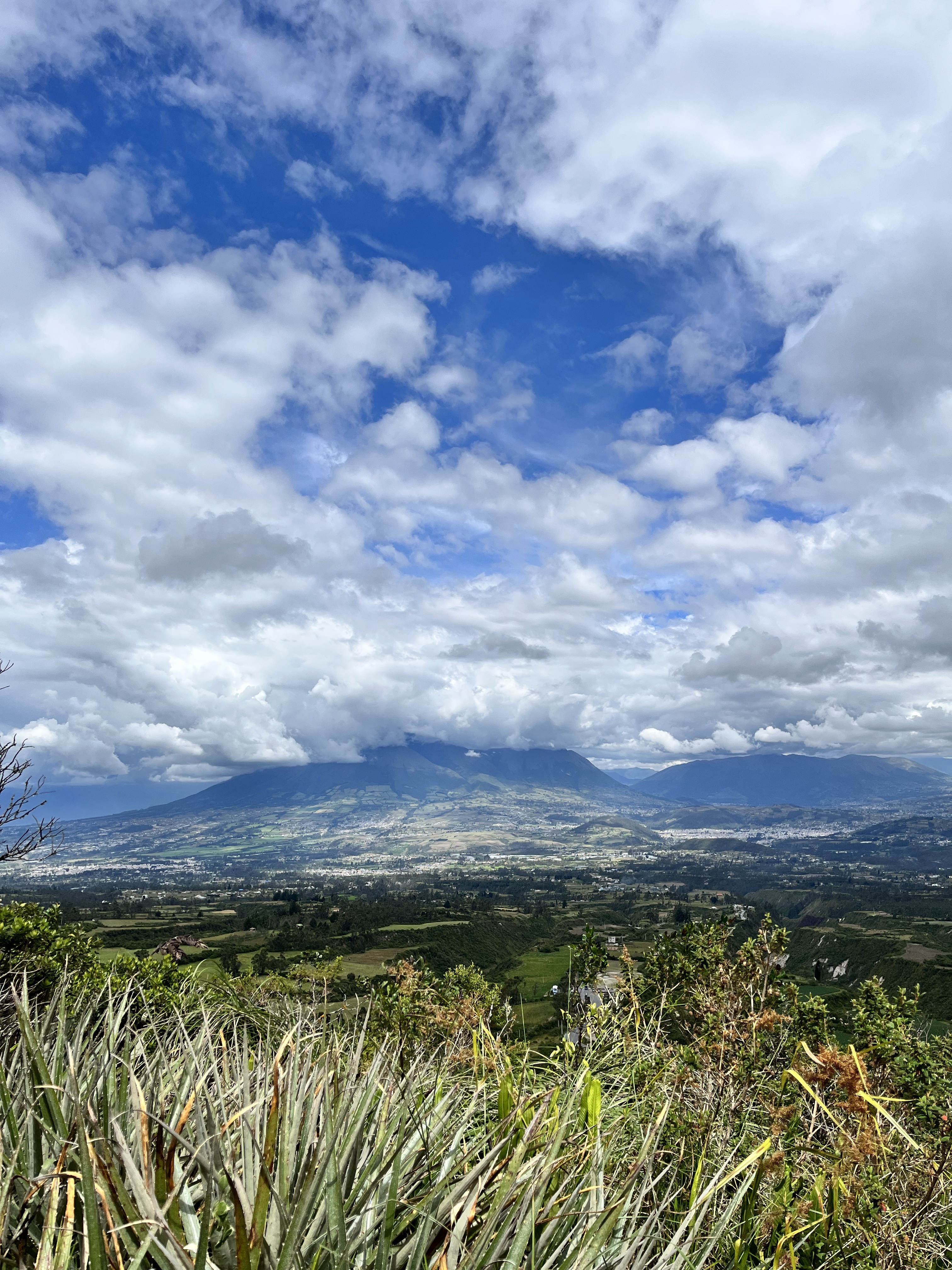
After our stop at the equator, we were off to the city of Otavalo, which sits near the extinct volcano, Imbabura.

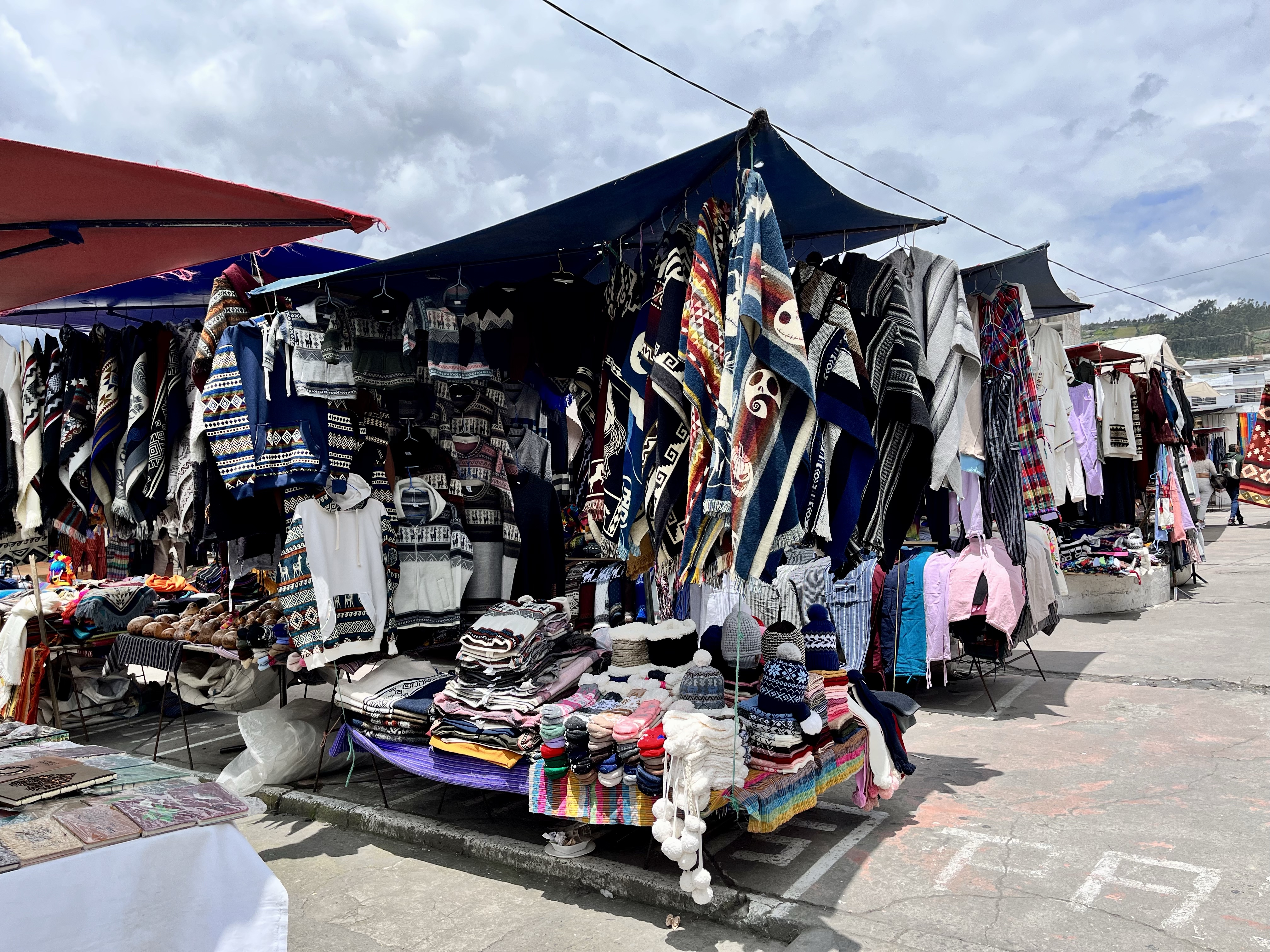
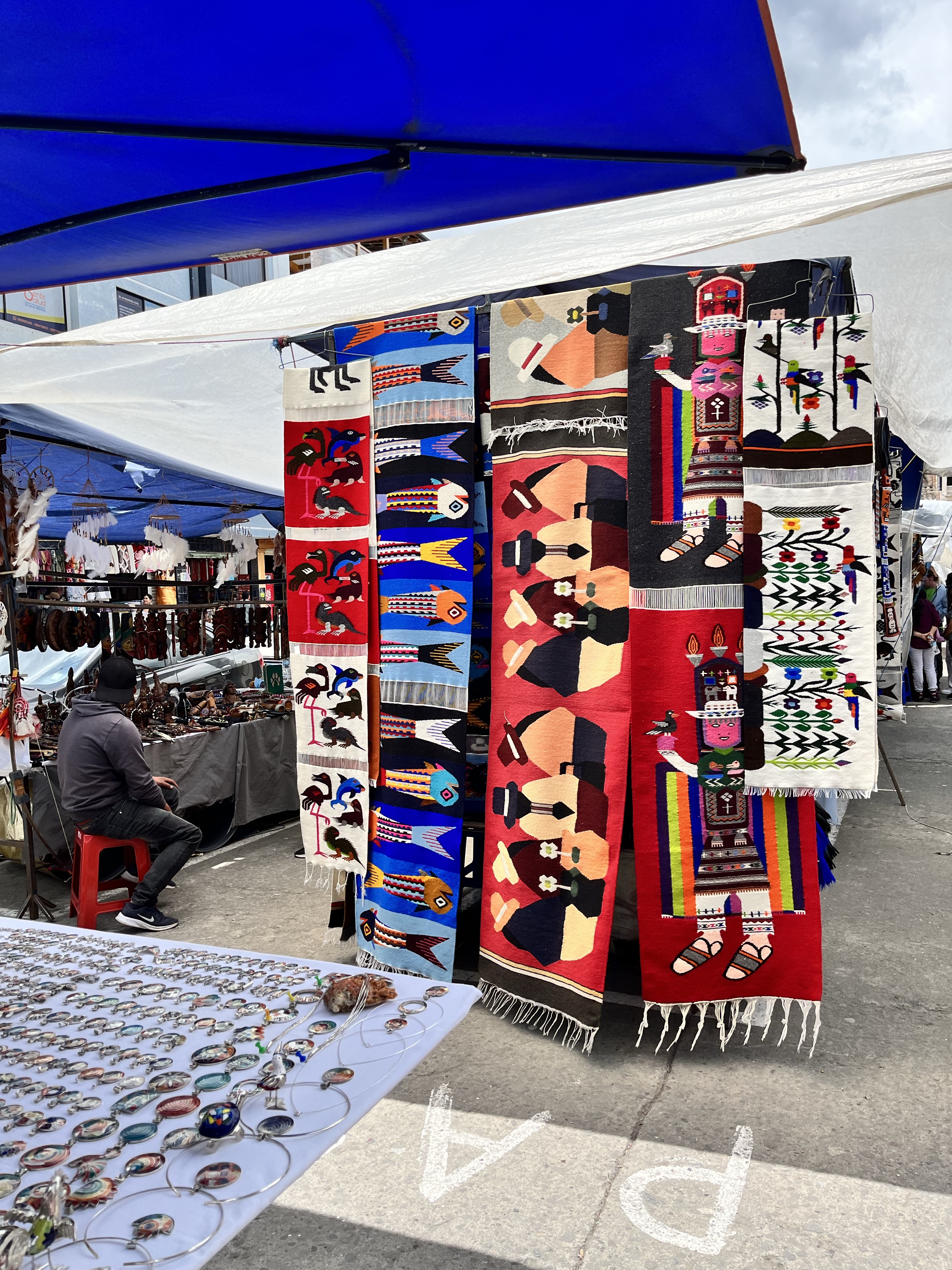
As I mentioned before, Otavalo is known for its handicraft market, and the main activity of this day tour was shopping in the market. So, we had about an hour and a half to wander and shop!

A couple of things to note. Saturday is the biggest market day. We visited on a Tuesday; the market was still quite large, with plenty of options. However, I’d plan for Saturday to get the full effect, if possible. An hour and a half was more than enough time.

Also, if you look at something too long, touch something as you walk by, or linger in front of a stand, you will be approached by the seller. (Mom learned this the hard way, which resulted in her walking around whispering to herself, “No, don’t touch that!”). This isn’t necessarily bad, especially if you want to buy something from them. But don’t go with the idea that you’ll be browsing uninterrupted.

The phrase “solo estoy mirando,” or “I’m just looking,” is a good one to learn. 😜

So what can you expect to find in the market? Lots of jewelry, ponchos, blankets, and sweaters! You’ll also find tapestries, wooden carved trinkets (including kitchen spoons; highly recommended!), art, and other nicknacks. Sometimes, the prices are negotiable. However, I wouldn’t ask to drop more than $5, and it depends on the item. Blankets, ponchos, and tapestries? Sure. A $1.50 hand-painted magnet? I’ll just pay $1.50.

Lake Cuicocha

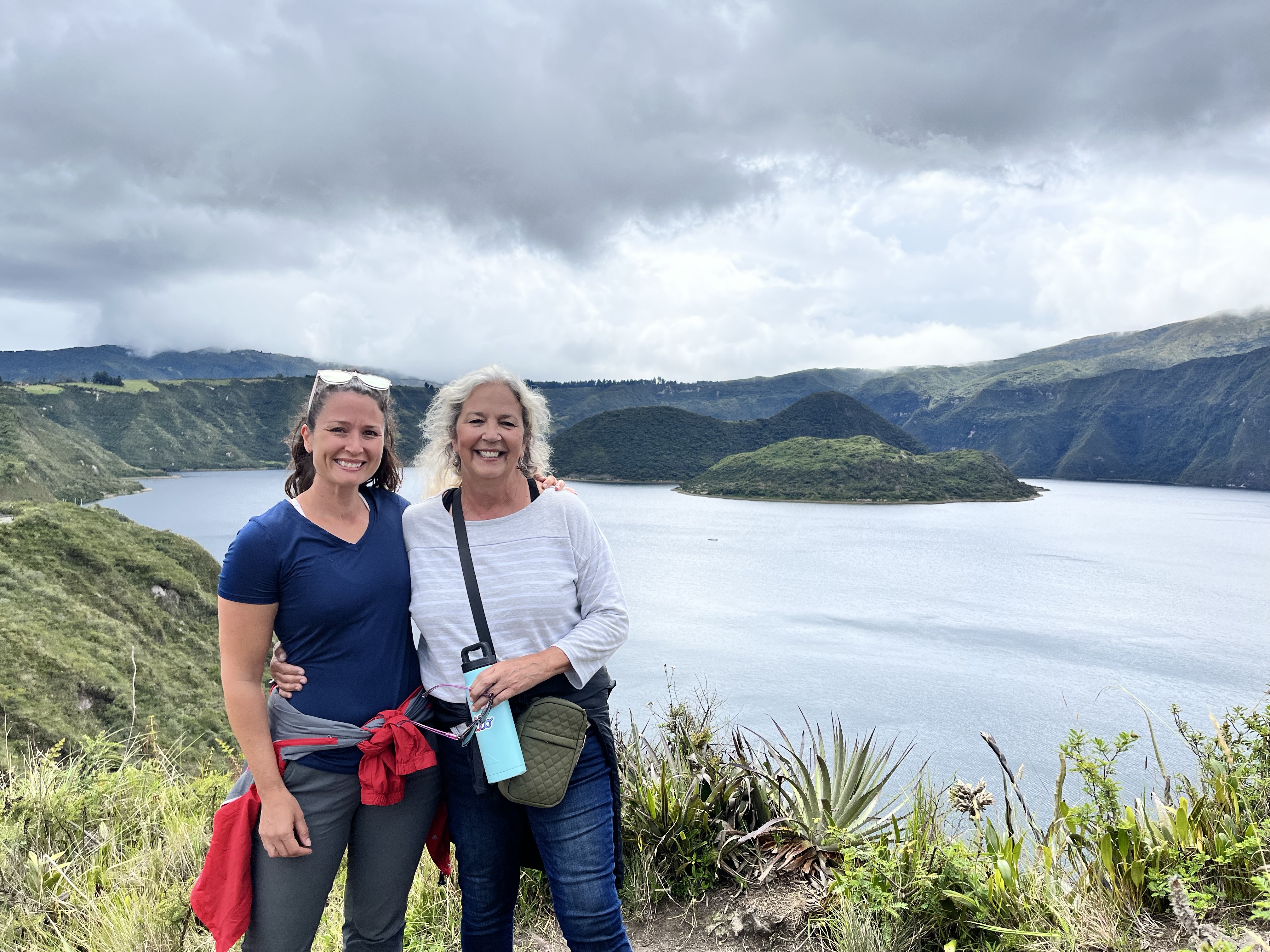
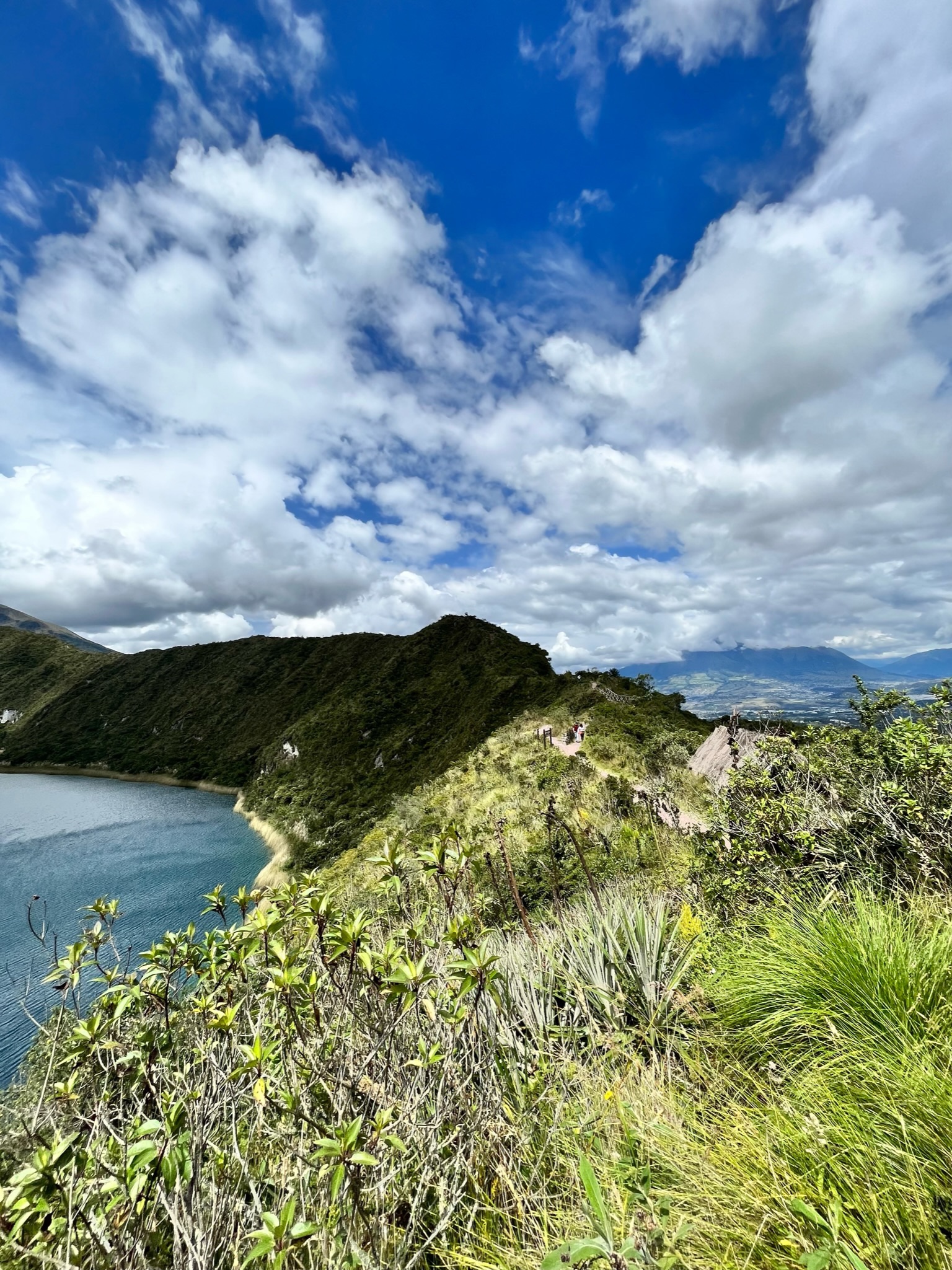
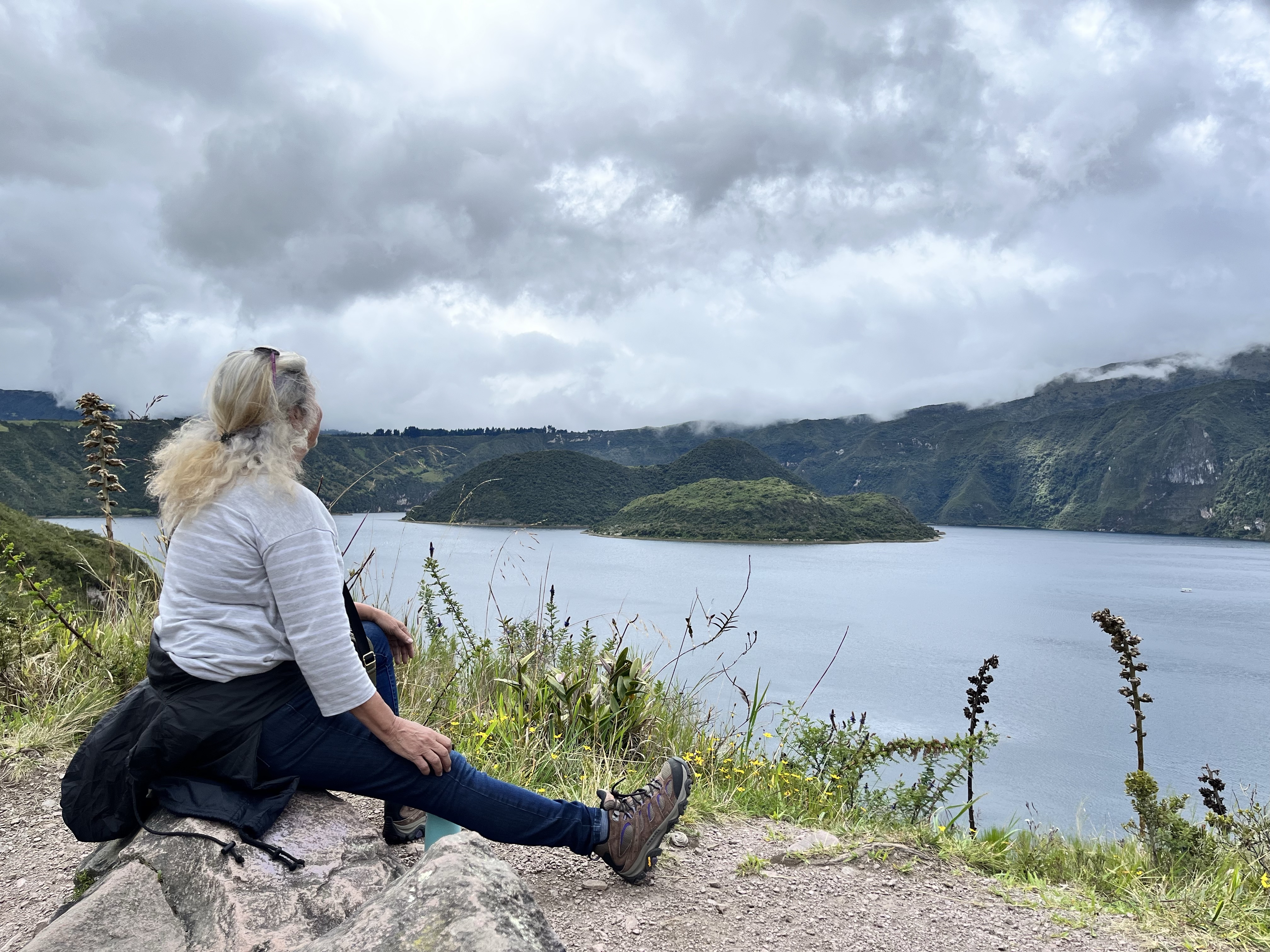
Our final stop for the day was Laguna de Cuicocha, which is Kichwa (the indigenous language) for Lago del Cuy… or Guinea Pig Lake! It’s named after the largest of the two islands in the center, which resembles a guinea pig.

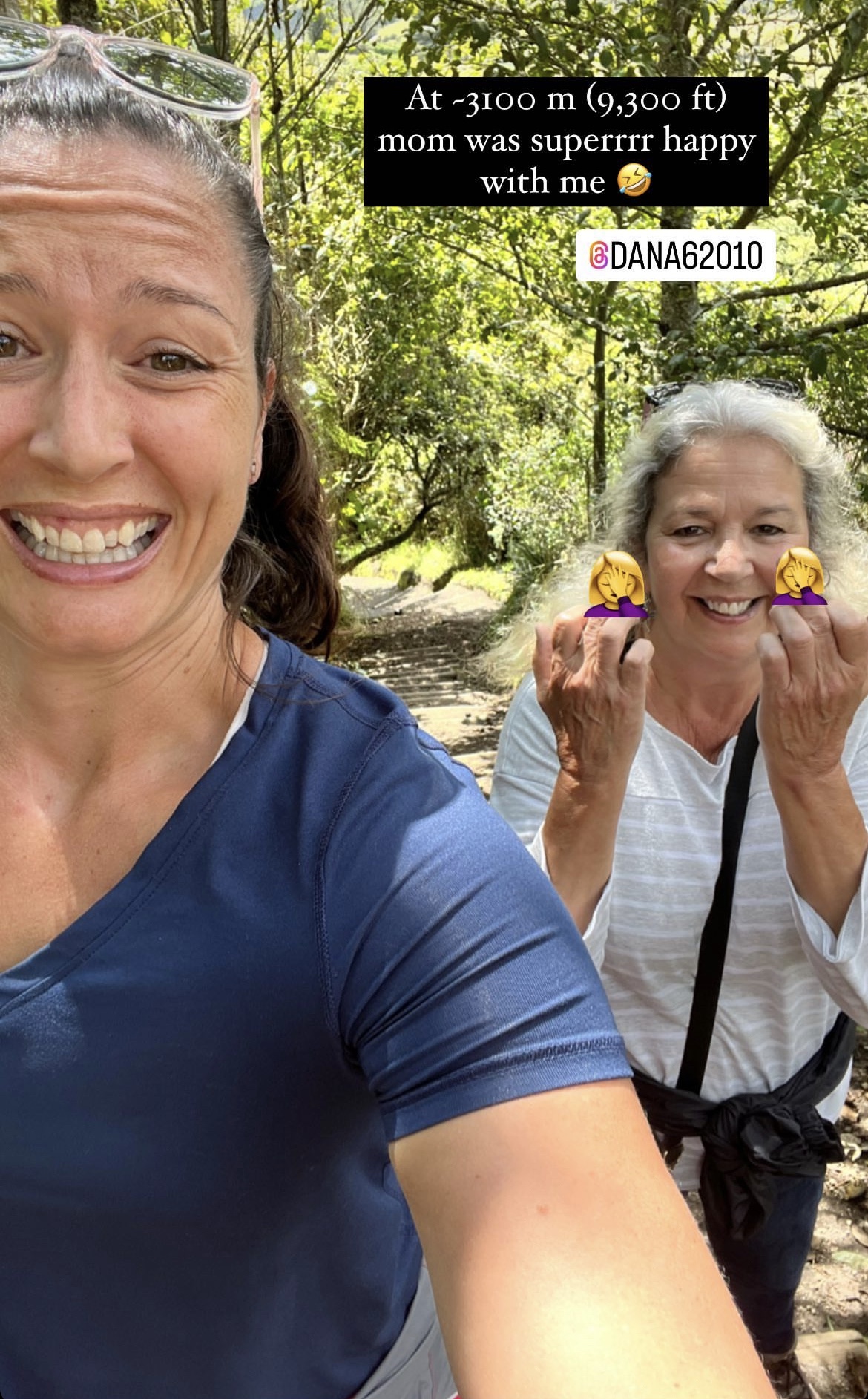
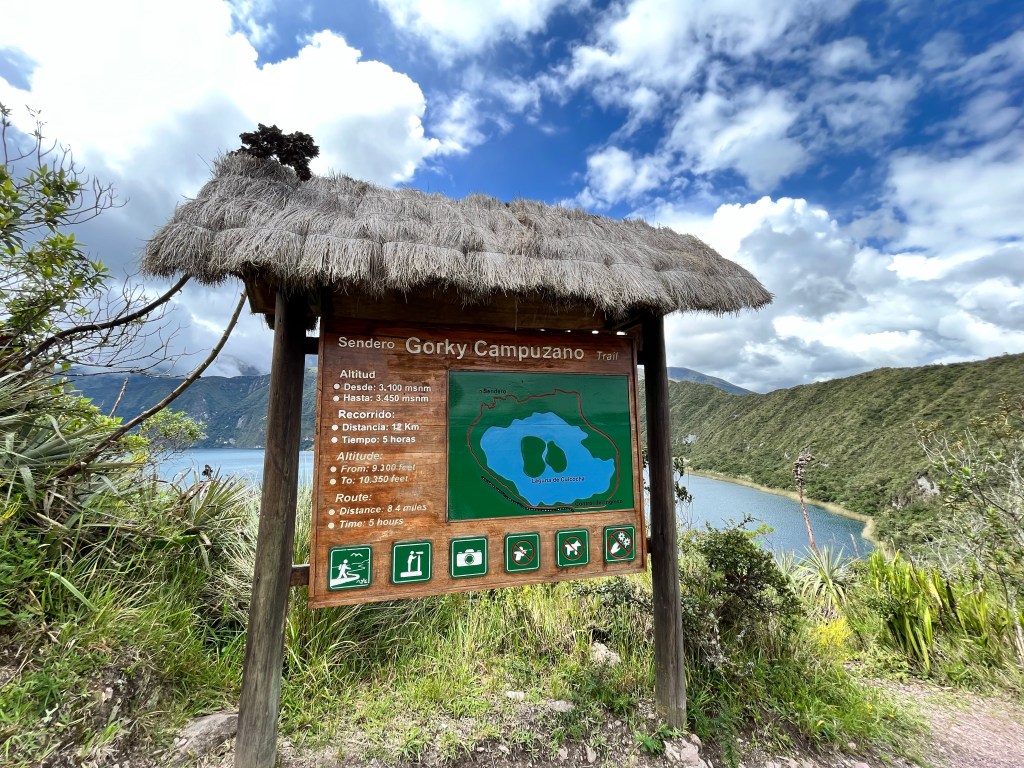
This is the country’s second-most famous volcano crater lake, the first being Quilotoa. Like Quilotoa, you can hike the rim, but we didn’t have enough time. Also, I think Mom was ready to murder me because one thing we hadn’t really considered was the altitude, especially after coming from the coast. The lowest point of the ridge trail with the main viewing area sits at ~3,100 meters (~9,300 feet). So, even the short walk up to the viewpoint was strenuous!

Mom’s opinion of walking up to the viewpoint.

Lunch

All this going makes for hungry gals!

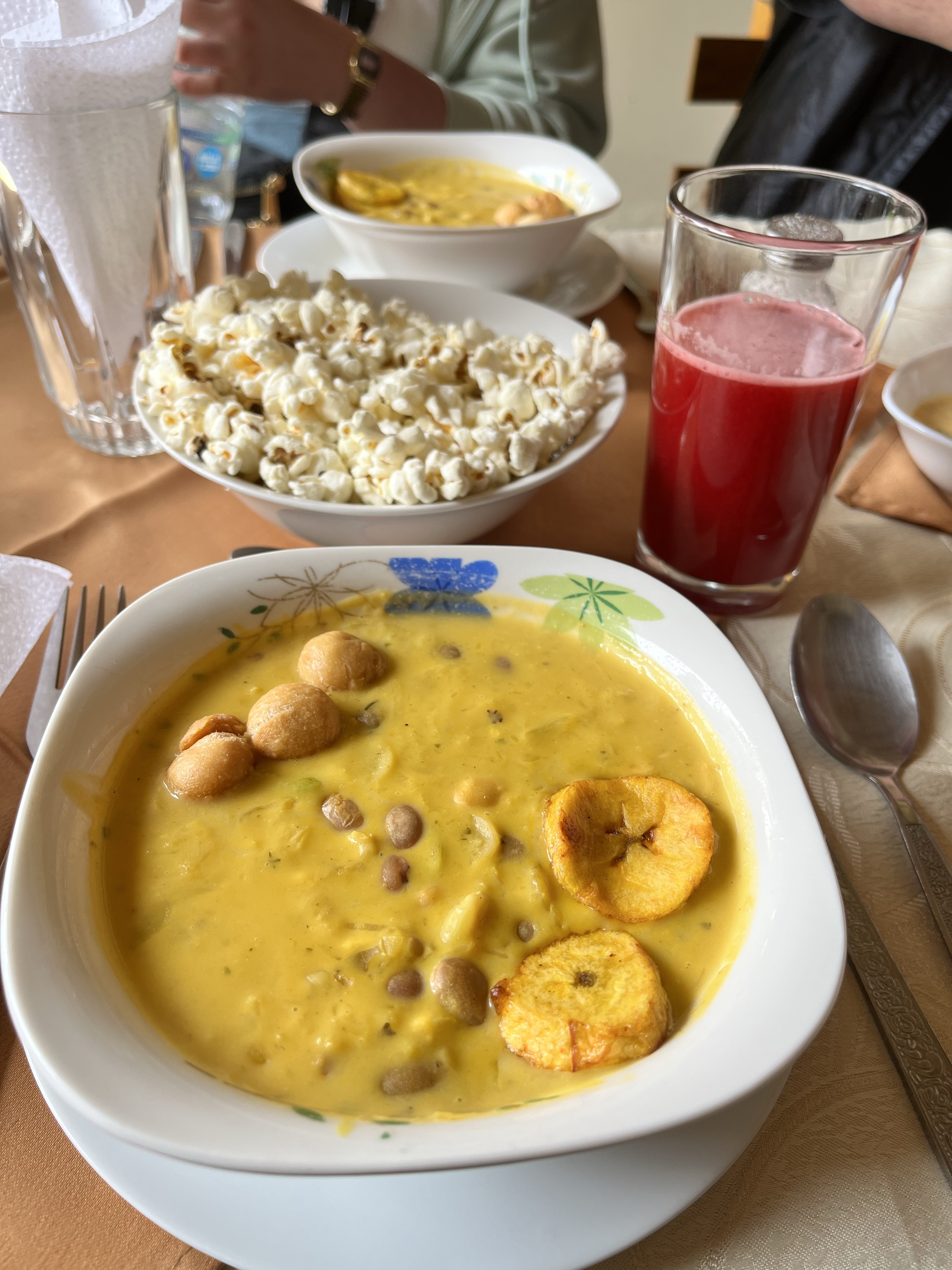
So, actually, the final stop before heading back to Quito was for lunch… a big lunch! And we were lucky. Since we were visiting around Easter, the restaurant prepared fanesca, the traditional Easter soup!

Fanesca (with popcorn. It goes in the soup!)

It was a long but fun day, and booking a trip with a tour company really makes it easy to see other places if you’re short on time. I’d highly recommend it, especially since they keep the groups small (no more than 12) and the guide is local.

Next up on the adventure–my cousin arrives! So, until then…

Majestic mom.

Nos vemos,

Whitney

La Isla de la Plata (the Poor Man’s Galapagos), Ecuador

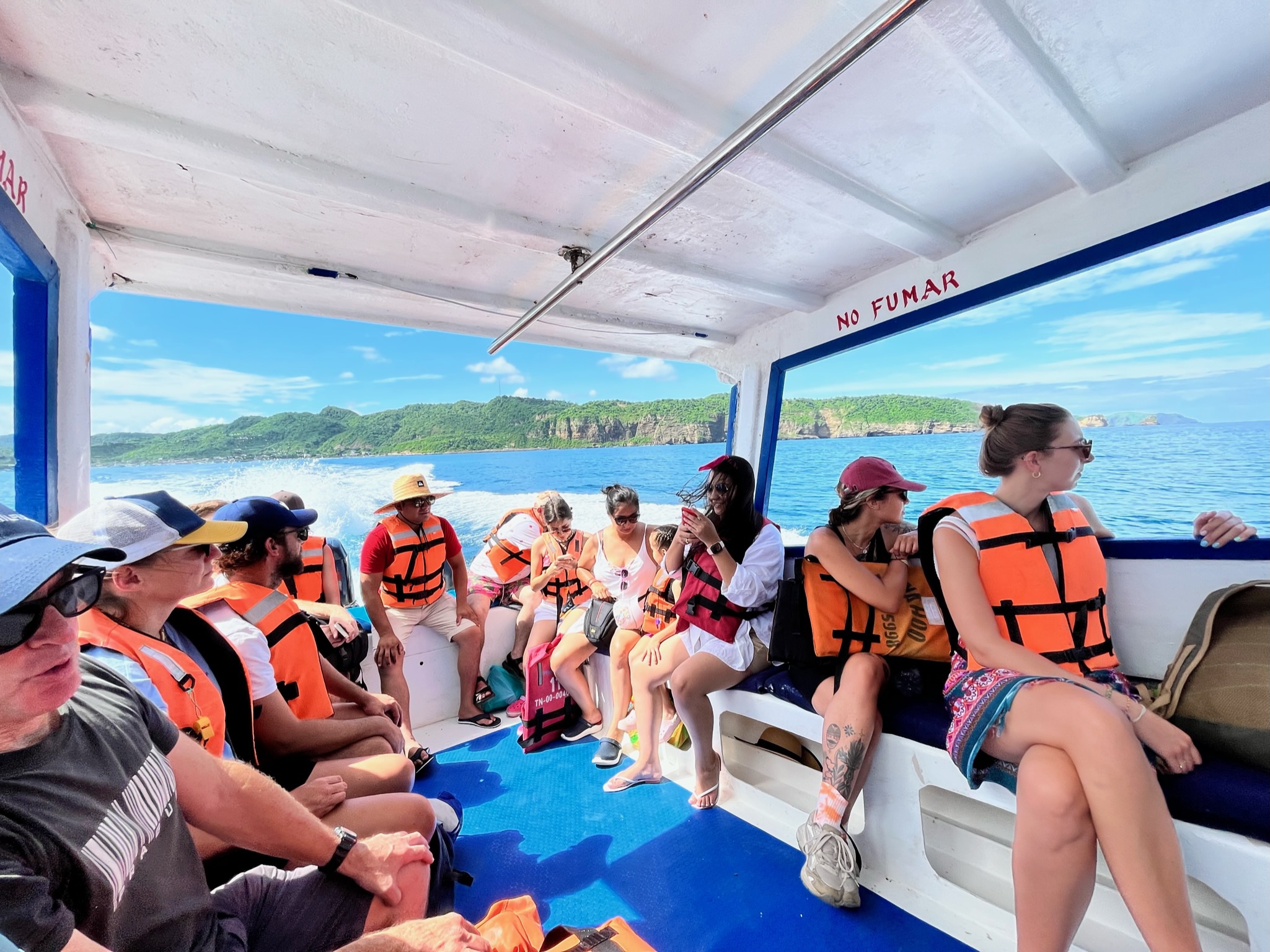
La Isla de La Plata (or the Island of Silver) is an uninhabited island about an hour by boat off the coast of Puerto López, making it an easy and popular day trip and a “must-do” on our trip.

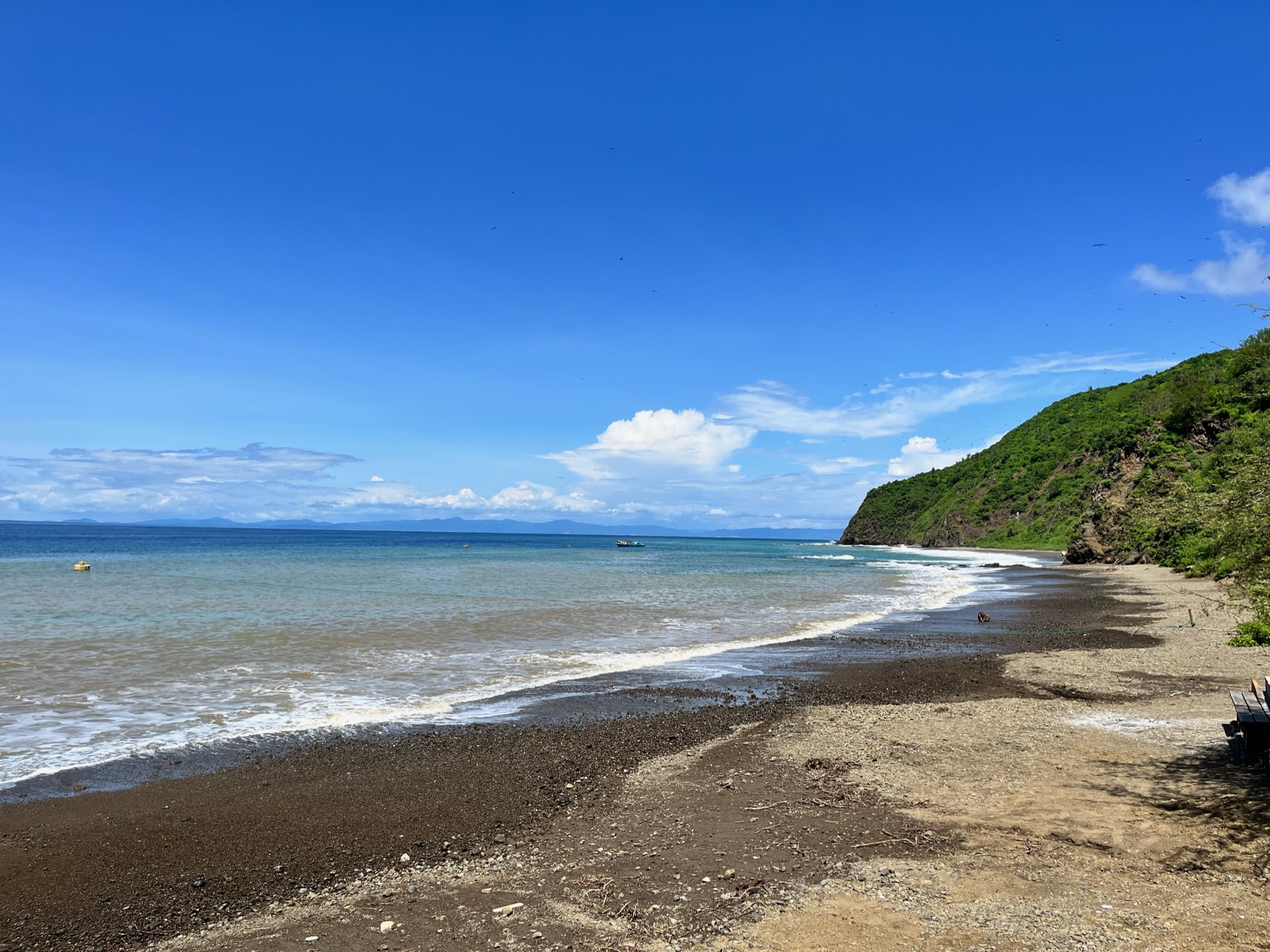
View from the beach of la Isla de la Plata.

Based on what we saw, all tours are nearly the same. So, although we scheduled our tour through our hotel (~$40), it would have been just as easy to find a tour company on the melacón (boardwalk) and schedule it that way.

So, let’s get going, shall we?!

First up, all boats leave from the pier at 9:30 am…Ecuadorian time. So, don’t be surprised if you don’t leave at precisely 9:30. Oh, and you’ll need $1 to board the boat, which isn’t included in the tour cost. Why? Who knows.

The tour is an all-day excursion with both hiking (walking?) and swimming activities. So, I recommend bringing (or wearing) your swimsuit, wearing good walking shoes, and bringing sunscreen, a hat, and LOTS of water.

The tour also includes lunch and some snacks. For us, this meant some fruit, banana bread, and one cheese and one tuna salad sandwich. So, you might want to bring some snacks.

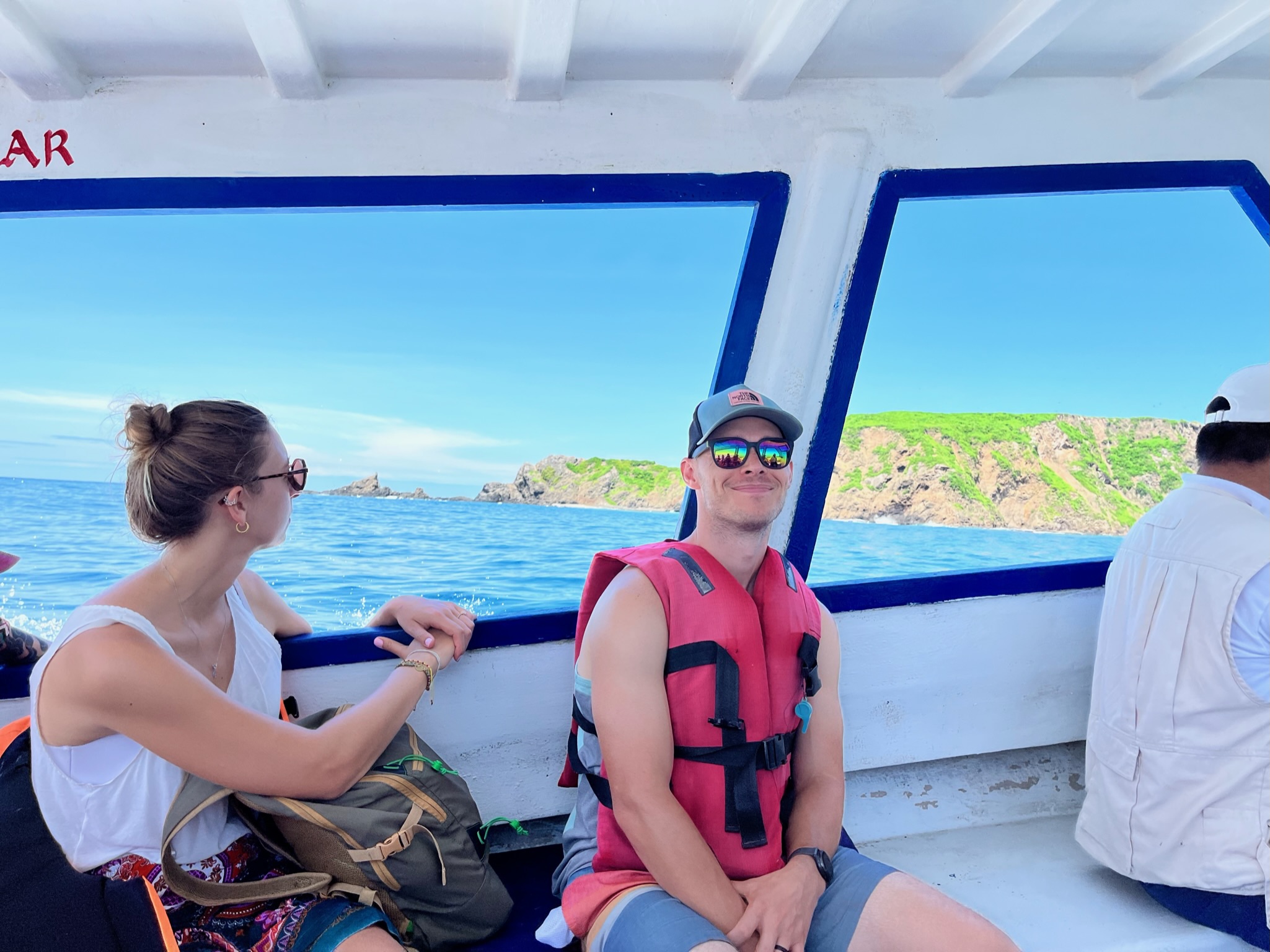
After about an hour on the boat, we arrived at the only man-made structure on the island, which is a small visitor’s center with some bathrooms and places to sit but not much else. Getting off the boat is also a bit interesting. Be prepared to get a bit wet because there is no dock!

Getting off the boat.

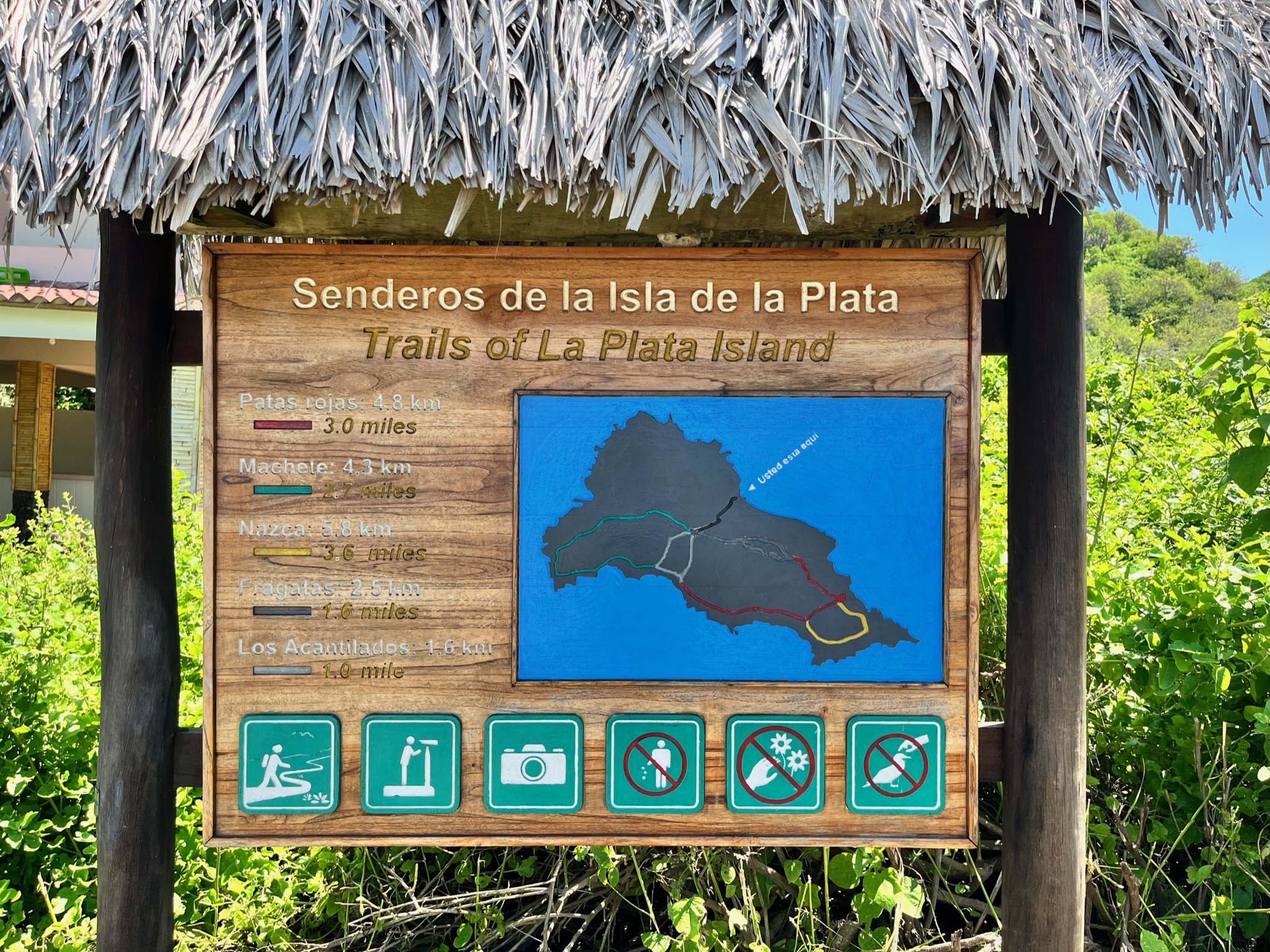
You can only tour the island with a guide since the island is protected and part of Machalilla National Park. So, first thing on arrival, the guide gave us a brief overview of the island and let us vote on which trail to take. He recommended Los Acantilados (the light grey trail) for the cliffs and the birds. No one objected, so that’s what we did!

But first, regardless of what trail you choose–red, green, yellow, or grey–you have to take the black trail, which is “150 meters and 80 steps up!” according to our guide (as he smirked).

The trail map.
On the way up…

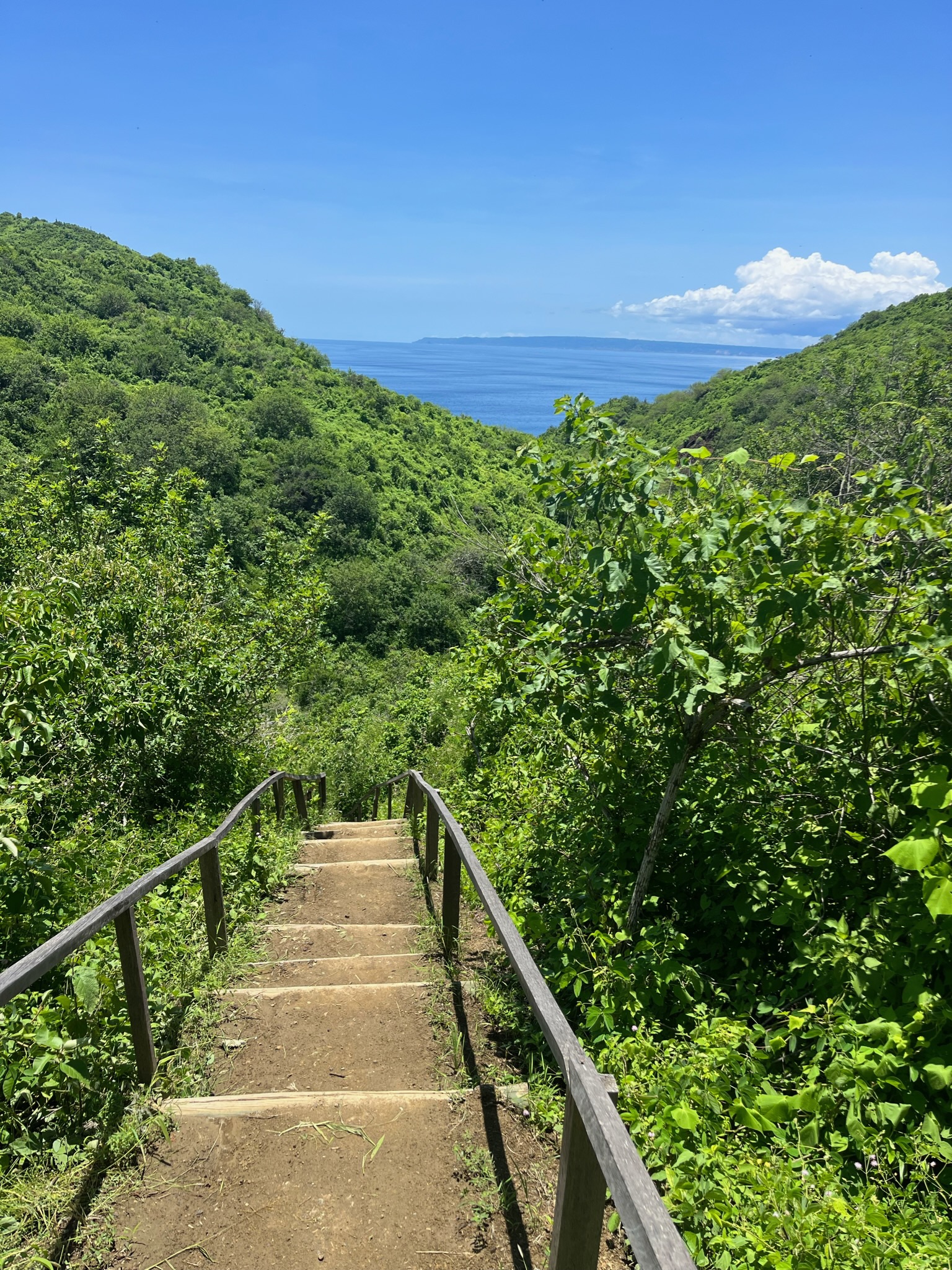
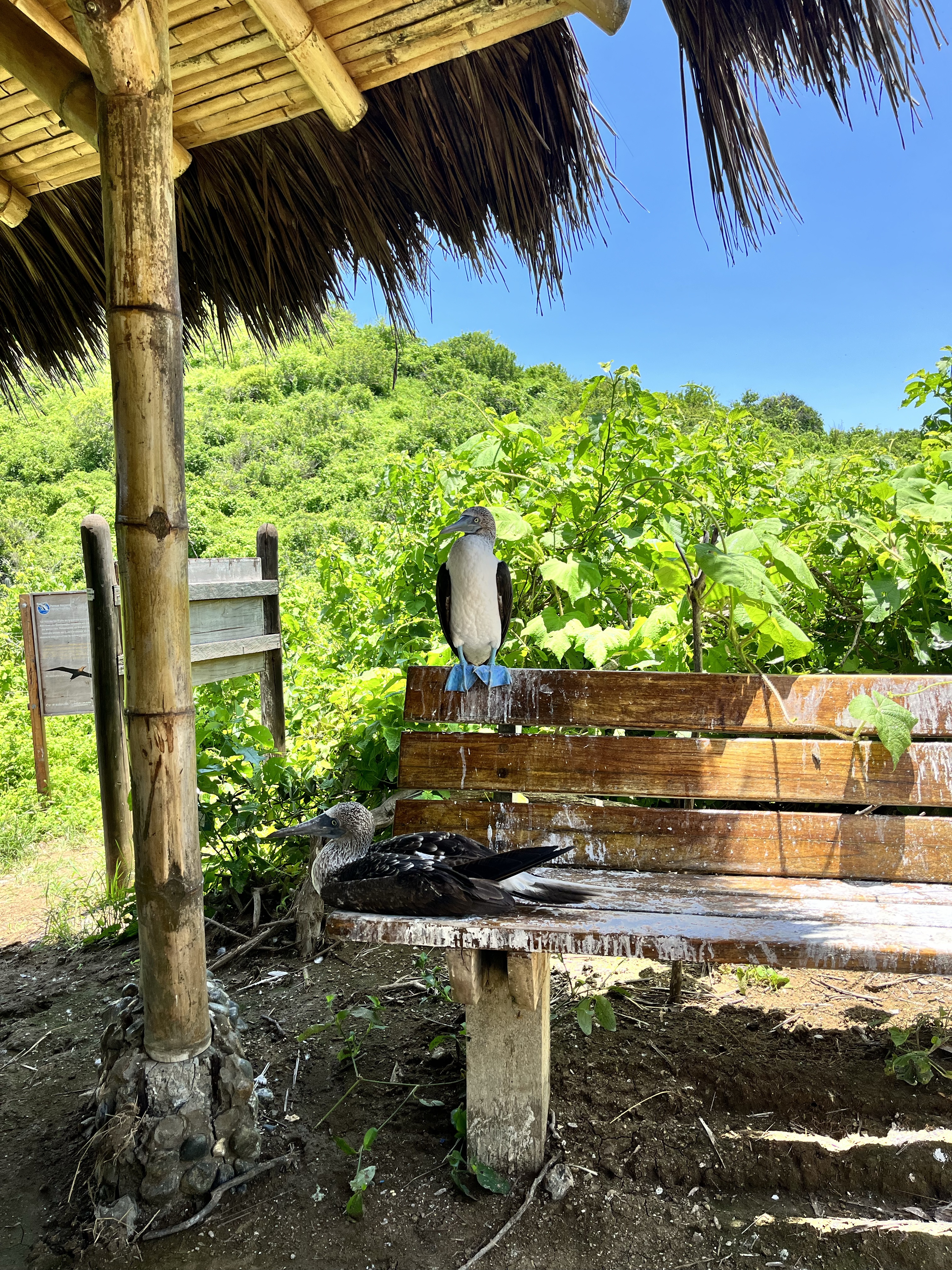
The hike up was definitely… up! And it was HOT, hence my suggestion to bring lots of water. Full sun on the equator is no joke. However, we were rewarded with our first boobie sighting at the gazebo at the top!

Blue-footed boobies that is!

A male and a female. What silly birds!

And in case you’re wondering where the island got its name, supposedly (according to our guide), one reason is the bird poop, which can cover the island’s cliffs, giving it silver-sheen from afar. Historically speaking, they discovered gold and silver (plata) on the island, hence the name.

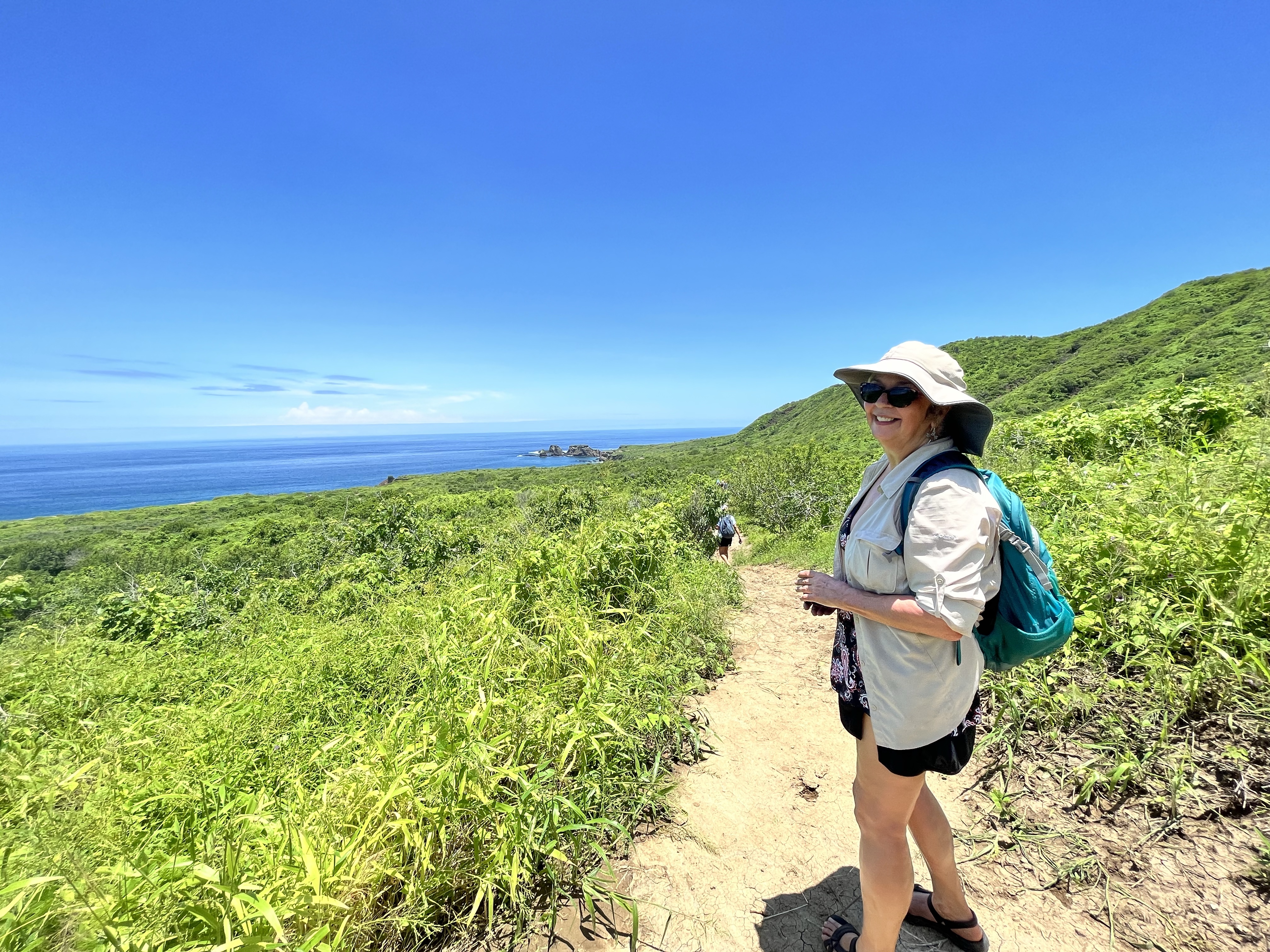
As for the hike, it was beautiful, but I reiterate, it was HOT! There is no shade, so be prepared to sunscreen-up. Also of note, we visited in the rainy season. Yes, we were lucky with a perfectly sunny day. But, the day before, it rained all day and hard. Consequently, the vegetation on top of the island was green. However, our guide showed us some pictures during the dry season; it’s the complete opposite! So, depending on the time of year you visit, you’ll have variable experiences!

Walking the path to the cliffs.

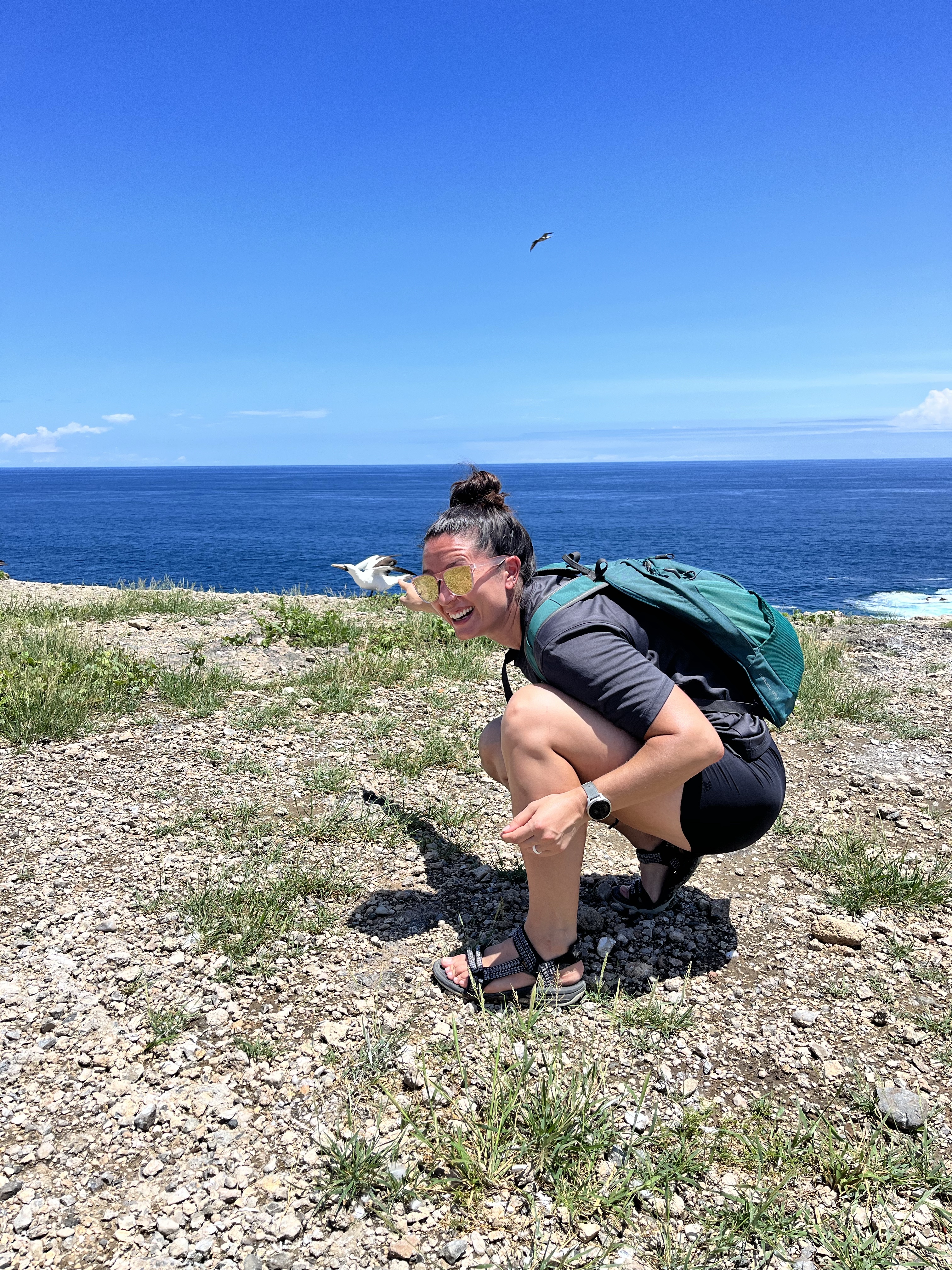
Now, this may come as a shock, but I’m no nature photographer, and the iPhone can only go so far. So, I don’t have many bird pictures, but there were a lot of ’em. Trust me.

I did, however, pretend to poke a bird, which is obviously very important.

The boobies like to hang out in the shade on the side of these cliffs.

The hike took longer than I expected, maybe 2–2.5 hours or so. Once we were back on the boat, they gave us lunch (no trash on the island!), then we changed locations for snorkeling.

Honestly, this part wasn’t great. Like I said, it rained the day before, so the general visibility was poor. Plus, the water was quite deep and choppy where we were, so few fish were swimming near the surface, and diving down was difficult. But we swam in the Pacific Ocean, which was the important part!

Proof of ocean swimming.

After that, it was time to head back to the mainland! We arrived around 5 pm THIRSTYYY and hungry but generally pleased with the day! I’d definitely recommend the day trip, but maybe go a bit more prepared!

Group photo!

Next up, we headed back to Quito for a few days with a day trip to Lago Cuicocha. So, until then…

Nos vemos,

Whitney

Puerto López, Ecuador

Man, life has been busy lately!

February and March were quiet, but then it was a month and a half of going nearly non-stop! My mom & cousin visited for three weeks; there was a week-long conference in Tena that Shane (and, therefore, I) participated in; we had some friends (and co-lab members) in Tena for a few days; and then we hit the road for butterfly collecting!

It’s also a bit sad because this was likely my last butterfly collecting trip, potentially ever, since we will move back to Germany towards the end of the year. But that’s not the point of this post. Instead, I’m here to tell you all about my adventures with my mom, starting with our trip to Puerto López!

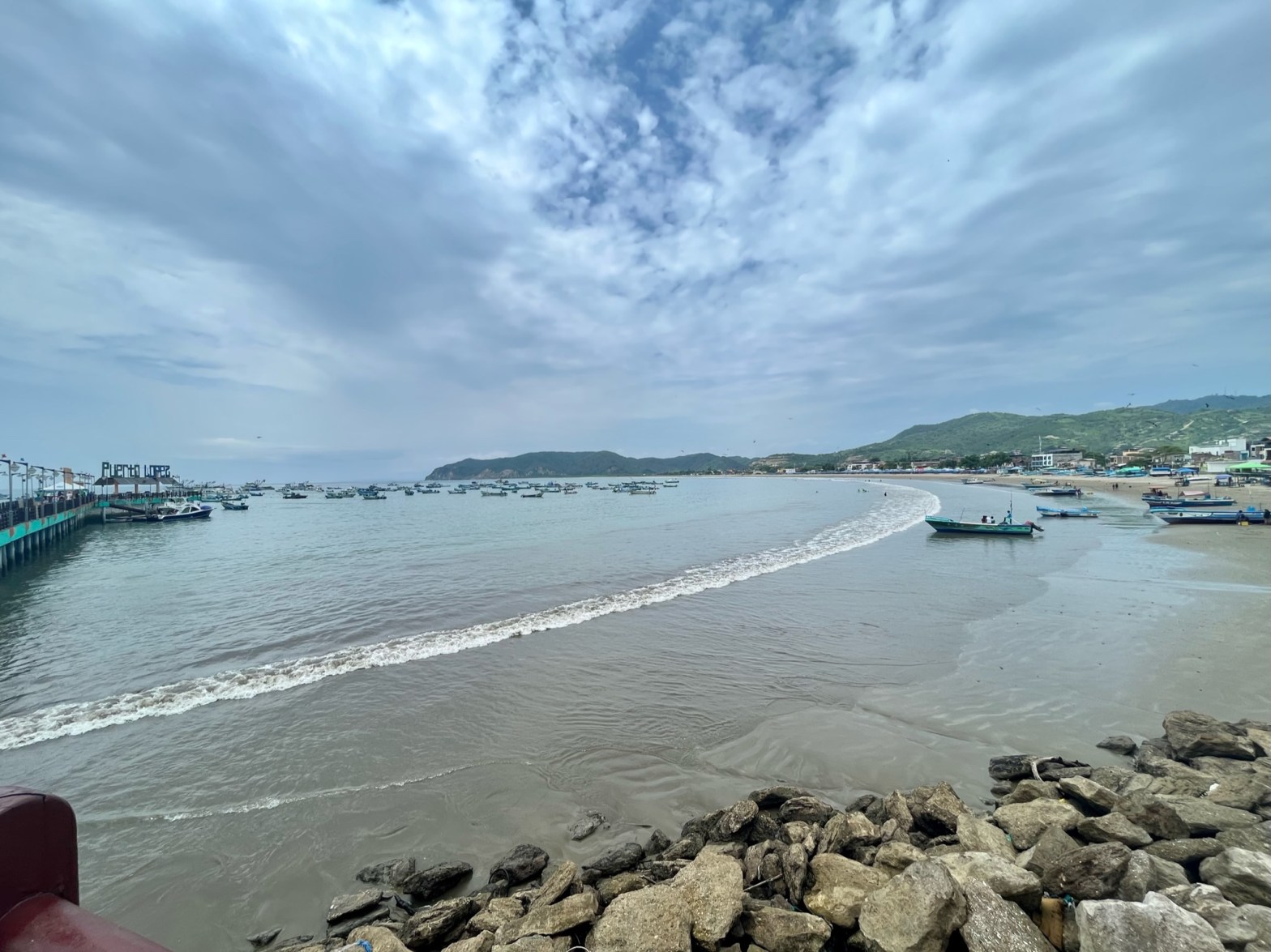
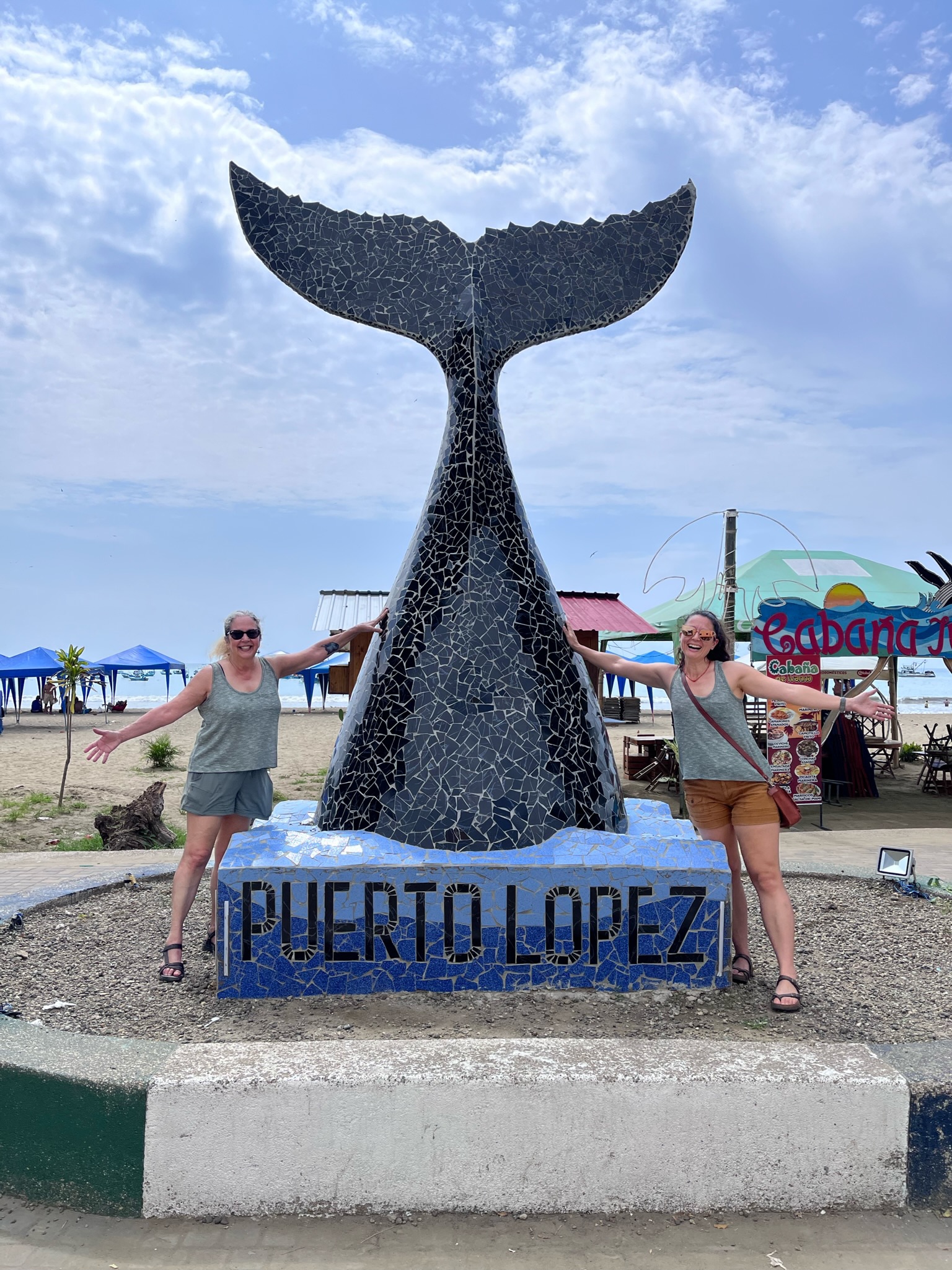
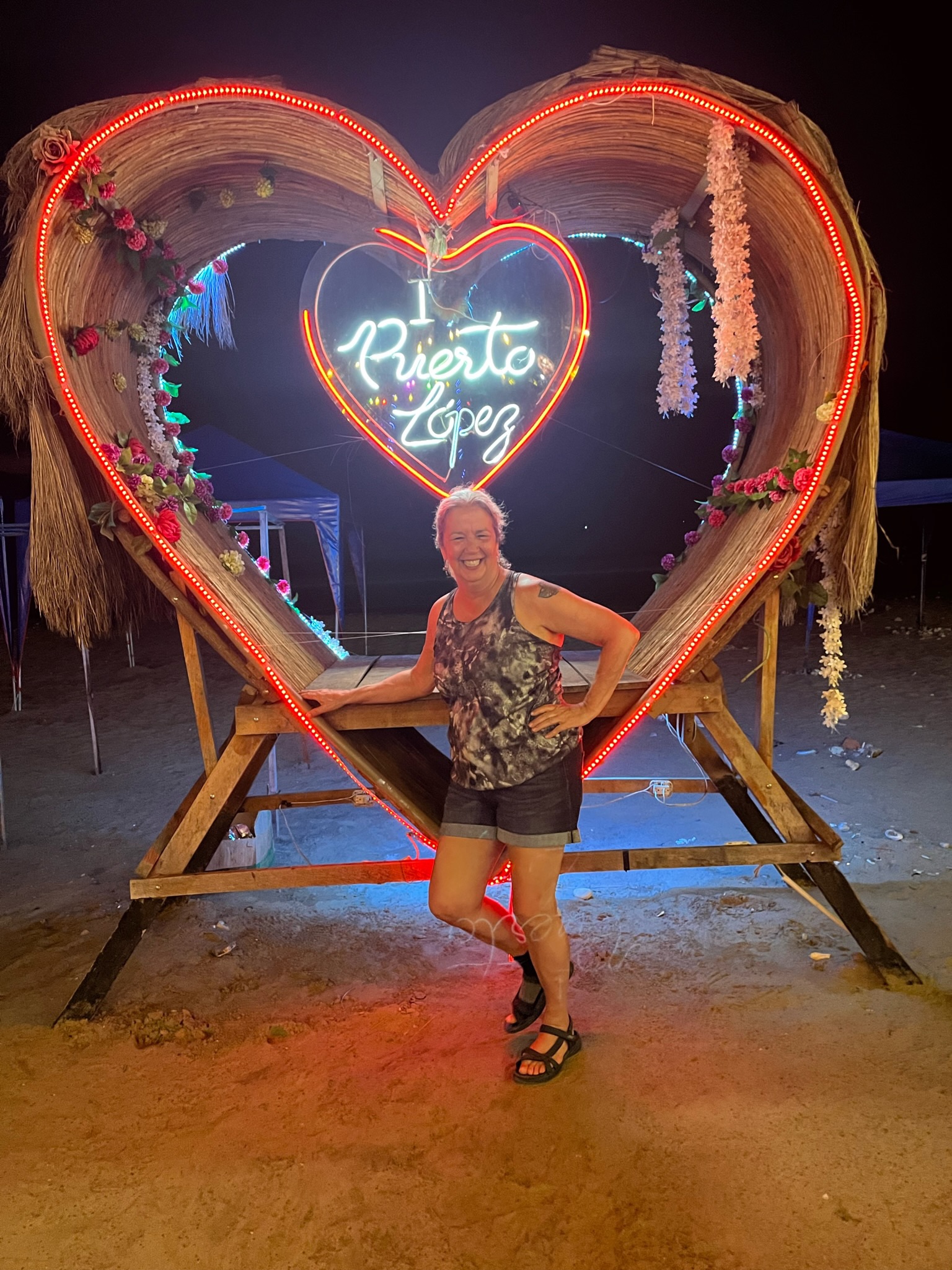
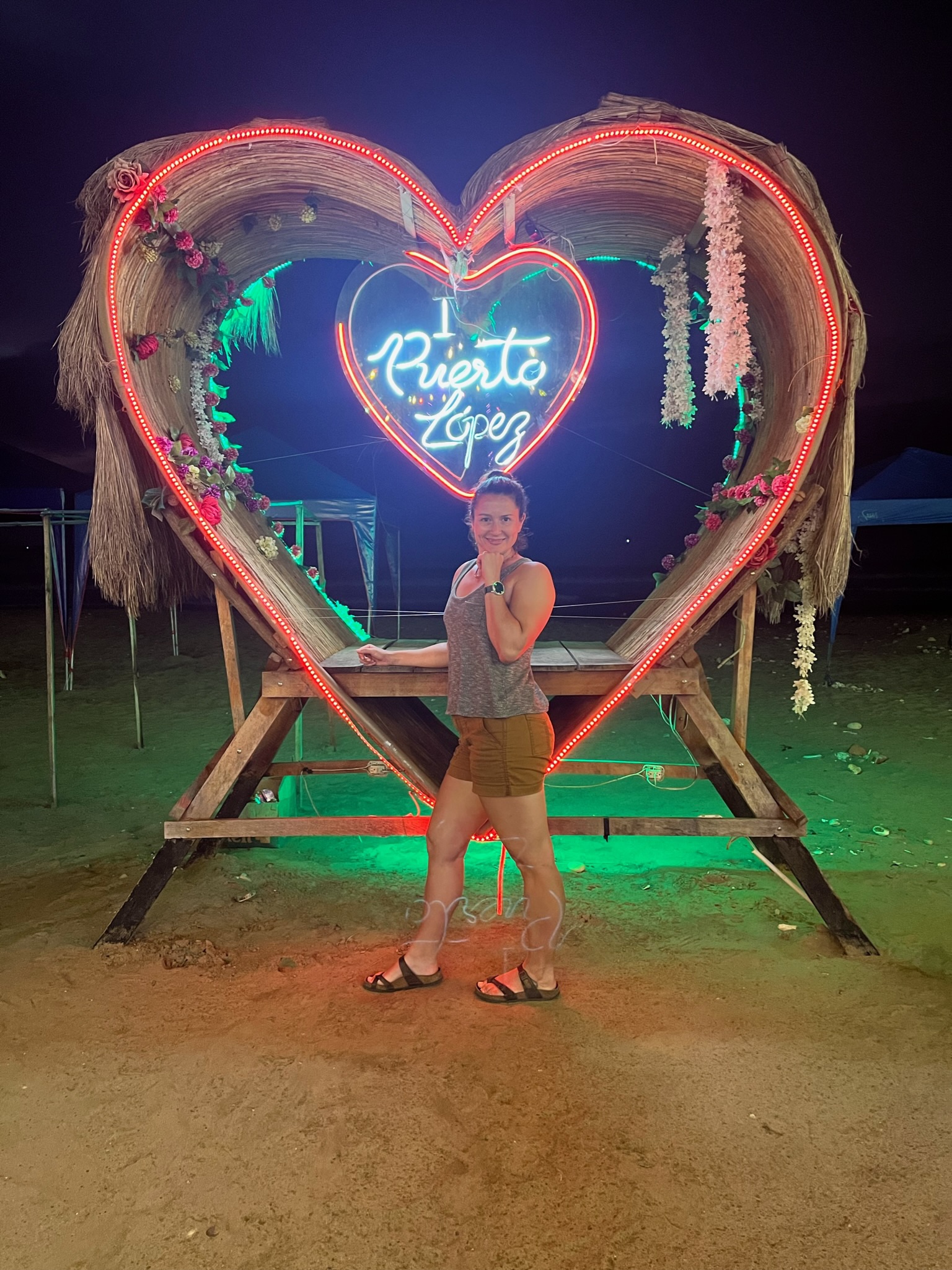
As you may have deduced from the whale tail statue, Puerto López is a small town located on the coast, approximately two hours south of the larger city of Manta.

So, on mom’s first day, I had her up and at ’em at 4 am to catch our 6 am flight to the beach. It’s good she loves the beach because otherwise, she might have killed me because she doesn’t love 4 am. 😂

All smiles at 5 am!

Activities

The beach!

Obviously!

Oddly enough, we didn’t actually swim here, but you definitely can, and many people did. Instead, we spent more time walking the malecón (boardwalk), which has plenty of beach bars and ends with a pier. I can highly recommend sunset on the beach with a cocktail.

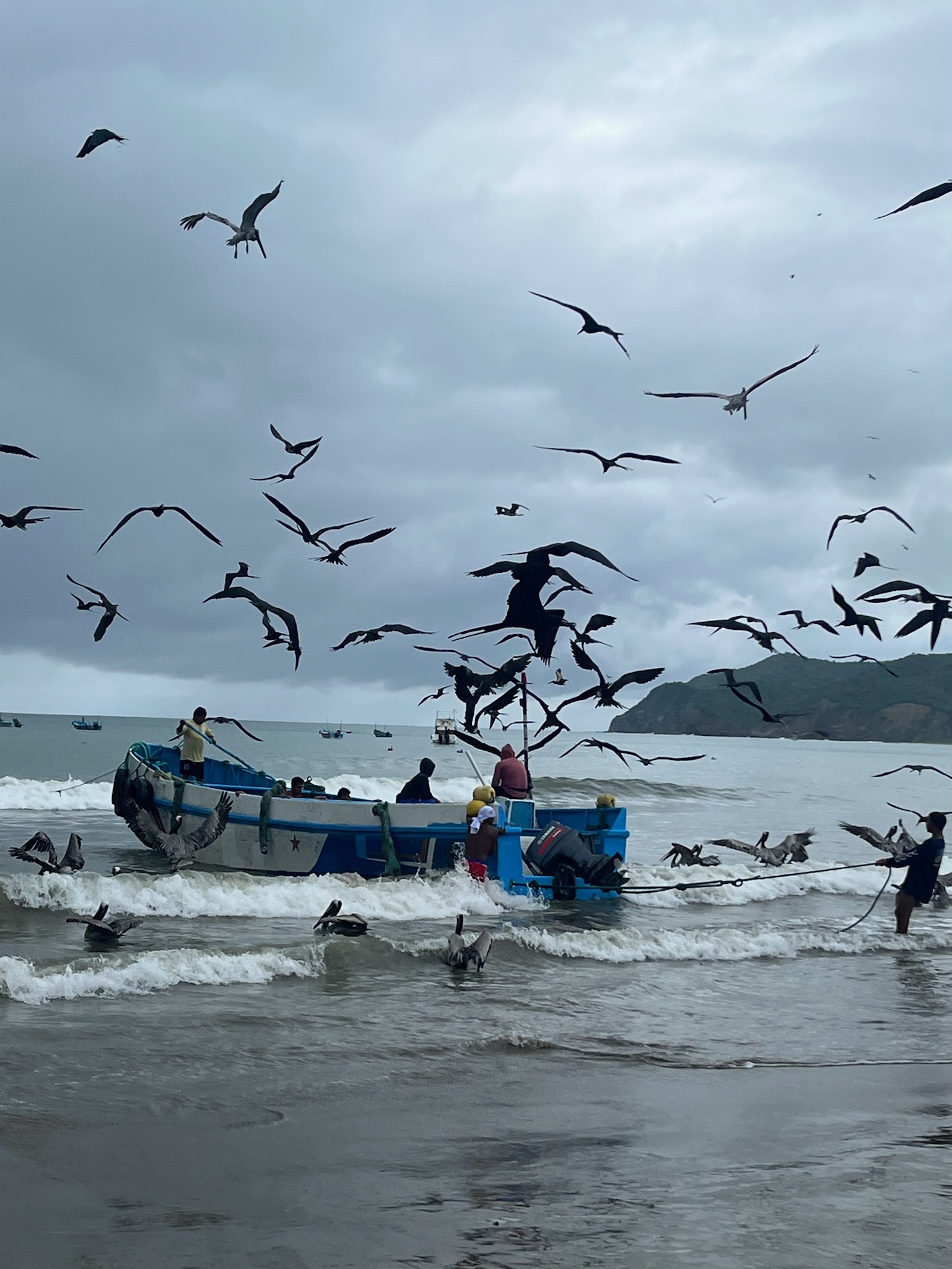
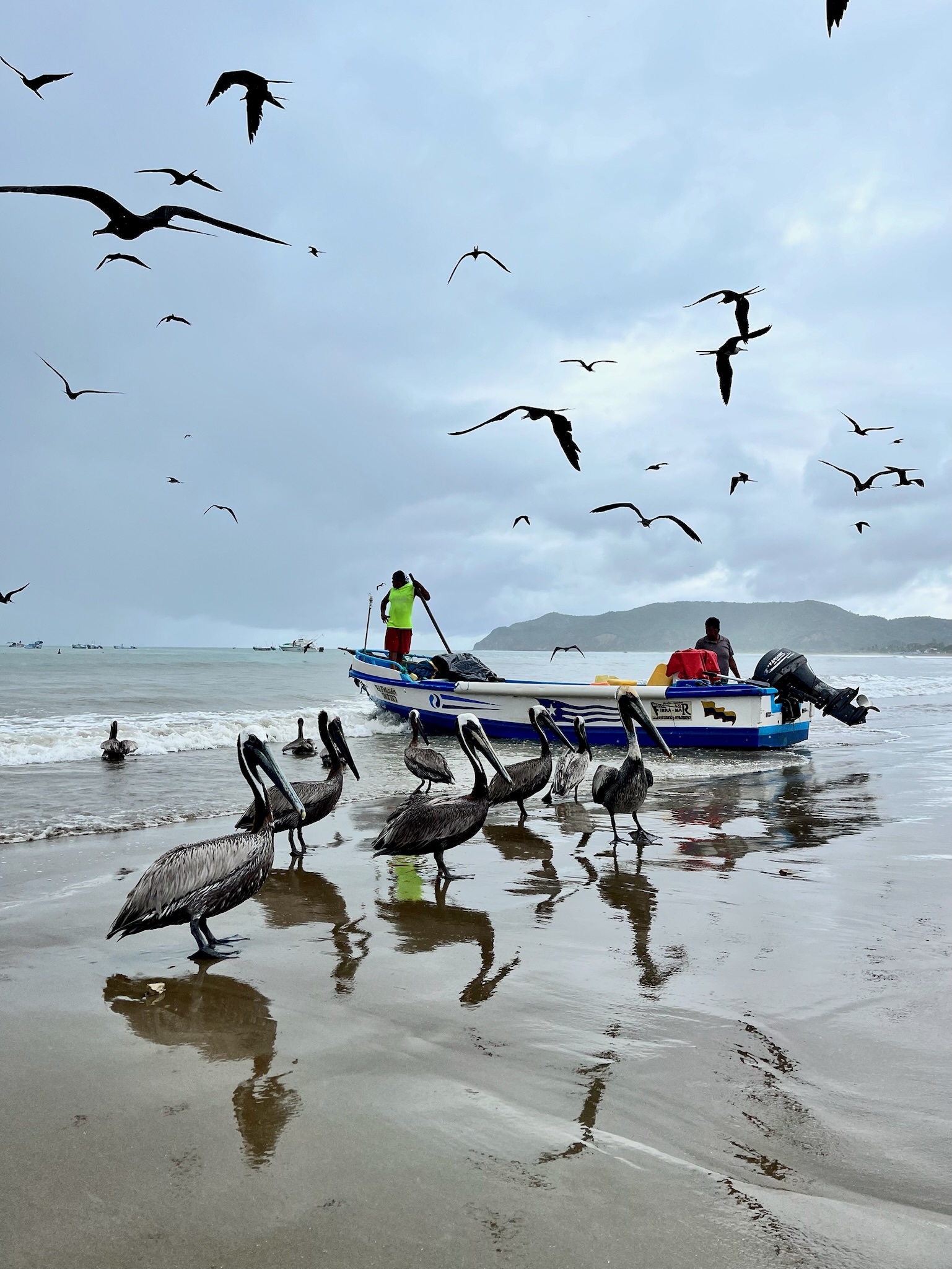
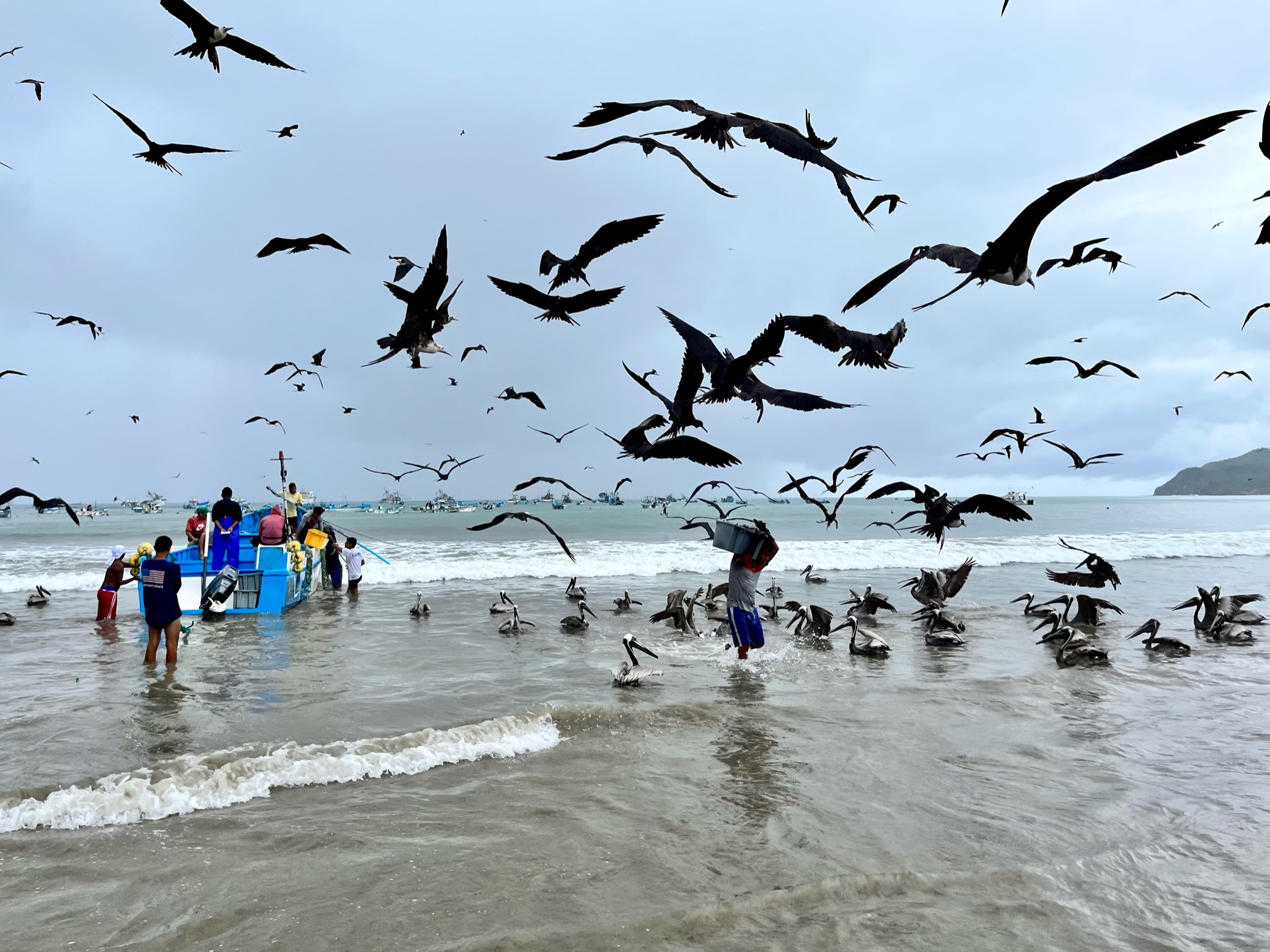
Puerto López is primarily a fishing village. So, I also highly recommend walking on the beach in the morning when the fishermen bring in their catch. The pelicans and frigates were INSANE. I’ve never seen a pelican that close-up before. Then the poor fishermen were constantly fighting off the birds trying to steal their fish!

There was also quite a large and busy patio de comidas (food court) directly on the beach that was only active in the morning. So, if you’re looking for a local experience, I’d recommend going there!

La Playa de los Frailes

This beach, located in Parque Nacional Machalilla, about 20 minutes north of Puerto López, is known as one of Ecuador’s most beautiful beaches. It’s a popular attraction in the area, so finding a taxi willing to take you is easy. You can also arrange a tour, which we did, and it essentially meant we had a dedicated taxi driver for the day.

Fun fact. We never actually saw Los Frailes beach… 🤦‍♀️

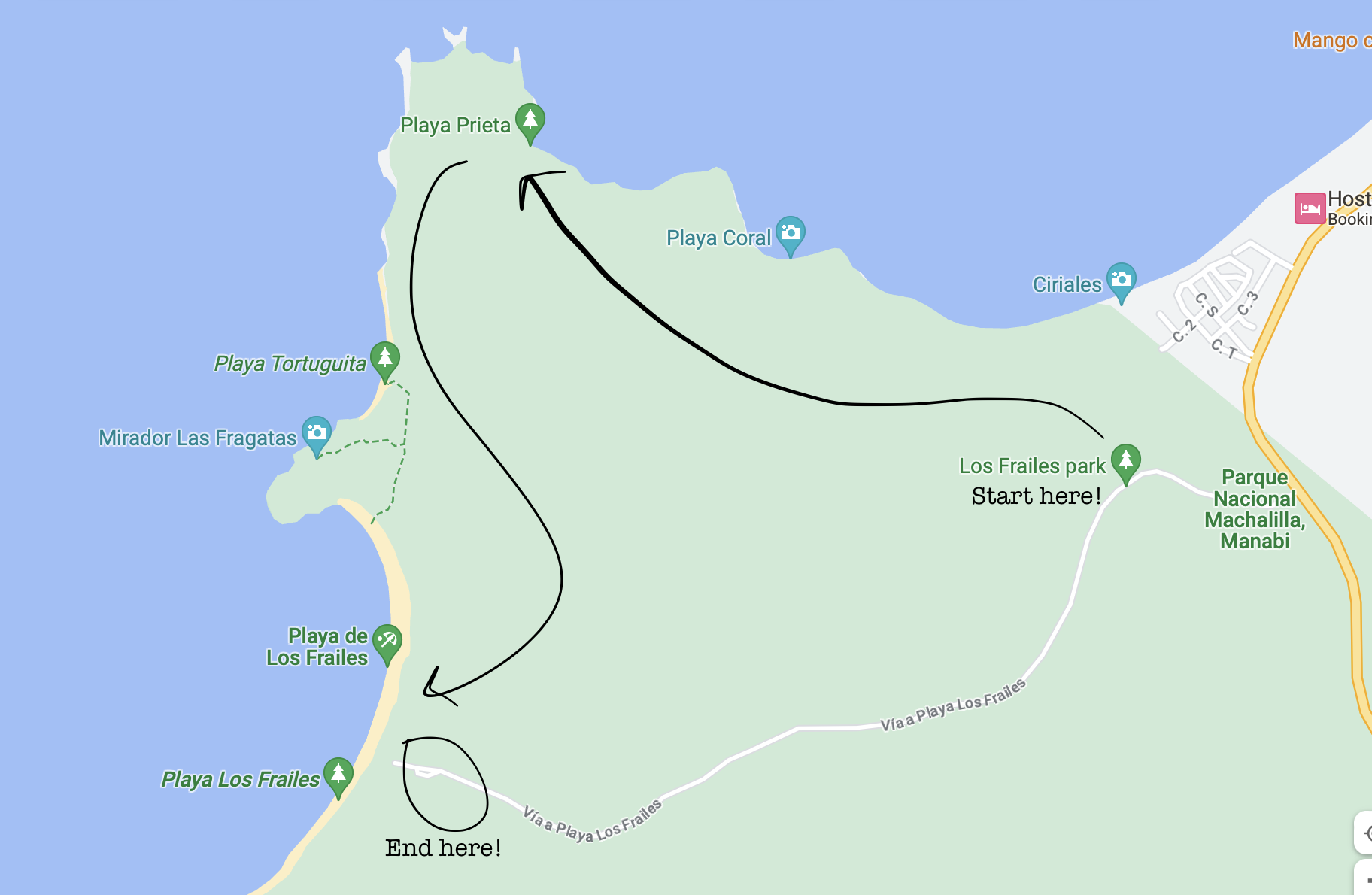
Ok, so hear me out. Take a look at this map. What’s your impression?

Do you also see an out-and-back trail?? Because that’s what we thought.

Public Service Announcement #1

It’s not an out-and-back trail. What this map doesn’t show you is the road leading to the parking lot at the end of the trail, where our driver was waiting for us.

Public Service Announcement #2

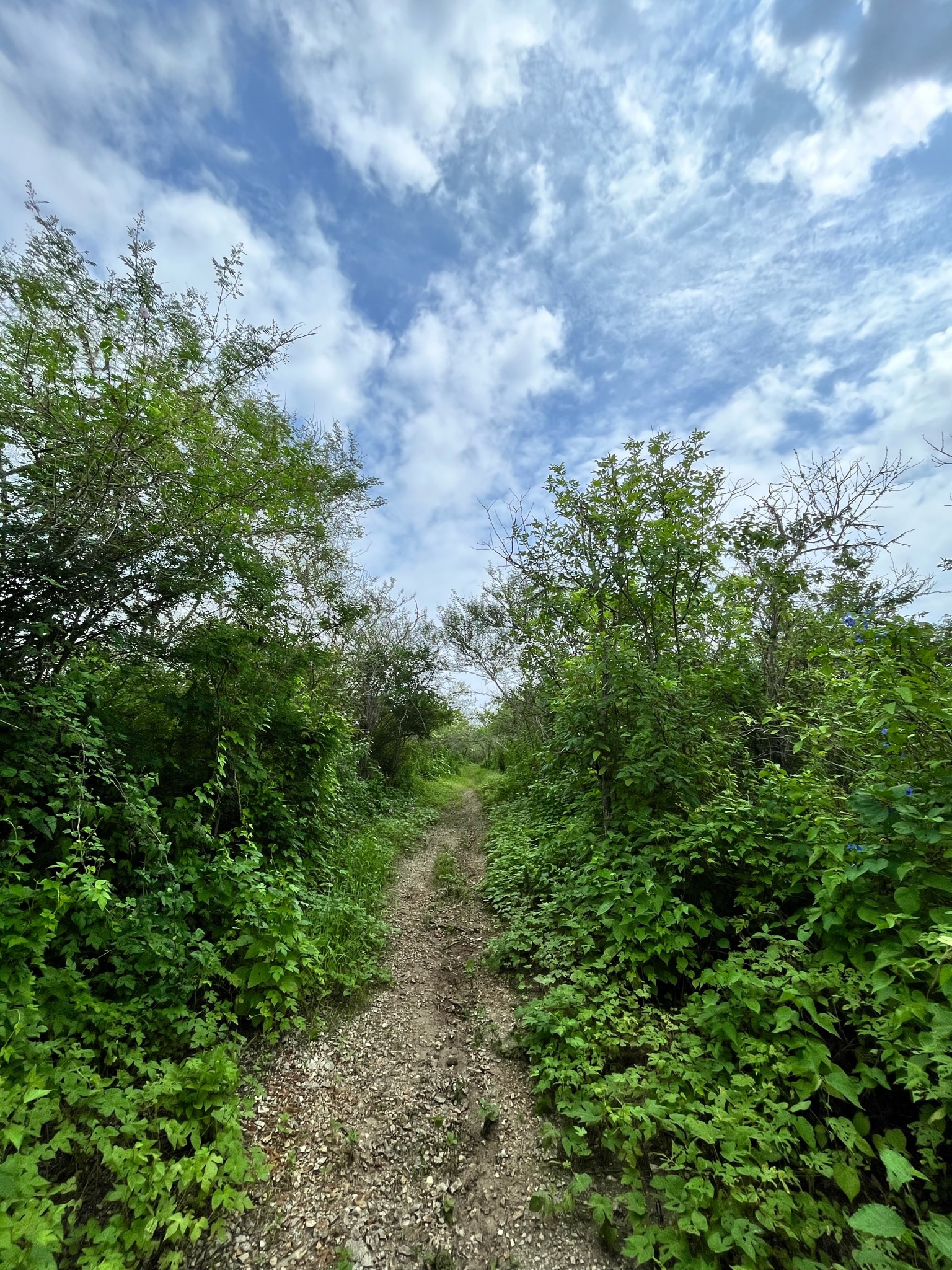
If you’re going to walk the trail and not take a taxi straight to Los Frailes beach, don’t wear sandals! It’s an easy to moderate hike, but the trail is uneven. It would have been much easier with closed-toe shoes…

So, what did we do? We walked for about an hour to Playa Prieta, the black sand beach at the halfway point (which was beautiful too, by the way). Then, since my mom had foot surgery 6 months earlier, we wore the wrong shoes, and we thought we had another two-hour walk back from the end of the trail, we turned around and walked back to the beginning.

And that, my friends, is how we missed the beach we came there to see!

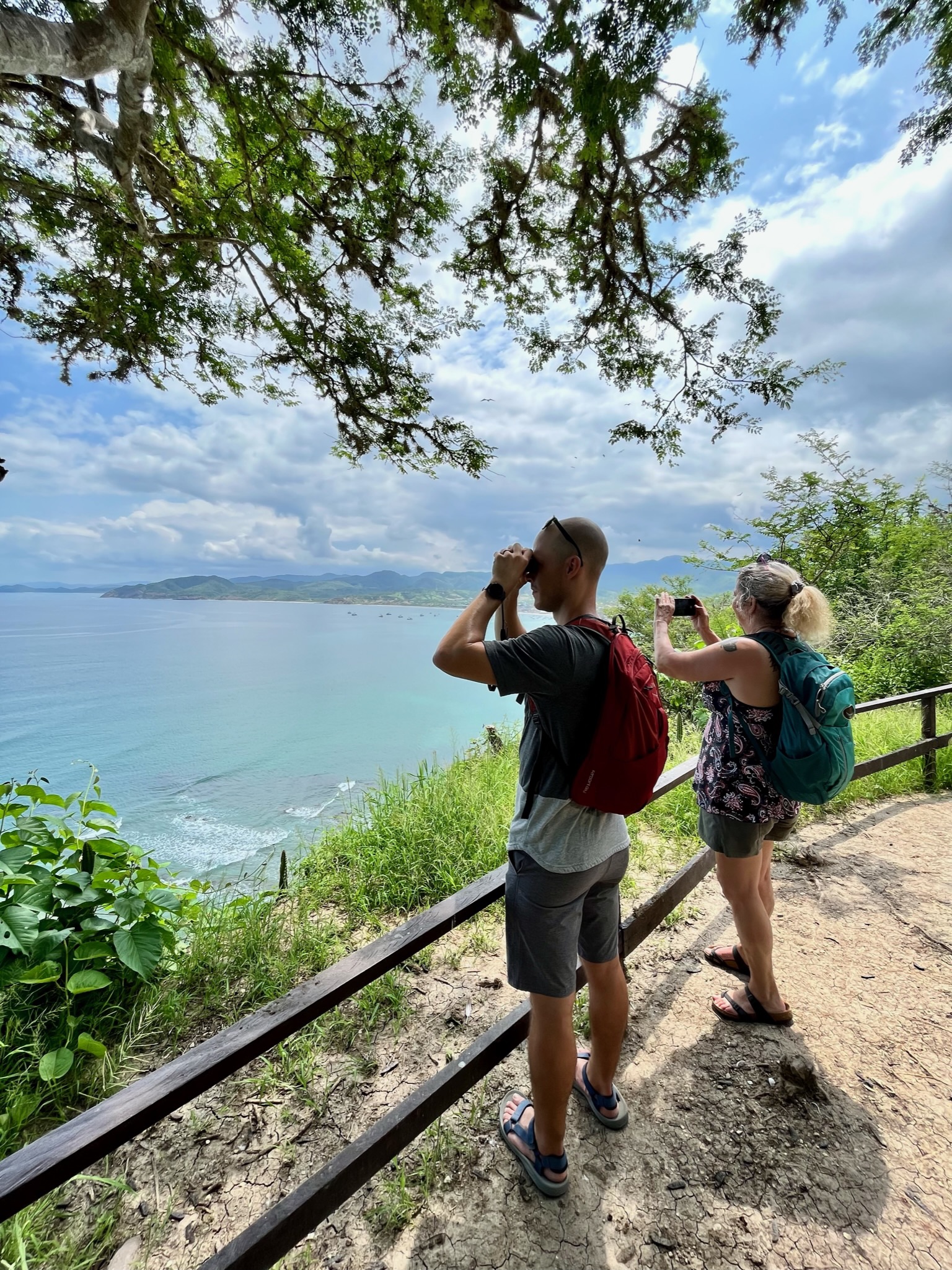
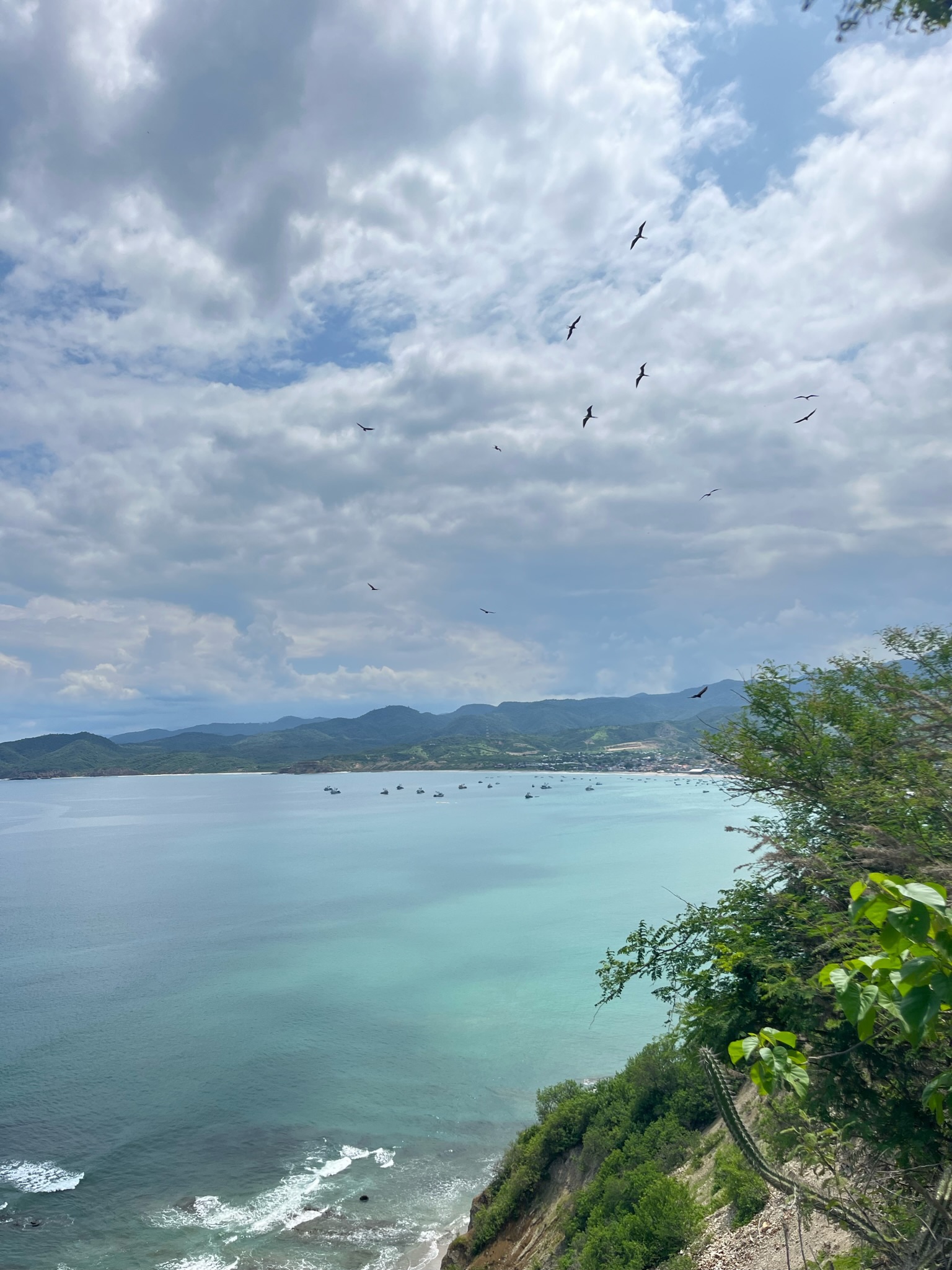
We did pass a really beautiful lookout and had the black sand beach to ourselves, though. So, it was still worth the trip!

Agua Blanca

Agua Blanca is a small community and archeological site in Machalilla National Park, the same one that houses Los Frailes Beach. For $5, you’ll be guided through a small museum (the tour is in Spanish only, but they speak slowly), taken to the nearby archeological site, then pointed in the direction of the sulfur lagoon ($1), which most people come for.

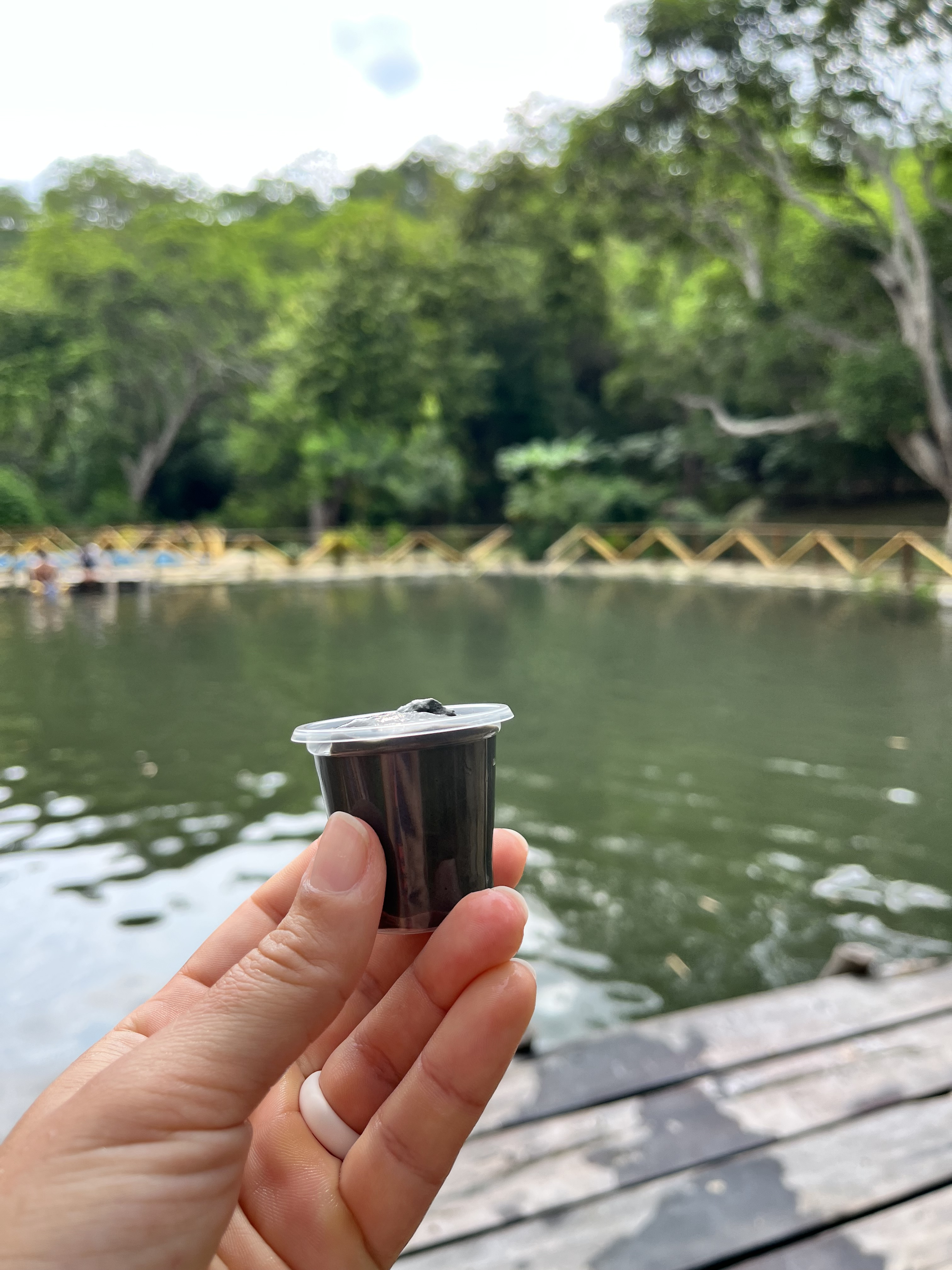
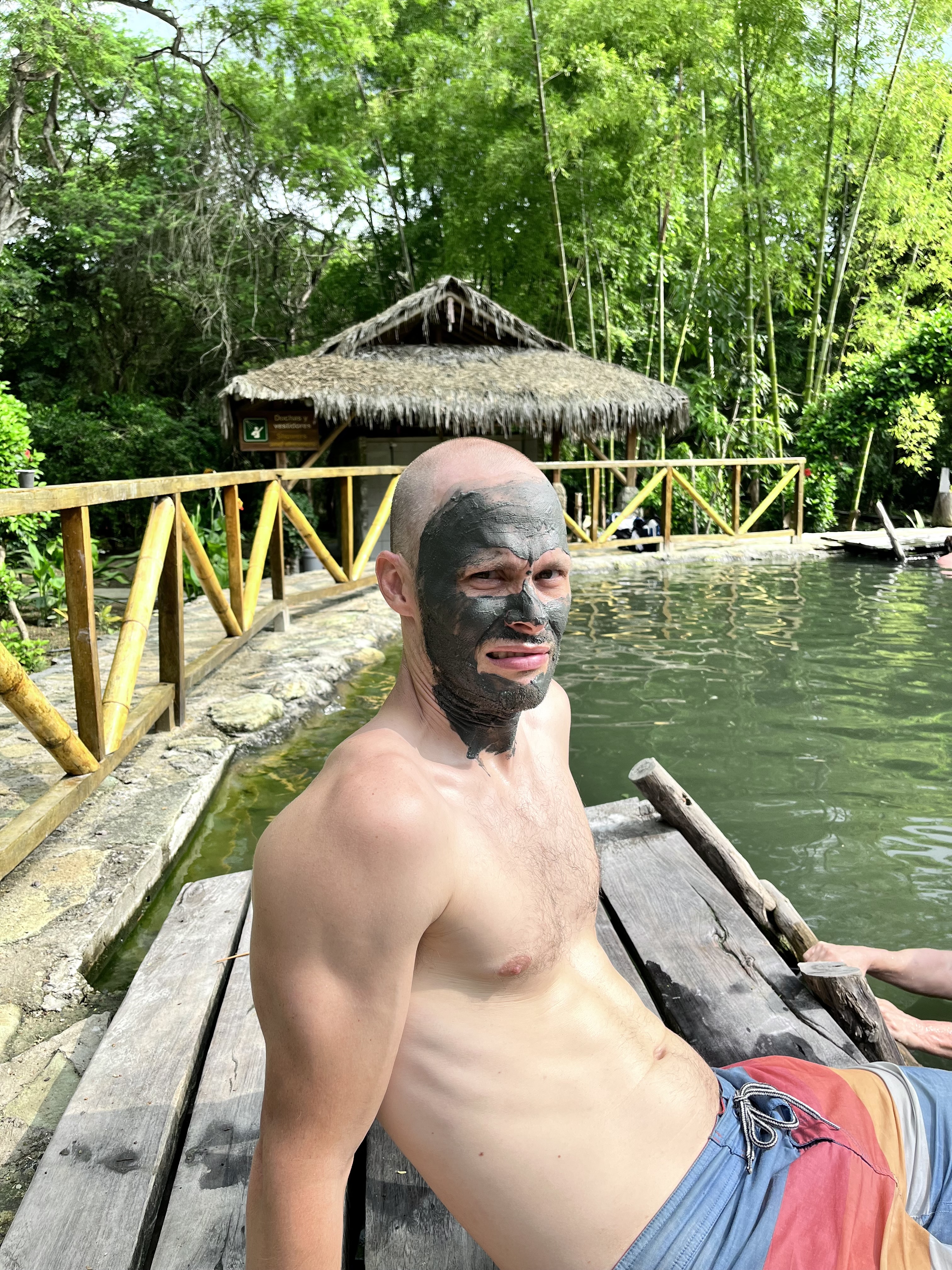
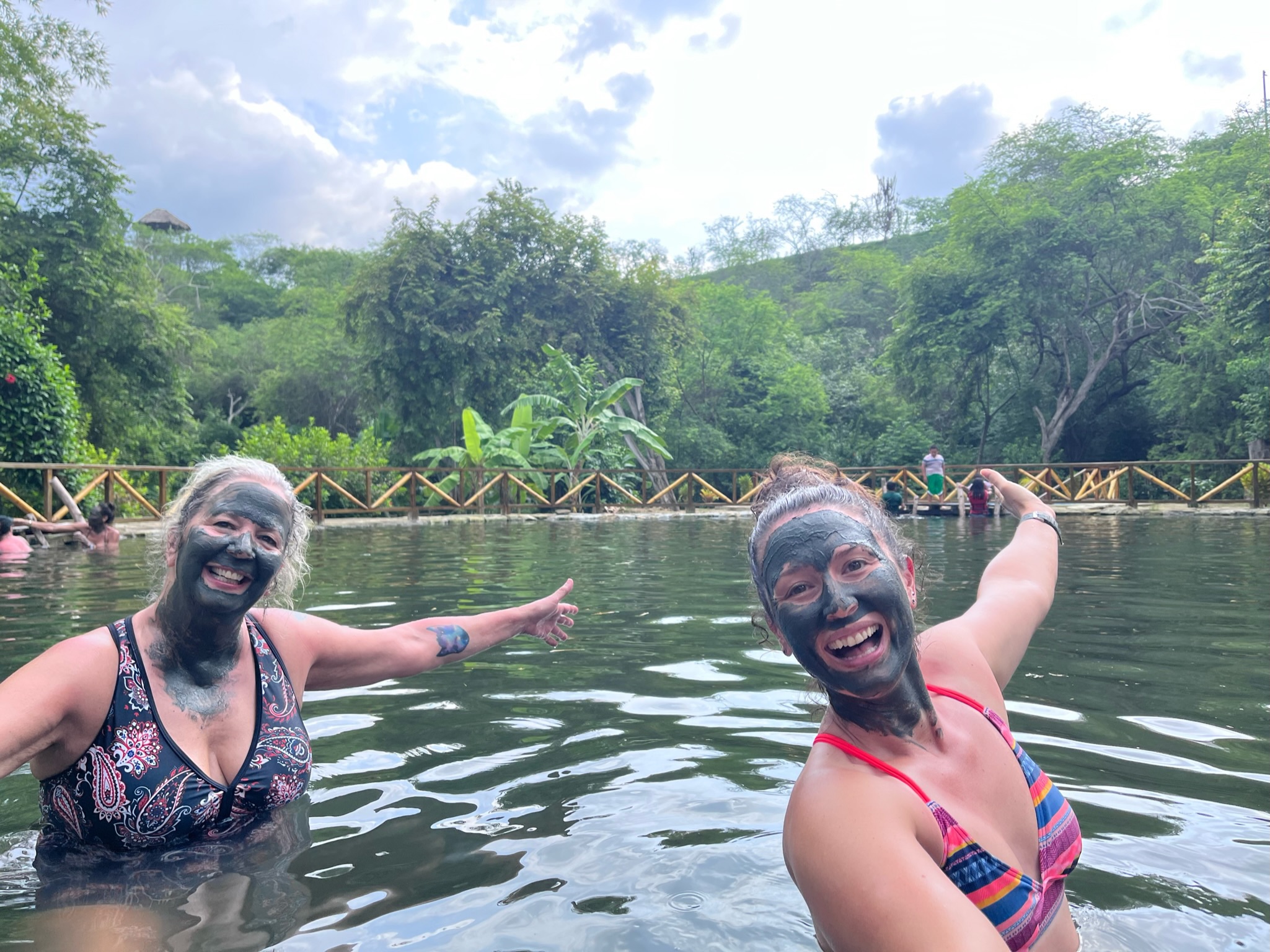
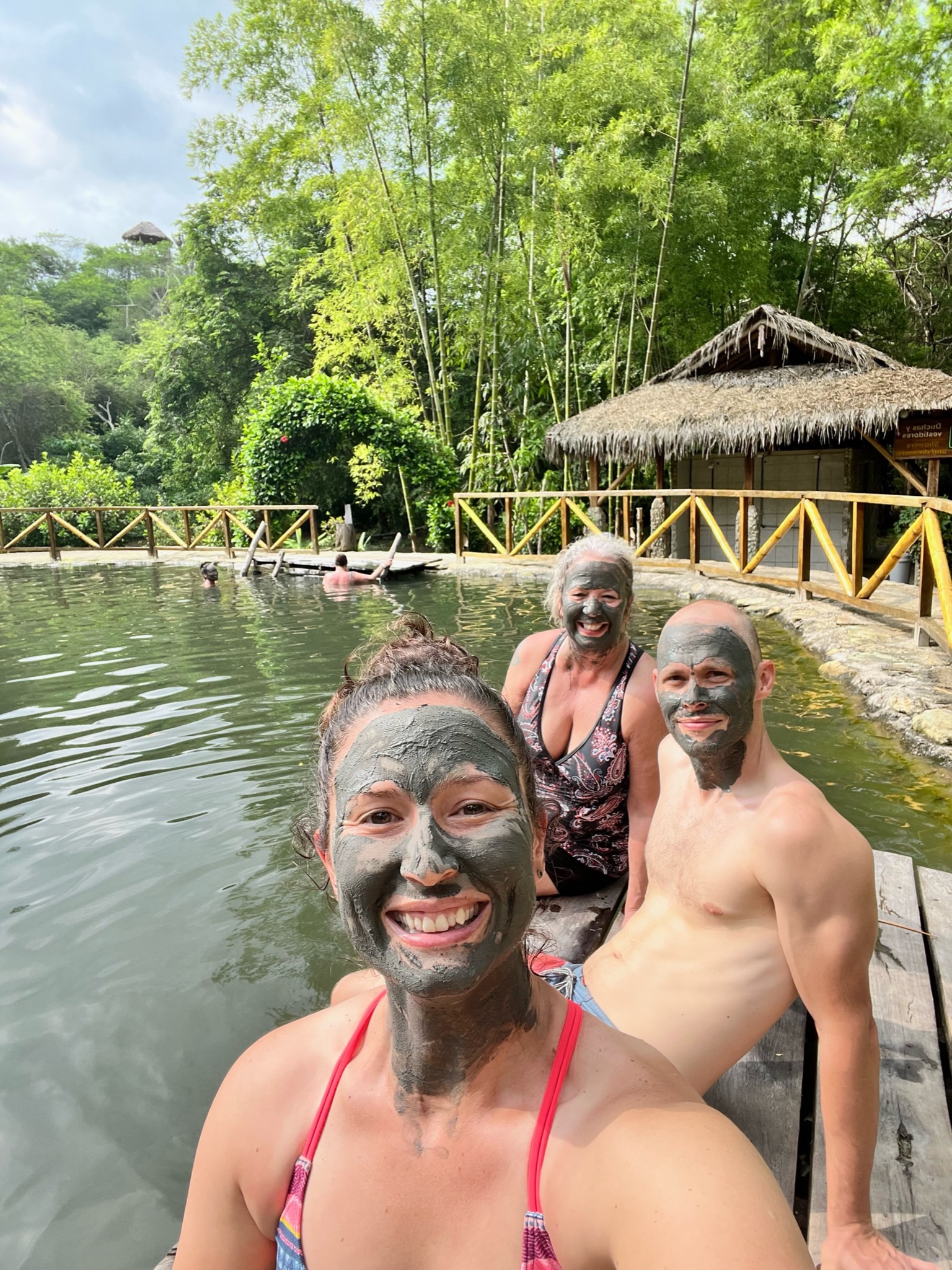
The lagoon at Agua Blanca smells. Bad. But all that sulfur and whatnot in the mud and water is supposed to be medicinal and make your skin all soft and young. And they give you a small cup of mud to rub all over yourself in the name of youth! So, I guess you win some, ya lose some?

Once Shane realized he was 100% absolutely not getting out of rubbing mud all over his face, he wasn’t pleased. He also never quite adjusted to the smell (he’s a super smeller, ya know 😆), so he might advise skipping the lagoon, but Mom and I had a great time!

What do you think? Do we look younger?!

La Isla de la Plata

Also known as the Poor Man’s Galapagos.

It’s beautiful and worthy of a post of its own. So, I’ll leave you with this picture until then!


Logistics

Getting there:

From Quito, I recommend flying to Manta and then taking a bus from the Terminal Terrestre (i.e., the main bus station, ~2 hours, ~$4 per person) to the Terminal Terreste in Puerto López. From there, you’ll need to take a tuk-tuk into the town (~5 min, $2). A taxi from the airport is also an option, though (~1.5 hours, ~$40). You could also opt for a bus from Quito, but you’re looking at at least 9 hours of travel time to Manta instead of 45 minutes.

Where to stay:

We stayed at the Victor Hugo Hotel, which was more expensive. However, the hotel was nice and in a quiet part of town walkable to the melacón. Plus, our sea view rooms were worth it!

Finding tours:

Do it once you get there! We arranged our tours through the hotel, but the tour companies are plentiful on the melacón. You can expect ~$20-25 per person for an all-day tour to Los Frailes and Agua Blanca and ~$40 per person for the Isla de la Plata tour.

Cheap eats:

Of course, you’ll find plenty of food and drink options on the melacón, but they’re expensive for Ecuador! For something more local, I recommend encebollado (the national dish, by the way!) at Encebollados de Rita, which was also a cab-driver-approved location. $3 will get you a bowl of encebollado and a drink.


Until next time, Puerto López!

Nos vemos,

Whitney

Anaconda Lodge in the Amazon Rainforest, Napo, Ecuador

For the past year, I’ve been taking Spanish classes online. The people in your class change from day to day, so typically, the teachers start by having everyone briefly introduce themselves. Where are you from? Where do you live? Why are you learning Spanish?

Consequently, one of the first phrases I learned was “Vivo en Tena, Ecuador. Es una ciudad pequeña rodeada de la selva!” Or, “I live in Tena, Ecuador. It’s a small city surrounded by the jungle.

This might seem silly, but it’s a fact that I often forget on a day-to-day basis since most days I am in the city. However, about an hour away from Tena on the banks of the Napo River is Anaconda Lodge, which quickly reminded me that we actually live in the Amazon basin!


We booked the 3 day/2 night package, which started with a ~20-minute boat ride down the Napo to the lodge, located on Anaconda Island (which doesn’t actually have anacondas, much to Sis’ disappointment). We met Francisco, one of the owners, at Punto Ahuano, quite literally where the road ends, and then off we went!

Day 1: The Chocolate Tour

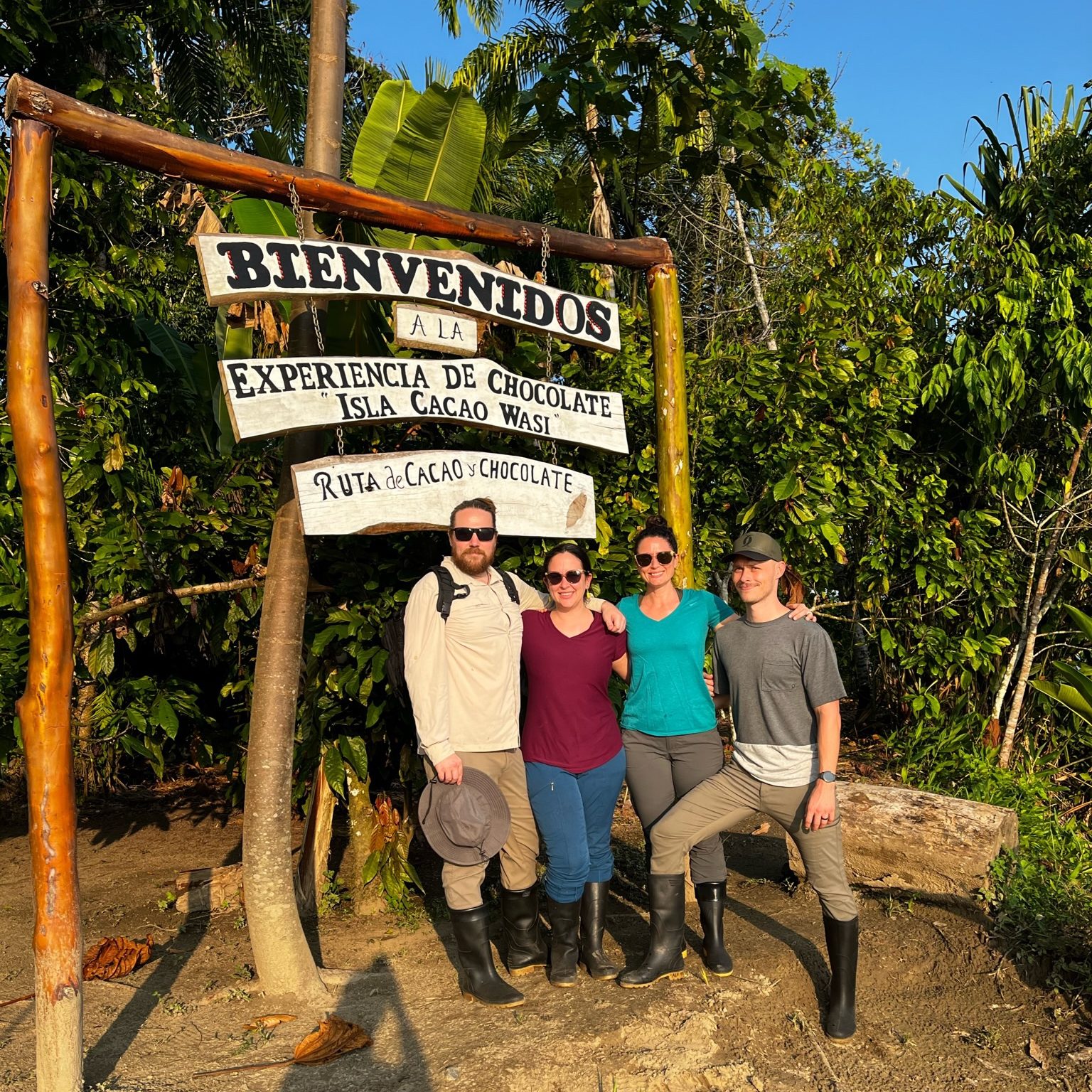
After settling into our room and having some lunch, we were off to our first activity. A quick boat ride up the river took us to la Isla Cacao Wasi, a small family-run cacao farm.

This is where things got interesting, and not for reasons you may think. Let me start by saying our guide, Fredy, was fantastic. He took us on 3 of our 4 guided adventures and really opened up with us by the end. We were all joking around with each other and having a great time! And he’s super knowledgeable about the area. The catch? He spoke Spanish the entire time!

Now, maybe you’re thinking… why is this special? You’re in Ecuador; of course, he spoke Spanish. Well, Sis and Terry don’t live here and aren’t actively learning Spanish, so, based on our arrangement with the lodge, we expected our tours to be in English. However, in an effort to be friendly and practice a little Spanish himself, Shane struck up a conversation in Spanish with Fredy, and the rest was history!

Shane and I became Spanish-to-English translators! 😳

This was actually quite a confidence boost. We were both a little shocked at how much we easily understood and could relay to Sis and Terry. It was nice to see that our learning efforts were actually paying off!

Anyway, back to the tour.

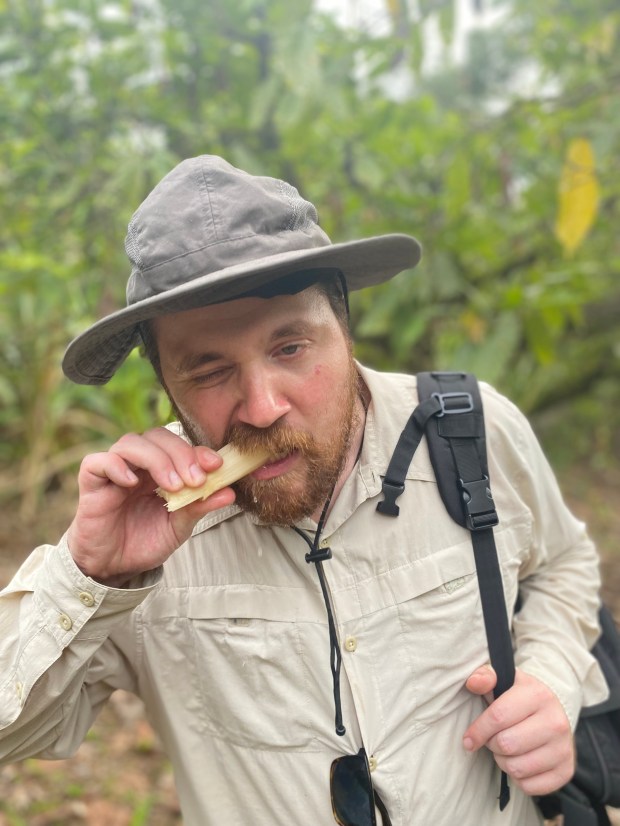
First, we did a short walk around the property. Fredy explained that many families living near the Napo grow primarily one crop to sell (it was cacao for this family), but they also grow smaller amounts of other things for personal use or secondary income, such as sugar cane, yuca, bananas, and guayusa, which is a regional tree, the leaves of which are used for tea.

Gettin’ some of that sweet sweet sugar cane!

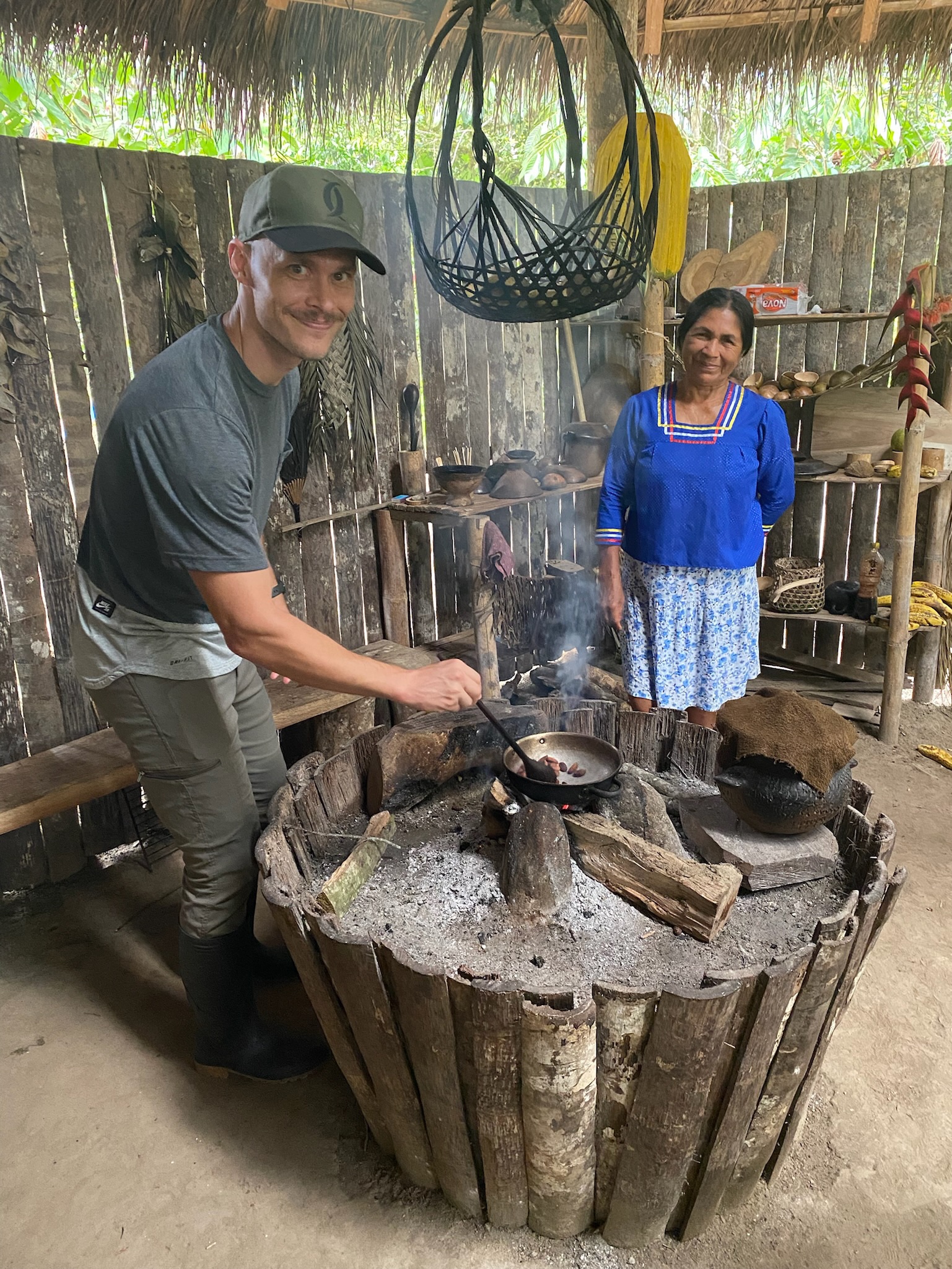
Next up was the important part, the cacao! This tour was similar to the one I took in Mindo, where they explained the entire process, from cacao to chocolate. The difference, however, was that this chocolate was made before our eyes over a small wood fire! Also, we actually participated in roasting, peeling, and grinding the cacao beans, then melting the cacao paste into chocolate. Once you have dried beans, the entire process (at least for our small batch) takes no time!

Roast those cacao beans, baby!

The best part? We got to eat it (served with guayusa tea)!

And finally, we got to THE most anticipated part of the afternoon… the blow dart! This thing is HARD to use.

First, I have no aim. This is nothing new. Second, despite having my contacts in, I couldn’t even see the stupid dart after shooting it. I was a lost cause. Luckily Sis was equally as bad (no offense, Sis). Shane and Terry both managed to hit the target*, though!

* “I hit the target on the first try, thank you!” –Shane

Day 2: Hiking, Tubing, and Caimans!

We had a packed day of activities planned for our one full day on Anaconda Island. First up was a hike through the primary forest, a short boat ride away with a mirador (viewpoint) of the river and Anaconda Island.

You might not realize it, but the Amazon basin is not flat. I mean sure, it’s flat compared to the Andes mountains to the west of us, but when you’re walking through the woods, you notice the uphill! Not to mention, it’s hot and humid in the rainforest, which means we were all sweating through our shirts after about 20 minutes… and through our faceprint, for Sis and me.

Ecuador has a large indigenous community, including the Kichwa people, which is an umbrella term for those who speak Kichwa (sometimes spelled Quichua), which evolved from Quechua spoken in other places like Peru. Quechua, as we learned on this trip, was spoken by the Incas, and the language was created to unify the various tribes under Incan rule.

Eventually, the Spaniards arrived in Ecuador and made their way east to cities on the edge of the Amazon, enslaving the indigenous people. Those who escaped fled to the banks of the Napo river and other areas of the Amazon basin and established the Kichwa communities we know today.

Oh, and a little geography lesson: the Napo River feeds into THE Amazon River in Peru, which eventually makes its way to Brazil. So, this river is a big deal.

All of this to say, some of the Amazonian Kichwa paint their faces for various occasions with achiote seed pods, which make a beautiful natural red/orange paint!

We didn’t see any crazy animals on our hike, but Fredy did point out various trees and their uses, for example, the tree used to make the blow gun and the Chonta palm tree, where chontacuro (the grub I made Sis try) live. We also saw a dead tarantula (RIP) and leaf cutter ants and TASTED these tiny little ants that live inside a specific type of tree. They tasted like lemon. It was wild!

Oh, and any guesses on the best natural bug repellant?

Termites. 😳

Break off a chunk of their nest, let them crawl on you, then quickly rub them up and down your arms (smooshing them in the process). Surprisingly, it doesn’t smell bad… a bit musky, but not bad. And, indeed, we repelled bugs! Just gotta get over that creepy crawly first bit…

Getting that all natural bug repellent.

We were hot and ready to relax after the hike. So, a lazy-river tube down the Arajuno river, on the other side of the island, was next on the agenda.

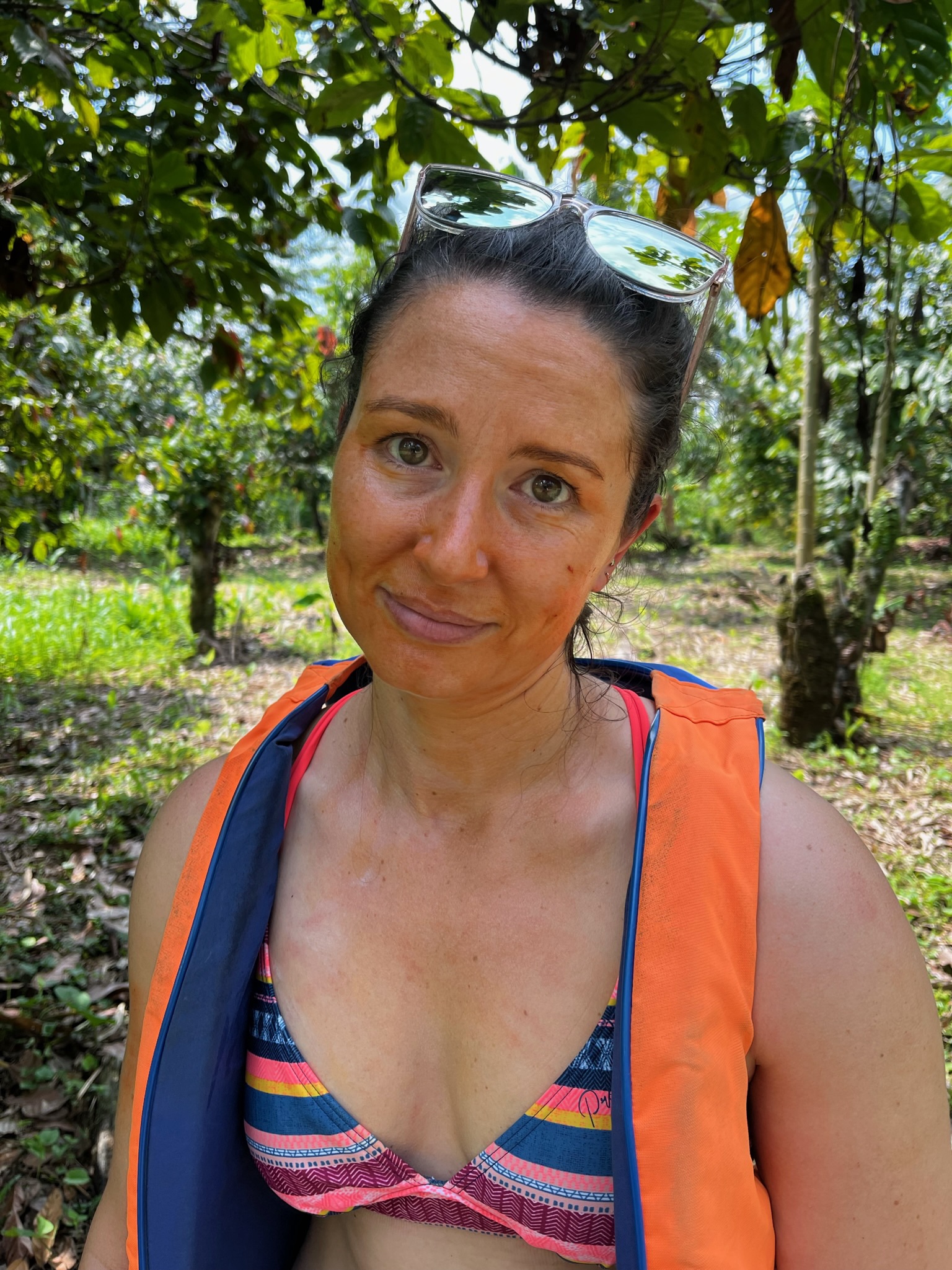
Our phones were in the boat for this one, so there were no pictures. Except, remember how Sis and I had our faces painted? Well, in case you were wondering, sunscreen took it right off. I completely forgot about the face paint and turned myself into an Oompa Loompa. Yay for natural products! 😂

I’m nearly the same color as my life vest. 🤦‍♀️

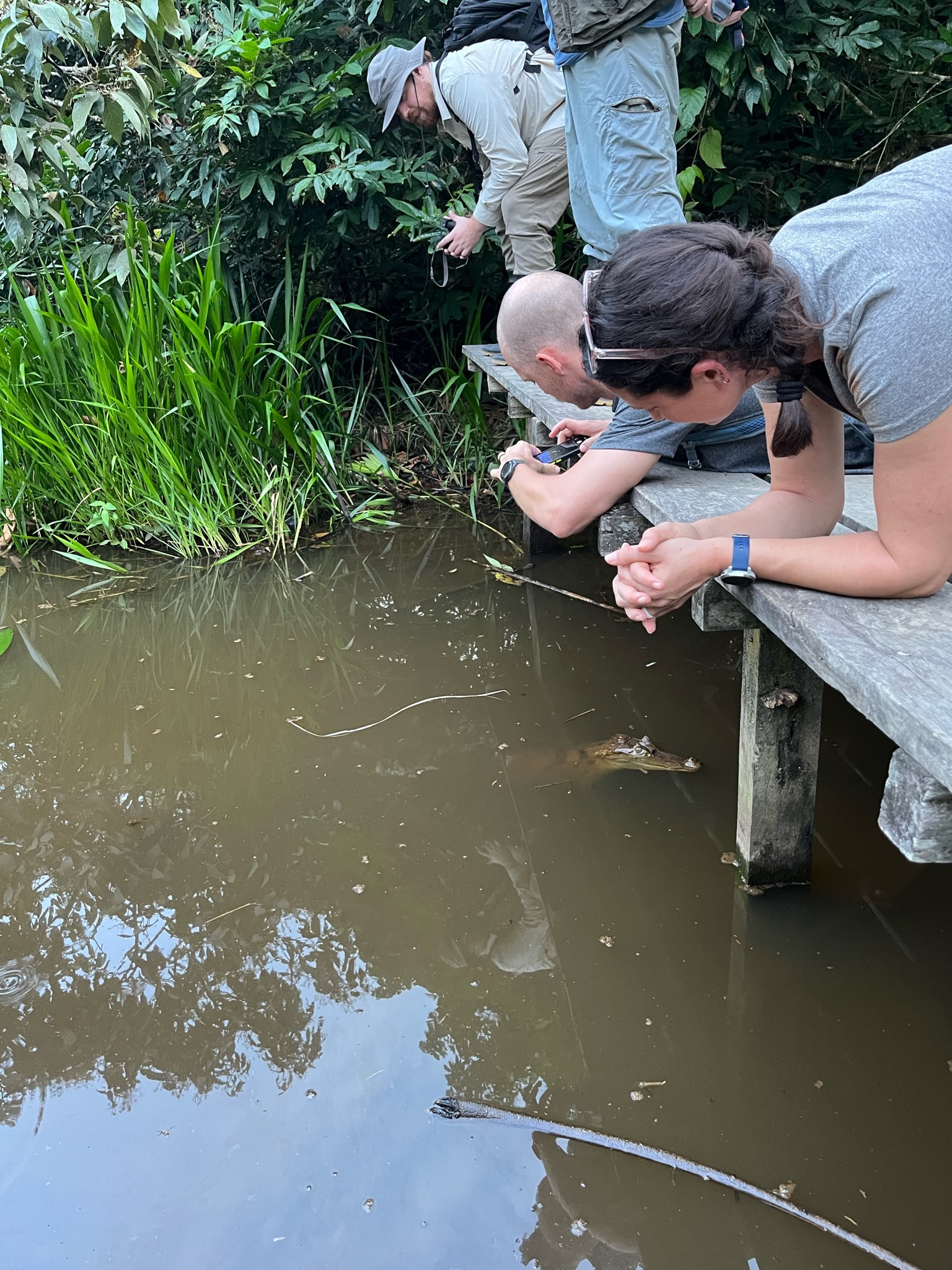
After lunch, our next activity was a walk to the Caiman Lagoon on Anaconda Island with Francisco, one of the owners. There are two types of Caiman in this protected lagoon. Which kinds, you ask? I’ll have to refer you to Francisco for that because I don’t remember.

What I do remember is how beautiful this lagoon was and how cool it was just to hang out and watch them lingering in the water!

Our final walk of the day was after dinner at night. In the dark, the forest is completely different. I’m sure there were many creatures we didn’t notice, but what was abundantly clear were the swaths of ants that emerged! Small ants, medium-sized ants, BULLET ANTS. Yep, the ones with one of the most painful stings. And there was a legitimate 500 meter (at least!) ant highway, which we named Ant Avenue (obviously, cause You gotta walk on through the Ant Avenue!… please tell me you sang that).

Bullet ants. Please notice the tiny dots next to the big ants… those are regular sized-ants.

And that about sums up our time at Anaconda Lodge! I would be remiss to not mentioned is how delicious the food was and how Francisco and his wife and co-owner, Silvia, work closely with the community to provide support and protect the land. Both of these really made the our experience there feel extra-special.

So, if you’re looking for a little taste of the jungle, I highly recommend spending a few days at Anaconda Lodge!

Nos Vemos,

Whitney

Rafting in Tena, Ecuador, with Raft Amazonia

We’re switching it up, folks!

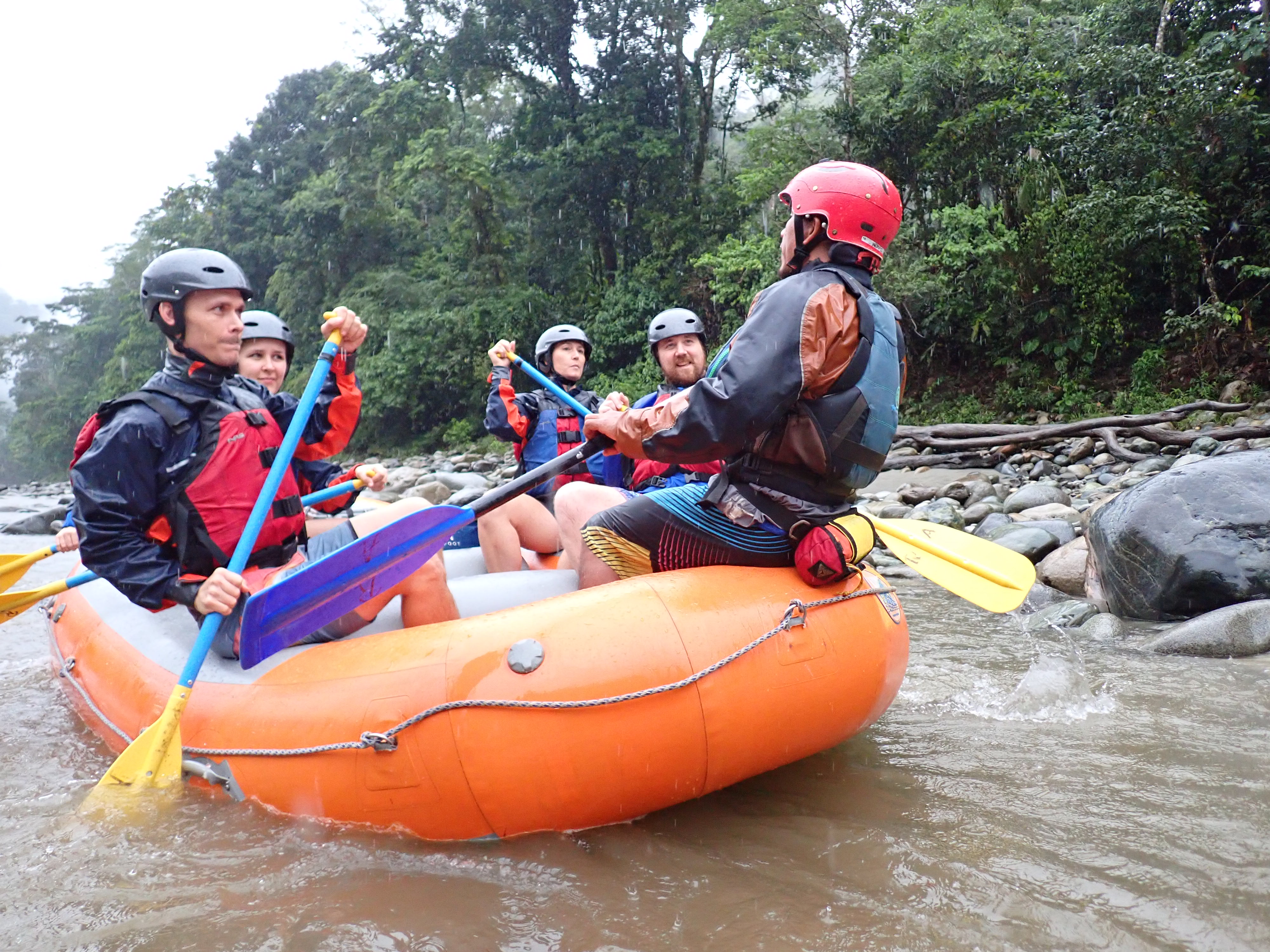
When Sis and Terry were here, we went rafting with Raft Amazonia, a Kichwa-run rafting company in Tena. We had THE BEST TIME! However, in this case, I don’t think my words can do it justice. On the other hand, Terry’s a storyteller; his words make you feel our experience.

So, with that, I’m handing it over to him.

Oh, and to avoid confusion, my sister (Kelsey) and I call each other Sis. So, the “Sis” in this story is me (Whitney).


January 2, 2023 – 5:15 am

It’s dark outside, the sound of heavy rain pounding in the courtyard and the roll of the thunder. A humming fan blows warm air onto the bed; the excitement of the adventure ahead looms, and it is hard to sleep. We finally gear up around 7:00 am and head outside to meet the guides at the office. Shane and I ran to the ATM, and in true traveler fashion, my card would not pull out any cash. Shane came to the rescue, and we rallied with Sis and Kels. We whistled down a cab to avoid a walk in the heavy rain, finally making it to the rafting office. Confirming the trip was still on, we knew it would be fun if they were going out in this weather.

We were going to conquer the Jatunyacu and Napo Rivers in the heart of the Amazon Jungle by white water raft!

Thirty minutes in a van brought us to our put-in spot, and we got to know our newest teammate, Molly, a Peace Corp Ranger on assignment in Tena. She was to be on the right side with Kels in the middle and Shane at the bow. Gregory, our local guide, gave us a brief lesson on the river and how to operate as a team. He commanded the helm on the left side, with Sis in the middle and I at the bow. Hush conversations of how crazy it was we were going to whitewater raft the Jatunyacu in this downpour. The company does not simply stop for weather such as this.

This is the Amazon Rainforest.

Practice before we begin.

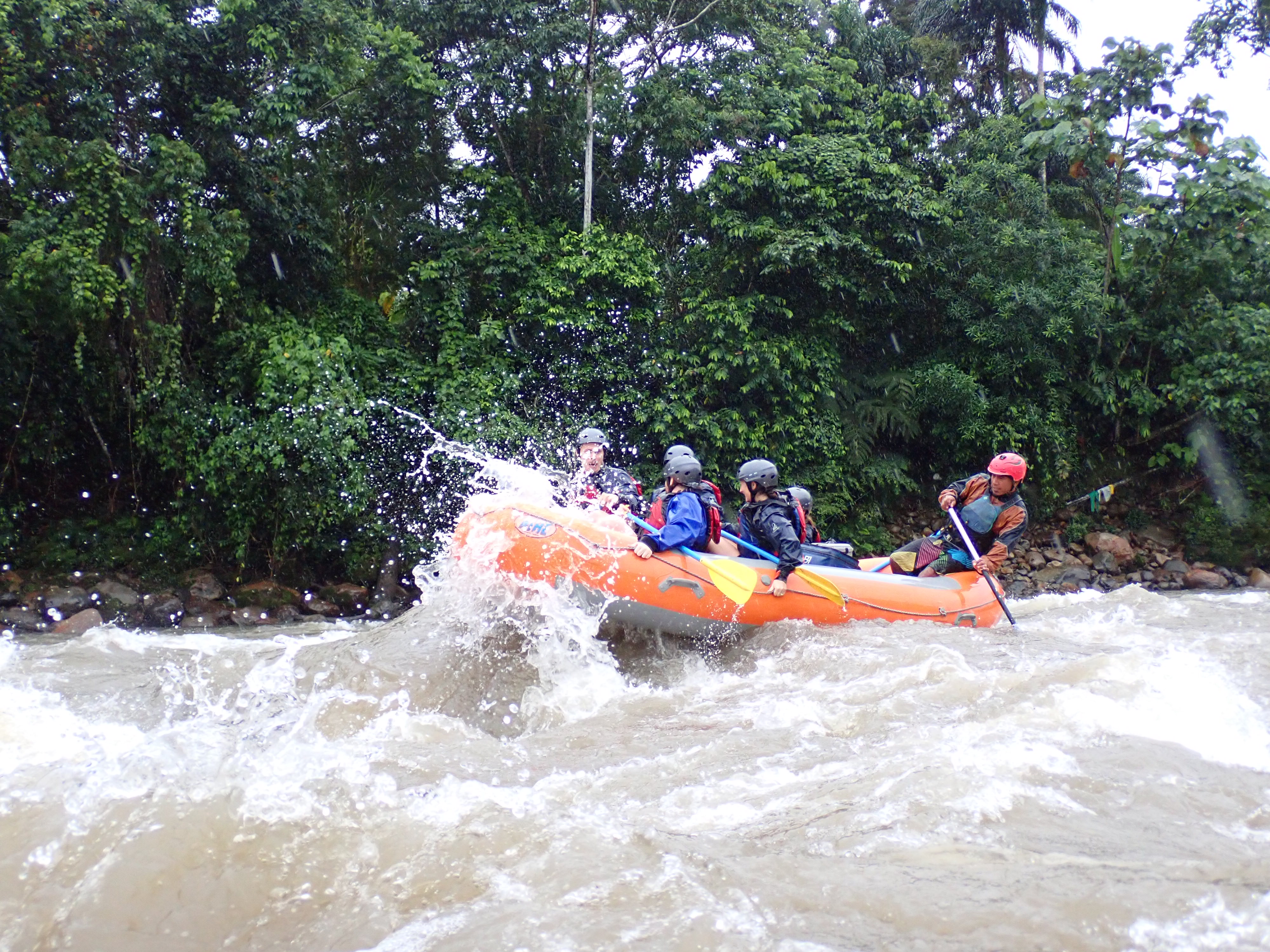
We geared up, loaded in, and responded to the commands as we began to pick up speed. Within two minutes, the river had picked up, and we were in it. We rammed straight into a giant boulder; Gregory commanded, “Inside!” We obliged by quickly throwing ourselves inside the boat instead of sitting on the side. The boat spun, and the command, forward, was issued. Quick glances assured one another that we were all surprised at what was in store for us ahead. The river beckoned our challenge and pulled us into a giant wave faster than expected. Engulfing the boat, I was knocked into the row behind and scrambled back into position with the aid of Sis. Shane managed to block most of the Jatunyacu with his face and chest. The sheer force was enough to shake you to your core, but the look on his face was what shook me. Almost concern washed across his face; we shared a moment of understanding. The Jatunyacu was not to be taken lightly; she has forged valleys and mountains, fed many, and created life.

Our first set of rapids.

The battle proceeded as it relentlessly rained, and the river gave us just as much as we could handle. It was us versus the Jatunyacu: the two power couples, Peace Corp Molly, and our fearless captain, Gregory. We were a force rarely seen by the Jatunyacu, and we begged her to give us everything she had. Rain fell, and the current ran us into rocks spinning us in and out, wave after wave.

Eventually, we stopped for lunch at a local Kichwa village. We were happy to buy some locally handcrafted items from the people of the river. Their ancestors have lived with this river for over 500 years.

We refueled with tuna burritos, Oreos, and Doritos, then hit the river for the second leg of our journey.

We fought valiantly! As the bow slammed into boulders, meeting massive waves cresting the boat, Kelsey was sure we were sinking there for a second! The current pulled us away, and the river roared.
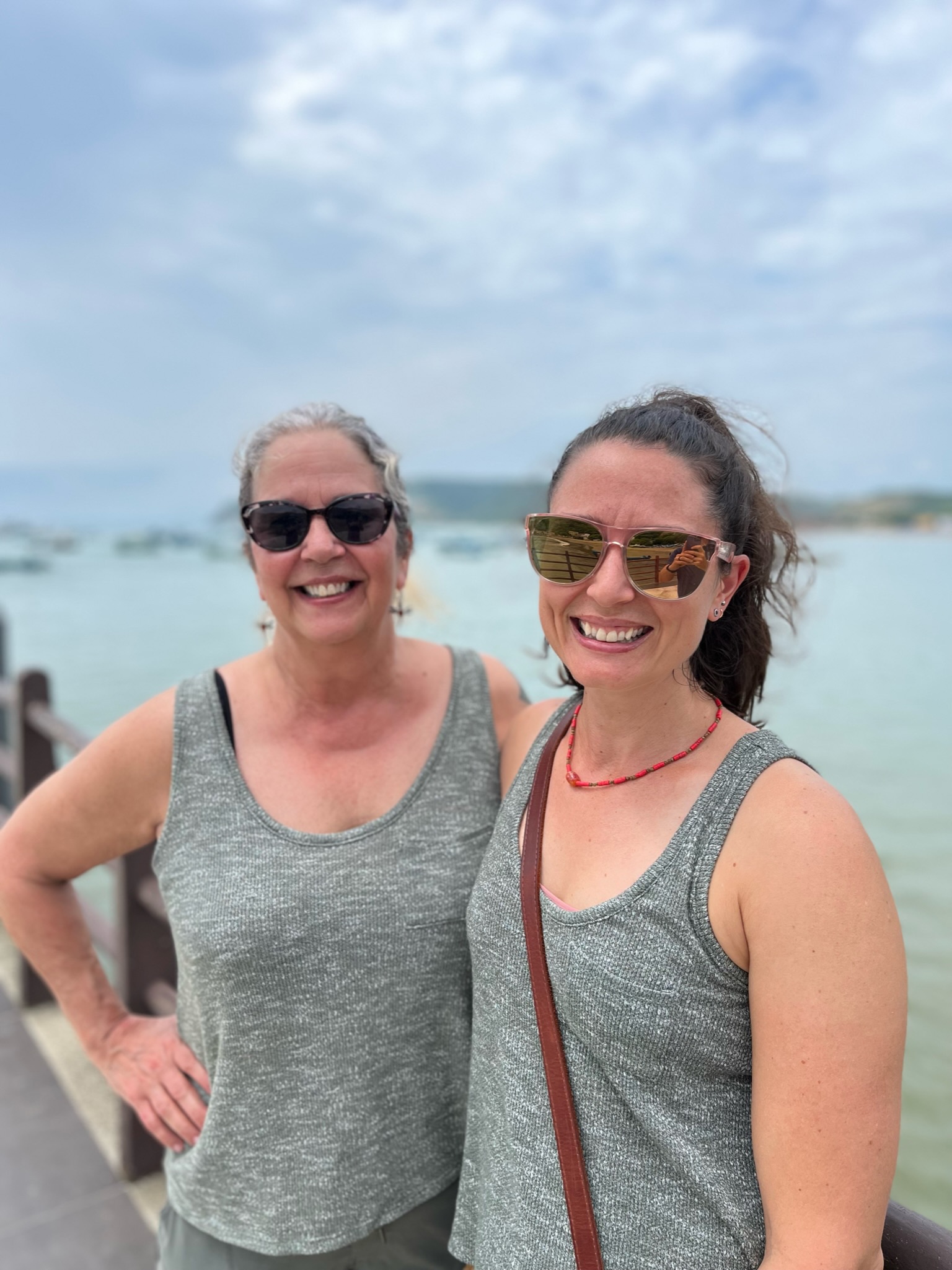
“Forward!!!”

The command echoed through our ears as the battle slowly began to subside. The Jatunyacu had given us everything we asked of her and then some. We met her every step of the way with a fierce will to conquer this beautiful river. 

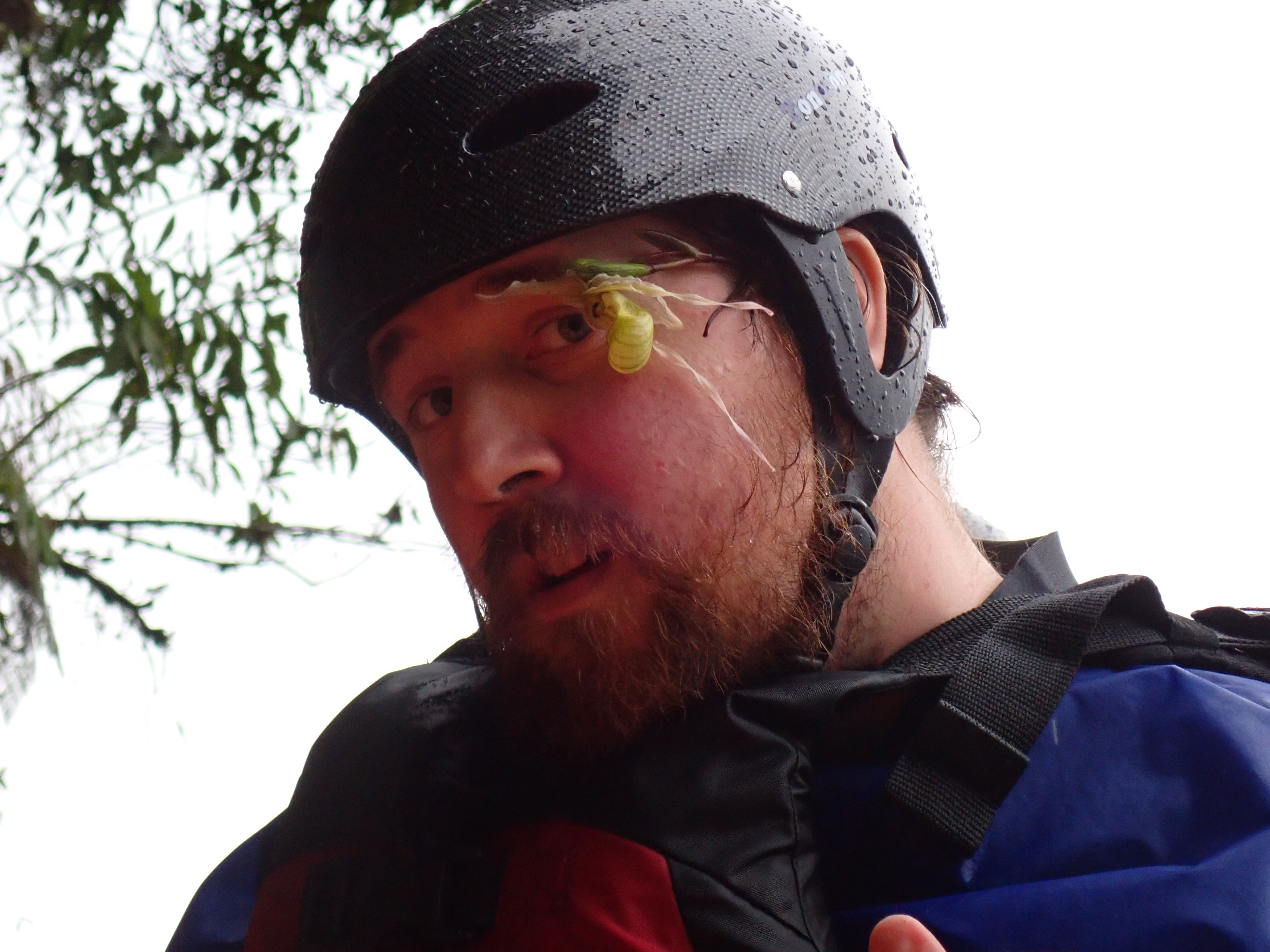
A calming float showed the beautiful life found on the river. The Jatunyacu carried us to beautiful waterfalls, breathtaking views of its landscape, and all the wonderful vegetation it is home to. She showed us the beautiful orchids that resided across the giant cliff faces carved by the life of the Jatunyacu. There was beautiful wildlife, with species of birds and even a few insects that didn’t stop for the rain either. We saw caves, crevasses, and cutouts under the cliffs; we were being shown the true beauty of Rio Jatunyacu. There were incredible sights, vast forests, and a true glimpse of the life she provides for so many. She also showed us her scars. Countless riverbanks are plagued by illegal gold mining operations. The rich soils of the Jatunyacu River are being stripped, altering the water flow and damaging the ecosystem that has adapted to its environment over thousands of years. Piles of debris from the “in-and-out” operations are left stretching hundreds of meters long. It showed the reckless nature of so many of us as we wage war with nature. 

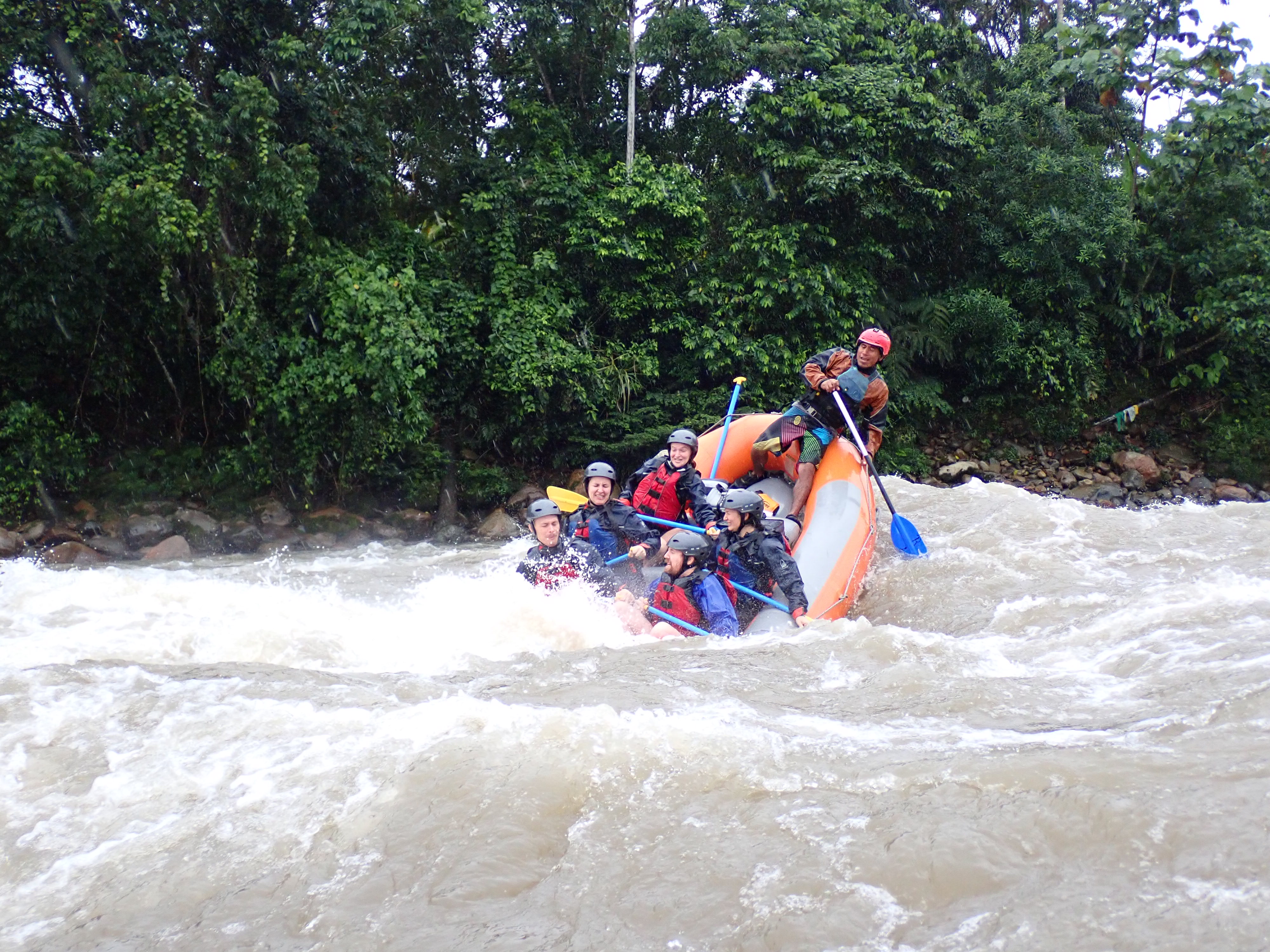
We began our final stretch, transitioning from the Jatunyacu to the Napo River, which started to pick back up. We had just spoken about how tame the river had become, and we must be close to the end. Conversations about how we made it and had won were quickly silenced by Gregory’s fierce “Forward!” command. Looking ahead, we stared directly into the mouth of the Napo herself. “Forward! Forward, team!” Gregory demanded from the helm. The river raged and refused our conquest. Crashing down the rapids, our boat crested a wave, and staring above us was the biggest wave of the day. The Napo opened up a couple feet above our heads and welcomed us to experience a mere taste of her power. The boat was pulled backward, then a powerful wave engulfed the bow and threw us overboard.

Flipping over the right side, Gregory, Sis, and I took a dive while Kels, Shane, and Molly were dunked under the boat. Each of us began our own battle. The current held me down as I pushed to the surface. After breaching the surface and taking in my first breath of air, I took a quick scan to locate the group, who looked slightly disconcerted. I had just enough time to take a breath before being slammed by another wave. The current pulled me down, denying my kicks to the surface. Finally, I crested, and, to my surprise, I was right beside Kelsey. She was feet-downriver (as instructed) after fighting off her own waves. We drifted towards our accompanying kayak guide while Gregory climbed on top of the boat, attempting to flip it back upright. Shane was underneath the boat, trying to stay afloat, managing to get out only to run into the river bank.

On top of that, I watched my croc float away and realized I wasn’t even wearing the other one; it’s a vision that will not be soon forgotten. But, Sis had made her peace with the Napo, quickly positioning herself to dare the bravest rescue of all… the croc. Meanwhile, Gregory flipped the boat and began to haul us in one by one. Finally, after getting situated and accidentally knocking a few folks down along the way, we were all together. I looked around and exclaimed, “my crocs are gone!” I had had them for many years, and they were just… gone. “They’re both there,” said a voice from behind. Sis looked at me and pointed to the floor of the boat. I looked down to find ol’ leftie wedged into the foothold and righty floating in the middle. Apparently, Sis had saved the right one as it floated down the river. A daring and selfless act, the truest characteristics of a hero!

And Molly? She was just cruising and laughing at the mayhem she was witnessing.

It was a hard-fought battle that I now understand why we lost. The Amazon is wild and free; we must respect her force or we must face the consequences. We enjoyed some well-deserved ice cream with cheese, a nice hot shower, and the best burgers Tena has to offer.

It was a life-changing day that I will cherish forever.

– Terry


Hasta luego,

Whitney

Our First Visitors in Tena, Ecuador!

Finally!

This trip was a long time coming. Sis and Terry were supposed to come to visit back in July, but thanks to the nationwide protests during that time, they ended up canceling their trip a week before they were due to arrive. Shane and I were super excited for them to visit! Somehow, it’s been four years since our Cambodia and Vietnam adventures, so we were long overdue for a trip. Also, we were really excited for someone else to see and experience Tena! We’ve been here for over a year, so our families and friends have heard all about it, but visiting makes it real!

My sissy and me! (Sung to the tune of the 1985 “My Buddy” commercial)

They arrived in Tena on New Year’s Eve, and boy-oh-boy, were we all in for a surprise!

We knew that el ańo viejo (old year) is one of Ecuador’s biggest New Year’s Eve traditions. At midnight, you burn a monigote, a paper mache puppet, so to speak, to get rid of all the bad from the year before. Last year we burned a Covid monigote, which, in all honesty, didn’t really work out in my favor since I got covid 2 weeks later. 🤷‍♀️ This year, we opted for Bugs Bunny (Space Jam version) and a tiger-cat-dog-thing.

2022/2023 monigote selection

This year, there were so many more monigote vendors than last year. Keep in mind these are simply little pop-up shops in the back of trucks and in alleyways. Last year, we saw maybe two people with a couple of options. This year, well, you can see the variety in the pictures! Now, in hindsight, this should have been a sign that we got the covid NYE experience last year… this year, things were back to normal!

And by normal, I mean the Viudas were back!

Viudas in Tena, 2023.

Quite frankly, this was wild to see… funny, but wild given that Ecuador is a pretty religious and conservative country, at least on the outside! 🤪 As the story goes, the traditional monigotes were men, created with a paper mache face and real clothes stuffed with sawdust or paper. Every monigote burned at midnight (obviously) leaves behind a widow, the Viudas. In reality, the Viudas are men dressed in drag, complete with balloon boobies and bootys.

The Viudas first started making their appearance midday, and their main goal was to block the road and collect money to fund their partying. So, you can imagine Sis and Terry’s confusion at seeing men in drag holding a rope across the road to stop cars as they arrived in Tena. 😂

As it got later and the partying continued, we went for a walk down the main road. By this point, for the most part, the Viudas we saw were getting continuously more vulgar, stopping traffic to uh… you can use your imagination… causing huge lines of traffic. As a bystander, it was great entertainment, and those people in traffic at that time of night knew what they were getting themselves into!

I will give a couple of groups credit, though; they were clearly just there to dance! Music was a requirement for any Viuda stop, and, because you’re in Ecuador, each group’s music must be louder than the next. But, this handful of groups had choreographed routines and were really fun to watch! Word on the internet is that some Viudas donate their collections, so I’m choosing to believe that these guys donated to their dance schools.

Oh, did I mention we witnessed all this at ~8:30 pm?! We were home and on our roof by ~10 pm for the fireworks and to burn our monigotes, so I can’t imagine what the street party looked like by midnight!

Like last year, the monigotes were hard to burn (too much paint!), but we eventually got them going! 😆

Disappointed Sis because she can’t start a fire.

The next day was mi cumpleaños!

As an ’86 baby, I turned 27 this year. 🥳💁‍♀️

We spent my birthday at… you guessed it… Shane’s work! 🤦‍♀️

Since it’s a holiday, the research assistants had the day off, so Shane and I were scheduled to cover all the butterfly and caterpillar care. In reality, we wanted to take Sis and Terry to see the university and the butterflies anyway, so it was a perfect opportunity to do so! Plus, they *said* they had a great time seeing (and experiencing!) how everything worked.

Arriving at Ikiam, the university.
Putting them to work!

Other than that, our time in Tena was primarily spent hanging out on our roof (they got to see the volcano!) and eating. 😂 We took them to our favorite breakfast spot for empanadas and bolones de verde (Cafetería Hamilton, if you’re ever in Tena), had fancy coffee at Cafe Tortuga, and finally tried chontacuro!

Chontacuro is a type of worm (grub?) common in the Ecuadorian Amazon. They feed on the pulp of the Chonta palm tree (a Peach palm in English, I think), hence the name. We hadn’t tried them yet for no reason other than the fact that “the place” to try them is in the Archidona patio de comidas. Archidona is the next town up, a whole ~15 min away, so you can understand why we had yet to make it there (she says sarcastically). These bad boys are freshly cooked to order and, to be honest, were pretty good! I can’t really describe the flavor, but if someone gave me a chontacuro without telling me what it was I wouldn’t think twice about it.

And, most importantly, we ate helado con queso, aka ice cream with cheese!

Per usual, our time in Tena was too short. We didn’t go up the tower! We only tried 3 of my 4 ice cream spots! We didn’t eat a typical almuerzo (lunch)! And, we didn’t even take a group photo in front of the Tena sign! 🤦‍♀️

However, we did go rafting and spend two nights at a jungle lodge, so more to come!

I swear, you can see the volcano better in person!

Hasta luego,

Whitney